European hamsterInteresting facts and information
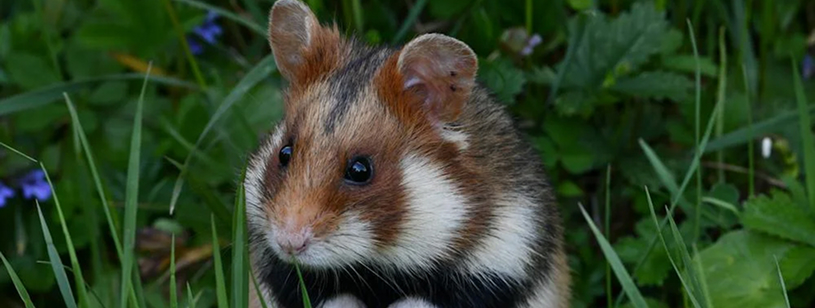
The European hamster (Cricetus cricetus) is a rodent in the family Cricetidae, found in Europe and parts of Asia. It digs burrows and gathers food, carrying it in cheek pouches.
The Syrian hamster (Mesocricetus auratus) and dwarf hamsters in the genus Phodopus are its relatives, not domestic forms of the European hamster. Pet hamsters on other continents do not represent the natural distribution of Cricetus cricetus.
Quick facts
| Common name | European hamster |
| Scientific name | Cricetus cricetus — European hamster |
| Typical lifespan | About 2-4 years in the wild, up to about 6-8 years in captivity |
| Maximum speed | Quick over short distances to its burrow |
| Length | About 20-34 cm, plus a 4-6 cm tail |
| Weight | About 200-500 g or more |
| Diet type | Omnivore (seeds, grain, plants, roots, insects) |
| Main predators | Foxes, polecats, stoats, birds of prey, owls, dogs and cats |
| Conservation status | Critically Endangered (CR) globally |
| Distribution | Europe and parts of Asia, including Russia and Kazakhstan |
| Living environment | Steppes, grasslands, farmland with deep soil, edges of towns |
- Primary category:Mammals
- Explore this animal's categories:
Interesting facts
- Cheek pouches - The European hamster can stuff large amounts of seeds into its cheek pouches and carry them to its burrow.
- Fierce for its size - Unlike pet hamsters, the wild European hamster defends itself boldly, even against people and large predators.
- Long winter sleep - It hibernates for about six months, from autumn to spring, waking every few days to eat from its food store.
- A threat display - When cornered, it rears up on its hind legs, puffs up its cheeks, shows its teeth and hisses or screams.
- A black belly - Unusually for a mammal, its belly is black, darker than its back.
- Once a pest, now rare - In the past, European hamsters were killed in large numbers as pests of grain fields; today they are critically endangered.
Records and remarkable features
- The European hamster (Cricetus cricetus) is a burrowing rodent found in parts of Europe and Asia. It stores food in underground chambers. It is a different species from the Syrian hamster commonly kept as a pet.
- The largest hamster - The European hamster is the largest of all hamsters, weighing up to about 500 g or more.
- Huge food stores - A single hamster may store several kilograms of grain and other food in its burrow for the winter.
Physical characteristics and adaptations
European hamsters are well adapted to life underground, with features that help them dig burrows and store food.
Key physical adaptations
- A compact, muscular body - Lets it move quickly on the surface and in tunnels.
- Colourful fur - Reddish-brown on the back, with white patches on the face and sides and a black belly.
- Cheek pouches - Stretchy pouches inside the cheeks carry food back to the burrow.
- Ever-growing front teeth - Like all rodents, its incisors grow all the time and are used for gnawing seeds and for defence.
- Strong claws - Used for digging deep burrows.
- Senses for the dark - It is mostly active at dusk and night and relies on smell, hearing and whiskers.
- A short tail - Only about 4-6 cm long.
Habits and behaviour
European hamsters are solitary and territorial and rarely tolerate other hamsters nearby.
Daily life
- Living alone - Each hamster has its own burrow and territory.
- Active at dusk and night - It usually comes out to feed at dusk and during the night.
- Defending its territory - Hamsters that meet outside the breeding season may fight fiercely.
- Threat displays - When threatened, it stands up on its hind legs, opens its mouth and makes loud noises.
Social interactions
- Brief meetings - Males and females meet only to mate.
- Single mothers - The female raises her young alone and defends them fiercely.
- Solitary animals - Adults avoid contact with other hamsters for most of the year.
Defence techniques
- Biting - European hamsters have sharp teeth and will bite if threatened, including people.
- Escaping - When danger appears, they quickly run into their burrows.
- Burrows - Their burrows can be up to about 2 m deep in winter, with several chambers and entrances.
Habitat and geographic distribution
European hamsters live in steppes, grasslands and farmland with deep, firm soil, especially loess, where they can dig burrows.
Regional distribution
| Animal | Natural distribution |
|---|---|
| European hamster (Cricetus cricetus) | Europe and parts of Asia, from Belgium and eastern France across Central and Eastern Europe to Russia, Kazakhstan and western Siberia |
North American mice in the genus Peromyscus are other rodents, not European hamsters. Neither Syrian hamsters nor dwarf hamsters should be confused with Cricetus cricetus.
Habitat types
- Grasslands and steppes - Its original habitat, where it can dig deep burrows and find varied food.
- Farmland - Today, most European hamsters live in fields of cereals, alfalfa and other crops.
- Edges of towns - Some populations live in parks, cemeteries and gardens, for example in Vienna.
Climate and habitat change
- Changes in farming - Large single-crop fields, early harvests and deep ploughing destroy burrows and leave hamsters without food and cover.
- Climate change - Changes in winter weather may affect hibernation.
- Pesticides - Chemicals used in farming can poison hamsters and reduce their food.
Diet and feeding
European hamsters are omnivores that eat mainly seeds and plants, but also insects and other small animals.
What does the European hamster eat?
| Food group | Examples and context |
|---|---|
| Seeds and cereals | Wheat, maize, barley, peas, sunflower seeds |
| Green plants | Clover, alfalfa, dandelion, grasses |
| Roots and tubers | Potatoes, beet, roots of wild plants |
| Insects and other invertebrates | Beetles, caterpillars, earthworms, snails |
| Small vertebrates | Occasionally mice, frogs or birds' eggs |
Feeding methods
- Storing food - In late summer and autumn, it fills storage chambers in its burrow with seeds, grain and roots.
- Carrying food in its cheeks - It fills its cheek pouches and empties them in its storerooms.
- Careful feeding - It feeds in short bursts, often stopping to look out for danger.
- Winter supplies - During hibernation, it wakes up from time to time to eat from its stores.
Reproduction and life cycle
European hamsters breed in spring and summer, and a female can have one or more litters a year.
Breeding season
- The breeding season runs from about April to August.
- Males travel in search of females that are ready to mate.
- After mating, the female chases the male away.
Gestation and birth
| Characteristic | Details |
|---|---|
| Gestation | About 18-21 days |
| Number of young per birth | Usually about 4-12 |
| Young at birth | A few grams, blind and hairless |
| Nursing period | About 3-4 weeks |
Raising young
- The young are born helpless and depend completely on their mother.
- Their eyes open after about two weeks.
- At about 3-4 weeks old, they leave the burrow and dig their own.
- In the past, females often had two or three litters a year; today many have only one, which has contributed to the decline.
Survival
- Many young hamsters die in their first year, killed by predators or during their first winter.
- In the wild, European hamsters usually live about 2-4 years.
Name and history
Origin of the name
- The word "hamster" comes from German Hamster, from Old High German hamustro. The German verb hamstern, "to hoard", comes from the hamster's habit of storing food.
- In Romanian, the European hamster is called hârciog.
Taxonomic classification
| Classification | Name |
|---|---|
| Kingdom | Animalia |
| Phylum | Chordata |
| Class | Mammalia |
| Order | Rodentia |
| Family | Cricetidae |
| Genus | Cricetus |
Evolution and history
- Hamsters belong to the family Cricetidae, together with voles, lemmings and New World mice.
- During the Ice Ages, European hamsters lived in the cold steppes that covered much of Europe.
- Different species — The Syrian hamster (Mesocricetus auratus) is a relative of the European hamster, not its domestic form.
Cultural significance and mythology
The European hamster has been seen both as a symbol of thrift and as a farm pest.
The hamster in folklore and tradition
- A symbol of saving - In many European cultures, the hamster stands for collecting and storing supplies for hard times.
- Greed - In German and Slavic folklore, the hamster was sometimes a symbol of greed, because it stores more food than it needs.
- Fur and bounties - In the past, people trapped European hamsters for their fur and were paid bounties for killing them as pests.
Modern symbolism
- Thrift - The hamster is often used as a symbol of saving money.
- Hoarding - In German, hamstern means "to stockpile", a word often used when people buy up supplies in a crisis.
- Conservation - In Alsace, France, the European hamster has become a symbol of efforts to make farming friendlier to wildlife.
Conservation status and threats
The European hamster (Cricetus cricetus) is classified as Critically Endangered (CR) globally. The abundance of pet hamsters does not establish the status of this wild species.
Conservation status
| Species | Global IUCN status |
|---|---|
| European hamster (Cricetus cricetus) | Critically Endangered (CR) |
Main pressures
- Intensive farming - Large fields of a single crop, early harvests and deep ploughing leave hamsters without food and shelter.
- Poor diet - Studies in France found that hamsters living on a diet of maize alone can lack an important vitamin, which can lead mothers to kill their young.
- Persecution in the past - For centuries, European hamsters were killed in huge numbers as pests.
- Habitat fragmentation - Roads and towns split up populations, so they cannot mix.
- Climate change - Changes in temperature and light may affect hibernation and breeding.
Protection measures
- Legal protection - The European hamster is strictly protected in the European Union.
- Wildlife-friendly farming - Farmers are paid to grow mixed crops and leave strips of grain unharvested to give hamsters food and cover.
- Captive breeding and release - In France, Germany and the Netherlands, European hamsters are bred in captivity and released into the wild.
- Monitoring - Researchers count burrows every spring to follow how populations change.
In popular culture
Language and symbols
- Hamstern - The German word for hoarding comes from this hamster and has spread into other languages.
- Alsace - The "great hamster of Alsace" is a well-known symbol of nature conservation in eastern France.
Media
- Nature documentaries - Films about European farmland wildlife often show wild hamsters filling their cheeks with grain.
Mascots and symbols
- Saving - Hamsters are popular in advertising for savings and banking.
- Toys - Hamsters, mostly based on pet species, are popular as soft toys.
Did you know? About european hamster
- The European hamster is the largest hamster in the world.
- Unusually for a mammal, the European hamster has a black belly.
- It hibernates for about six months, waking every few days to eat from its stores.
- A European hamster may store several kilograms of food in its burrow.
- When threatened, it rears up, puffs its cheeks and hisses.
- Its burrows can go about 2 m deep in winter.
- The European hamster is Critically Endangered.
- Hamsters fed only on maize can lack a vitamin, which can lead mothers to kill their young.
- The German verb hamstern, "to hoard", comes from the hamster's habit of storing food.