Head lousePediculus humanus capitis — habitat, diet and reproduction
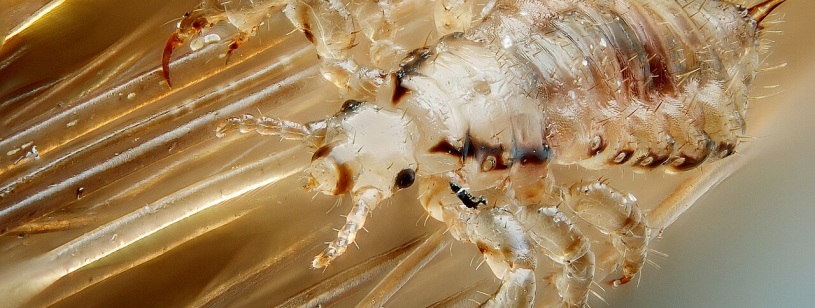
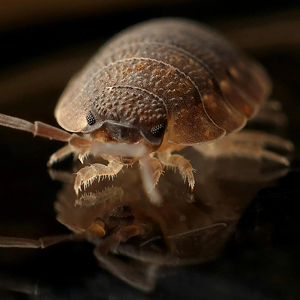
Male head louse (Pediculus humanus capitis), photographed with a microscope objective; greatly magnified. · Gilles San Martin / CC BY-SA 2.0 (https://creativecommons.org/licenses/by-sa/2.0). Cropped and resized.
The head louse is a tiny insect adapted to living among human hairs. Claws on its legs provide a firm grip, and it feeds on blood from the scalp. It neither flies nor jumps. Spread occurs mainly through close head-to-head contact and is not a sign of poor hygiene.
Quick facts
| Common name | Head louse |
| Scientific name | Pediculus humanus capitis |
| Lifespan | An adult can live up to about 30 days on its host |
| Diet | Blood-feeding: human blood |
| Conservation context | Widespread parasite mainly monitored in human health |
| Distribution | Worldwide alongside people |
| Habitat | Human scalp and hair |
| Length | About 2–3 mm as an adult |
| Family | Pediculidae |
| Development | Egg, nymph, adult; no pupa |
| Movement | Crawls among hairs; cannot jump or fly |
Interesting facts
- Six clawed legs grip individual hairs.
- Nits are attached eggs; empty cases may remain after hatching.
- Dogs and cats do not transmit human head lice.
- Clean hair does not exclude an infestation.
Characteristics
Adults are small, wingless insects with elongated, flattened bodies. Colour ranges from pale grey to brown, and females are generally larger than males.
Their legs are adapted for gripping hair rather than moving across smooth surfaces. Microscope photographs greatly enlarge the animal: its real length is only a few millimetres. Nymphs resemble smaller adults.
Behaviour
A louse crawls and remains close to its food supply. It lacks both wings and the specialised jumping legs found in fleas.
Direct hair-to-hair contact is the main route between people. Shared objects can play a role, but less commonly. Children’s activities provide many opportunities for close contact. This explains frequent occurrence in groups of children without implying anything about family cleanliness.
Habitat and distribution
Head lice occur worldwide. Their specialised habitat is human hair and scalp, providing both food and suitable developmental conditions.
Eggs are often attached close to the scalp, including behind the ears and at the nape. Distance from the skin affects their environment. Pets are not the hosts of human head lice and do not maintain their life cycle.
Diet and feeding
Both nymphs and adults need blood, feeding several times a day. Survival depends on remaining connected to the host.
An adult without access to human blood generally survives only one or two days. It cannot switch to dust or household food scraps. Saliva introduced during feeding can trigger itching, but symptoms do not always appear immediately. Absence of itching alone is therefore not conclusive.
Reproduction and life cycle
Females cement eggs to hairs. They remain more firmly attached than loose dandruff particles.
Under suitable conditions, eggs hatch after about a week. The nymph undergoes three moults and becomes an adult after roughly another week, with some variation. Empty egg cases may stay on the hair. Finding a live louse is consequently more useful for confirming an active infestation than seeing white particles alone.
Name and history
The commonly used name is Pediculus humanus capitis. Head and body lice are closely related, but their lifestyles and medical importance should not be confused.
Body lice spend much of their lives in clothing, whereas head lice remain associated with scalp hair. Genetic research continues to examine the relationship between these forms. Accurate identification matters when comparing information about different lice.
Conservation and threats
Head lice are widespread parasites mainly considered in the context of identifying and managing infestations. CDC states that they do not transmit disease, unlike the established role of body lice.
Scratching can damage skin. A detection comb can help examination, and a pharmacist or clinician can clarify identification and suitable management. Understanding the insect’s biology is more helpful than stigmatising an affected person or family.
Frequently asked questions
Can head lice jump?
No. They crawl and cannot jump or fly.
Do they occur only in dirty hair?
No. Infestation is unrelated to personal hygiene.
Can they come from dogs or cats?
No. Pets do not transmit human head lice.
Is every white speck a nit?
No. Dandruff and other particles can resemble eggs; finding live lice is important.