StoatMustela erminea — habitat, diet and reproduction
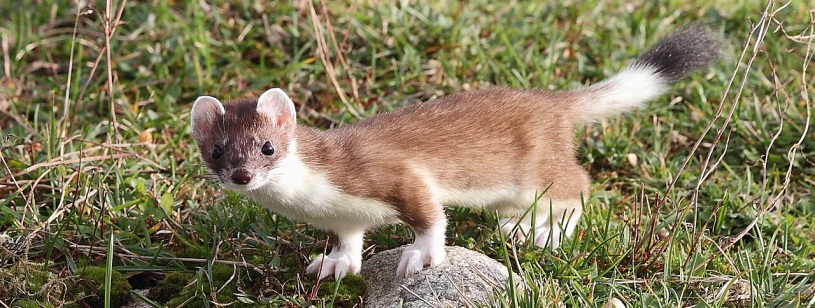
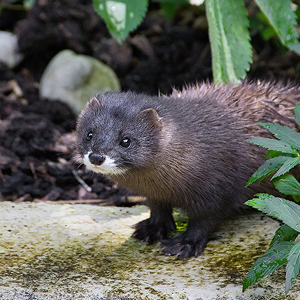
Stoat (Mustela erminea) with a black tail tip among vegetation. · Marton Berntsen, crop by User:MPF / CC BY-SA 4.0 (https://creativecommons.org/licenses/by-sa/4.0). Cropped and resized. Source: https://commons.wikimedia.org/wiki/File:R%C3%B8yskatt_(Mustela_erminea_erminea),_Lista,_Norway.jpg
The stoat (Mustela erminea), also called ermine, is a small predator with a long body and black-tipped tail. Its brown summer back contrasts with a pale belly. In cold regions, winter fur may turn white. A slender build allows it to pursue rodents through narrow spaces.
Quick facts
| Common name | Stoat; ermine |
| Scientific name | Mustela erminea |
| Lifespan | Several years; many studied individuals survive only 1–2 years |
| Length | Roughly 24–32 cm body and 9–14 cm tail; varies geographically |
| Weight | Roughly 140–450 g; males larger |
| Diet | Rodents, rabbits, birds and eggs |
| Predators | Foxes and birds of prey |
| Conservation status | Least Concern globally |
| Distribution | Europe, much of Asia and northwestern North America; introduced elsewhere |
| Habitat | Grassland, woodland edges, hedges, farmland and wetlands |
| Family | Mustelidae |
| Reproduction | One litter a year; often 6–12 kits in described European populations |
- Primary category:Mustelids
- Explore this animal's categories:Animals of AsiaAnimals of EuropeAnimals of North AmericaAnimals of RomaniaAnimals of Romania’s grasslands and plainsBurrowing animalsCamouflaged animalsCarnivoresForest animalsFurry animalsLive-bearing animalsMammalsMammals of RomaniaMustelidsPredatory animals of RomaniaSSolitary animalsVertebratesWild animals
Interesting facts
- The tail tip stays black even when winter fur becomes white.
- A narrow body allows pursuit through rodent tunnels.
- Embryonic development pauses between summer mating and spring birth.
- Surplus prey may be stored in a shelter.
Records and extremes
A stoat can capture a rabbit considerably heavier than itself. It approaches quickly and targets the back of the neck.
Climbing and swimming expand its movements. New Zealand observations show that water crossings can bring stoats to islands.
Winter whiteness helps conceal it on snow. In milder regions, some individuals remain brown or develop only partial whitening.
Characteristics
Short legs, rounded ears and a long, flexible body define its shape. The summer coat has a reddish-brown back and pale cream underside.
The clearly black tail tip helps distinguish it from the smaller least weasel. Males are generally larger than females.
Seasonal moulting replaces the coat. Winter fur may become denser and much paler, with appearance varying between regions.
Behaviour
Usually solitary, stoats use scent marks and several shelters. Former prey burrows may become dens, sometimes lined with rodent fur.
They are active by day and night, moving in bounds and investigating holes and edges. Smell is important when following prey.
Frequent meals meet high energy demands. Surplus food can be cached, and rodent availability influences population numbers.
Habitat and distribution
Mustela erminea occurs in Europe and Asia, including Romania, and extends into northwestern North America. Recent classifications separate some other North American ermines into distinct species.
Meadows, woodland margins, banks, farmland and mountain habitats can support it where food and cover exist. Hedges and vegetated ditches provide sheltered routes.
Open ground exposes stoats to foxes and raptors. Maintaining connected vegetation helps movement through agricultural landscapes.
Diet and feeding
Rodents are important foods, with rabbits prominent in some places. Birds, eggs, amphibians and other available animals supplement the diet.
The slender body reaches hiding places inaccessible to larger predators. In snowy areas, rodents can be pursued beneath the snow.
Small size creates hunting opportunities but also high energy costs. Food supply strongly affects survival.
Reproduction and life cycle
Mating occurs in summer, with birth usually the following spring. Delayed implantation pauses the embryo at an early stage before active development resumes.
European accounts often describe litters of 6–12 kits. Newborns are blind, deaf and sparsely furred. The female nurses, protects and later brings food.
Young become self-sufficient at around three months. Play and following their mother help develop hunting skills.
Name and history
Linnaeus described Mustela erminea in 1758. Ermine also refers to the white winter fur historically used in clothing.
European portraits used white fur with black markings as a symbol of rank and purity. The National Portrait Gallery explains this symbolism in images of Elizabeth I.
Conservation and threats
Globally Least Concern, the species can face local pressure from habitat changes, reduced prey and trapping. It naturally belongs in food webs across its native range.
Introduced populations can have different effects. Stoats brought to New Zealand in the nineteenth century to control rabbits became serious predators of native birds.
Conservation programmes seek to limit introduced populations on vulnerable islands. Protecting native habitats and managing invasive populations address different ecological situations.
Frequently asked questions
Is it white all year?
Its summer back is usually brown. Winter whitening occurs mainly in colder regions.
How does it differ from a least weasel?
A longer tail with a distinct black tip is a useful identifying feature.
Does it hibernate?
It remains active in winter and can hunt rodents beneath snow.
Why are kittens born the following spring?
Delayed implantation pauses early development after summer mating.
Does it occur in Romania?
Yes. Romania lies within its native range.
Why is it controlled in New Zealand?
Introduced stoats threaten native birds, their eggs and young.