Black widow spiderLatrodectus — habitat, diet and reproduction
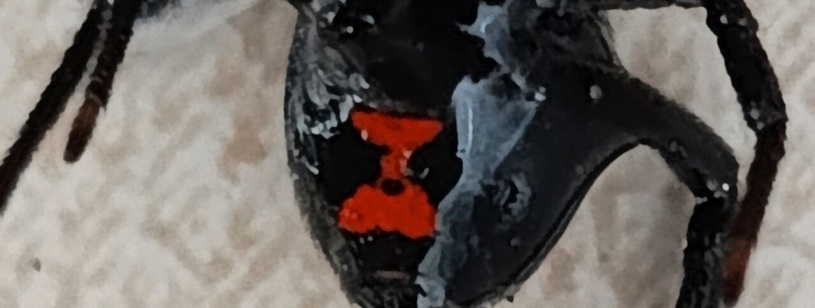
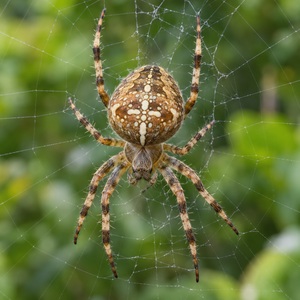
Female black widow (Latrodectus) showing the red hourglass mark. · Juan Carlos Fonseca Mata / CC BY-SA 4.0 (https://creativecommons.org/licenses/by-sa/4.0). Cropped and resized.
Black widow is the common name for spiders of the genus Latrodectus. Females are glossy black, and many species have a red hourglass-shaped mark on the abdomen. Their venom is potent, but bites are rare and very rarely fatal. A close relative with 13 red spots lives in southern and eastern Europe, including Romania.
Quick facts
| Common name | Black widow |
| Scientific name | Latrodectus (genus) |
| Lifespan | Females about 1–3 years; males much less |
| Length | Female body about 1 cm; male much smaller |
| Diet | Carnivore: insects and other arthropods caught in the web |
| Predators | Spider-hunting wasps, birds, lizards |
| Conservation status | Not evaluated; species are widespread |
| Distribution | Every continent except Antarctica |
| Habitat | Dry, sheltered places: under stones, woodpiles, sheds |
| Family | Theridiidae |
| Venom | Contains latrotoxin, which affects nerves |
- Primary category:Arachnids
- Explore this animal's categories:
Interesting facts
- The name comes from the belief that the female always eats her mate; in reality this happens only sometimes.
- Males are much smaller than females and rarely bite.
- Romania is home to the Mediterranean black widow (Latrodectus tredecimguttatus), also called the “karakurt”.
- The black widow’s silk is very strong for its thickness.
Characteristics
The female has a round, glossy black body with long, thin legs. In many American species, the underside of the abdomen bears a red hourglass mark. The European species has 13 red spots on its back, sometimes edged in white.
Males are small, with paler markings, and are often overlooked. Spiderlings start pale and darken with each moult.
Behaviour
The black widow is shy and nocturnal. It hides in a corner of its web, which looks messy but has very strong threads.
When an insect is caught, the spider wraps it in silk and bites it. It is not aggressive towards people and usually bites only when squeezed, for example when someone puts a hand on it without seeing it.
Habitat and distribution
Black widows live on every continent except Antarctica. The best known are the North American species.
The Mediterranean black widow lives in southern and eastern Europe, including Dobruja and southern Romania, in dry grassland and fields.
Diet and feeding
Black widows eat insects and other arthropods: beetles, crickets, flies and sometimes other spiders, caught in a sticky web near the ground.
The spider injects venom, then digestive juices that soften the prey, and sucks it up, helping control insects around homes and fields.
Reproduction and life cycle
After mating, the female makes several silk egg sacs, each with hundreds of eggs, and guards them in the web.
Spiderlings hatch after a few weeks and disperse, sometimes floating on silk threads carried by wind. They sometimes eat each other before leaving the sac.
Name and history
The scientific name Latrodectus roughly means “secret biter”. The name “widow” comes from some females eating the male after mating.
Researchers have shown this happens less often in nature than in the lab. The venom, latrotoxin, is studied for the way it acts on nerves.
Conservation and threats
Black widows are not threatened; many species are widespread and adapt to human dwellings.
A bite can cause severe pain, muscle cramps, sweating and nausea, usually for a few days. Deaths are very rare, and treatment exists for serious cases. Anyone bitten should seek medical help.
Frequently asked questions
Does the black widow live in Romania?
Yes. The Mediterranean black widow, a close relative of the American species, lives in the south and east of the country, especially Dobruja.
Is a black widow bite deadly?
Very rarely. It causes pain and cramps for a few days, and serious cases are treated medically.
What should I do if bitten?
Wash the area, apply a cold compress and seek medical help, especially if cramps or nausea appear.
Why is it called a black widow?
Because the female sometimes eats the male after mating.