Grass snakeNatrix natrix — habitat, diet and reproduction
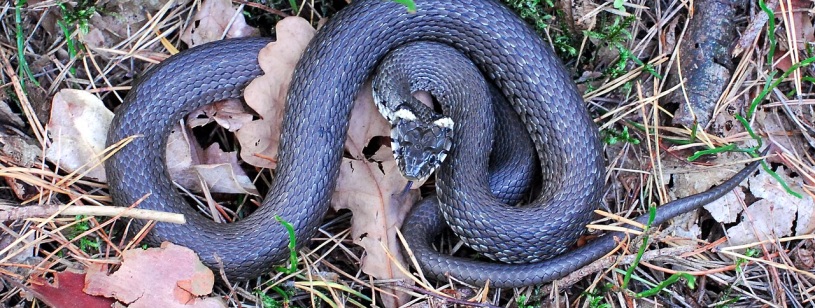
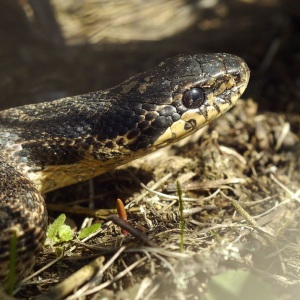
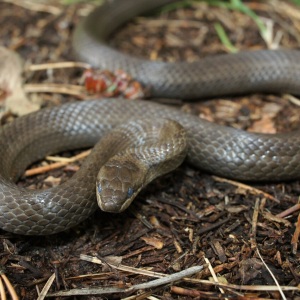
Coiled grass snake, Natrix natrix, with pale patches behind the head. · Pawel Ryszawa / Wikimedia Commons / CC BY 3.0 (https://creativecommons.org/licenses/by/3.0/). Cropped and resized. Source: https://commons.wikimedia.org/wiki/File:Natrix_natrix_Kalejty.jpg
The grass snake (Natrix natrix) is a semiaquatic snake often recognised by pale patches behind its head. It swims well and mainly hunts amphibians. It is not considered venomous to humans. This account concerns the species found in Romania and much of central and eastern Europe.
Quick facts
| Common name | Grass snake; common grass snake |
| Scientific name | Natrix natrix |
| Lifespan | Can exceed 20 years; Aarhus Natural History Museum reports a wild maximum of 23 years |
| Length | Males are often below 90 cm; females can exceed one metre |
| Appearance | Grey, brown or greenish, often with two pale neck patches |
| Diet | Mainly frogs, toads, newts and amphibian larvae |
| Predators | Herons, raptors, corvids, foxes and mustelids |
| Conservation status | Least Concern globally and in Europe |
| Distribution | Central and eastern Europe, extending into Asia |
| Habitat | Water margins, ponds, wet grassland, open woodland and gardens |
| Family | Natricidae; alternatively Colubridae, subfamily Natricinae |
| Reproduction | Eggs laid in warm, damp substrate, often decomposing vegetation |
- Primary category:Reptiles
- Explore this animal's categories:
Interesting facts
- Some threatened individuals become motionless with the mouth open.
- Grass snakes swim well and forage around water.
- Decomposing vegetation can provide warmth for eggs.
- Females are generally larger than males.
Records and extremes
Size varies with sex and population. Males are often under 90 cm, while females can exceed a metre and sometimes approach 1.5 m.
Aarhus Natural History Museum reports a maximum wild lifespan of 23 years. This is a longevity record, not an average for every individual.
Larger females can carry substantial egg clutches, sometimes numbering in the tens. Reproduction depends on food and body condition.
Characteristics
The elongated body has a distinct head and round pupils. Dorsal scales bear fine longitudinal keels. Colour can be grey, brown, greenish or nearly black.
Paired white, yellow or orange neck patches often have dark borders, creating a collar effect. They may be faint or absent in some individuals.
The pale underside can have black markings. Reliable identification uses several features together, rather than collar colour alone.
Behaviour
Grass snakes bask and seek cover when disturbed. They move through water and over land, rather than remaining permanently at one pond.
If escape fails, they may release a foul-smelling secretion. Some twist their bodies, open their mouths and become motionless: a defensive response called thanatosis.
Responses vary between individuals and circumstances. Movement can resume once danger passes, and undisturbed observation avoids provoking the display.
Habitat and distribution
Natrix natrix occupies central and eastern Europe, including Romania, and extends into Asia. Its western relative Natrix helvetica is now treated as a separate species.
Ponds, lakes, slow rivers and wet meadows provide suitable habitat. Gardens and open woodland may also supply prey, sunshine and shelter.
Winter refuges are on land in frost-protected ground cavities or spaces around roots. Habitat requirements therefore extend beyond the water itself.
Diet and feeding
Amphibians dominate the diet. Frogs, toads and newts are captured in or near water, while young snakes may eat tadpoles.
Fish, lizards and other small vertebrates are taken occasionally. Local prey availability and snake size influence the diet.
As a predator moving between water and land, the grass snake links these communities. Amphibian declines can reduce its food supply.
Reproduction and life cycle
Several males may pursue one female in spring, forming an intertwined mating aggregation. This differs from ritual combat between male adders.
Females lay eggs in warm, damp places such as rotting vegetation, decaying wood and compost. Decomposition supplies incubation heat.
Hatching may occur after about two months, depending on conditions. Young resemble adults and begin independent lives; suitable winter shelter remains essential.
Name and history
Linnaeus described the species in 1758 as Coluber natrix. Natrix is associated with swimming. IUCN places it in Natricidae.
Some classifications retain Natricinae within Colubridae. Recognition of Natrix helvetica as a distinct species also explains differences between older and current range maps.
Conservation and threats
IUCN lists Least Concern globally and in Europe. The broad range does not mean all local populations are secure.
Drainage, damaged waterways and amphibian losses reduce resources. Road traffic and deliberate killing add further pressure.
Connected wetland margins and terrestrial refuges support populations. Egg-laying sites matter alongside feeding areas, so conserving water alone is insufficient.
Frequently asked questions
Is it venomous to humans?
It is not considered venomous to humans and is best observed without handling.
Why are there yellow patches behind the head?
They form part of the characteristic pattern and can also be white or orange.
Does it only live beside water?
No. It also uses surrounding terrestrial habitats and winter shelters.
Does it mainly eat fish?
Amphibians usually make up more of the diet.
Why does it sometimes appear dead?
Thanatosis is a defensive response that can occur when threatened.
Does it give birth like an adder?
No. Grass snakes lay eggs.