SturgeonAcipenseridae — habitat, diet and reproduction
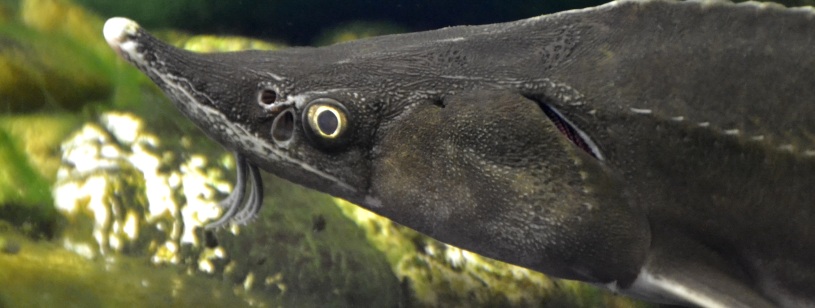
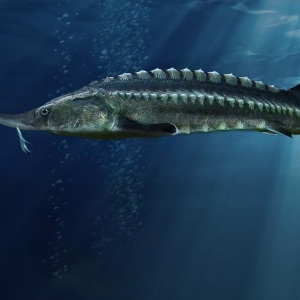
Sterlet (Acipenser ruthenus), a sturgeon with a pointed snout and bony scutes. · High Contrast / Wikimedia Commons / CC BY 3.0 DE (https://creativecommons.org/licenses/by/3.0/de/). Cropped and resized. Source: https://commons.wikimedia.org/wiki/File:Sterlet_(Acipenser_ruthenus).JPG
Sturgeons belong to the family Acipenseridae, fishes with elongated snouts, sensory barbels and bony body plates. Beluga, Russian sturgeon, stellate sturgeon and sterlet are different members. Some migrate between sea and river, while others remain in freshwater.
Quick facts
| Common name | Sturgeons |
| Scientific name | Acipenseridae — a family |
| Lifespan | Often decades; white sturgeon can exceed 100 years |
| Length | Species-dependent: sterlet commonly around 40 cm; exceptional white sturgeon exceed 6 m |
| Diet | Invertebrates and, in some species, fish |
| Predators | Fish and other aquatic predators, especially for eggs and juveniles |
| Conservation status | Varies by species; many are Critically Endangered |
| Distribution | Northern Hemisphere: Europe, Asia and North America |
| Habitat | Rivers, lakes, estuaries and coastal waters, depending on species |
| Order | Acipenseriformes |
| Distinctive features | Five rows of bony scutes and four barbels |
| Reproduction | Freshwater spawning, usually over hard substrate |
- Primary category:Fish
- Explore this animal's categories:
Interesting facts
- Four barbels help detect food near the bottom.
- The mouth extends to suck up prey.
- Bony plates form five rows along the body.
- Sterlet complete their life cycle in freshwater.
Records and extremes
Size differs enormously among species. FishBase gives sterlet a common length of around 40 cm. Canada’s white sturgeon recovery strategy reports individuals exceeding 6 m.
FishBase lists a maximum reported age of 36 years for sterlet. White sturgeon can exceed 100 years. These are species-specific examples rather than family averages.
Characteristics
The long body carries bony plates called scutes, and the upper tail lobe is elongated. Four barbels lie in front of the underside mouth.
Much of the internal skeleton remains cartilaginous. Snout shape and scute counts help distinguish species. Stellate sturgeon have a particularly elongated snout; sterlet are relatively small.
Behaviour
Many sturgeons forage close to the bottom using their barbels and mobile mouth. These adaptations work in water with poor visibility.
Beluga, Russian and stellate sturgeons migrate from the Black Sea into the Danube to reproduce. Sterlet movements remain within freshwater. Barriers can separate feeding and spawning areas.
Habitat and distribution
Sturgeons occur naturally across the Northern Hemisphere. Habitats range from rivers and lakes to estuaries and coastal seas, with freshwater spawning habitat essential.
Six species historically occurred in the Danube basin. Recent research describes European and ship sturgeons as regionally extinct there.
The Iron Gates dams interrupted access to upper river reaches for migrating marine populations. Protecting the remaining accessible habitat is vital.
Diet and feeding
Many species take bottom-dwelling insect larvae, worms, molluscs and crustaceans. Their extending mouths suck in food.
Adult beluga mainly eat fish. Diet therefore needs to be described by species and life stage.
Reproduction and life cycle
Adhesive eggs are laid in freshwater on suitable hard surfaces, including gravel and stone. Flowing water supplies oxygen.
Larvae initially use their own food reserves before feeding independently. Crevices can provide cover, while flow and temperature affect survival.
Many species mature late, and females may leave several years between spawning events. Adults can reproduce repeatedly over their lives.
Name and history
Sturgeon is a family-level common name. Beluga, Russian sturgeon, stellate sturgeon and sterlet are separate members of Acipenseridae.
Archaeological remains document Danube sturgeon fishing thousands of years ago. A 2025 ancient-DNA study found genetic links between some historical and modern fish.
Conservation and threats
Conservation categories are species-specific. The 2022 assessment lists beluga, Russian and stellate sturgeons as Critically Endangered, and sterlet as Endangered.
Overharvesting, poaching, barriers and habitat degradation threaten populations. Late maturity makes recovery slow.
Conservation combines adult protection, habitat restoration and monitoring. Breeding and release programmes require genetic safeguards and suitable river conditions; natural reproduction is a key measure of recovery.
Frequently asked questions
Is sturgeon one species?
The name covers the family Acipenseridae, including beluga, Russian sturgeon, stellate sturgeon and sterlet.
Which species appears in the photograph?
A sterlet, Acipenser ruthenus, photographed in an aquarium.
What are the barbels for?
They help locate food near the bottom.
Do all sturgeons go to sea?
Sterlet and other freshwater forms live in rivers or lakes.
How long can a sturgeon live?
It depends on the species: many live for decades, and white sturgeon can exceed a century.
Why is recovery slow?
Many species mature late and have long gaps between spawning events, making adult losses especially consequential.