JellyfishInteresting facts and information
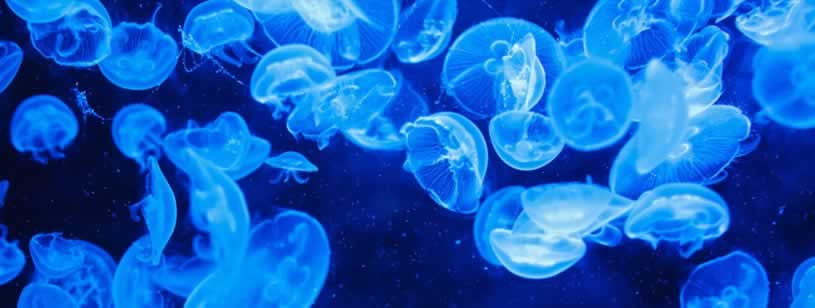
Jellyfish are aquatic animals with soft bodies and stinging cells. The name covers several groups of cnidarians rather than one species. They have no central brain or heart, but use a network of nerves to respond to their surroundings.
Jellyfish are known for their jelly-like bodies and stinging tentacles, which they use to catch prey by injecting venom. Many species are harmless to people, but others, such as the Australian box jellyfish (Chironex fleckeri), are among the most dangerous animals in the sea, with venom that can kill a person within minutes.
Jellyfish are very adaptable and have lived in the oceans for more than 500 million years. One small species can even turn back into a younger stage, which makes jellyfish interesting to scientists studying ageing and regeneration.
Quick facts
| Common name | Jellyfish |
| Scientific name | Cnidaria: Scyphozoa, Cubozoa and jellyfish-form Hydrozoa |
| Typical lifespan | Adults often live a few months to a year or more; polyps can live for years |
| Maximum speed | Most drift with currents; box jellyfish are strong swimmers |
| Size | From about 1 mm to about 2 metres across the bell (Nomura's jellyfish) |
| Weight | From less than a gram to about 200 kg (Nomura's jellyfish) |
| Diet type | Carnivore (zooplankton, small fish, crustaceans, other jellyfish) |
| Main predators | Sea turtles, sunfish, some fish and seabirds, other jellyfish, humans |
| Conservation status | Assess separately by species and population; different taxa and regions have different needs |
| Distribution | All oceans and seas of the world, from the surface to the deep sea |
| Habitat | Marine waters; a few species live in fresh water |
- Primary category:Invertebrates
- Explore this animal's categories:
Interesting facts
- Some Turritopsis dohrnii can revert to an earlier life stage under certain conditions. This does not make them immune to death or establish that all jellyfish are immortal.
- They are about 95% water - Many jellyfish are almost transparent, which makes them very hard to see in the sea.
- They have no brain or heart - Instead, they have a simple network of nerves that lets them react to touch, light and other signals.
- Some jellyfish make their own light - Species such as the crystal jelly (Aequorea victoria) can glow, a phenomenon called bioluminescence.
- Extremely long tentacles - The lion's mane jellyfish (Cyanea capillata) can have tentacles more than 30 metres long; one famous specimen measured about 37 metres in total, longer than a blue whale.
Records and remarkable features
- Jellyfish are aquatic animals with soft bodies and stinging cells. The name covers several groups of cnidarians rather than one species. They have no central brain or heart, but use a network of nerves to respond to their surroundings.
- The Australian box jellyfish (Chironex fleckeri) is one of the most venomous animals in the world; its sting can kill a person within minutes.
- Nomura's jellyfish can have a bell about 2 metres wide and weigh up to about 200 kg.
Characteristics
Jellyfish have very simple, jelly-like bodies, but they are remarkably well adapted to life in the sea. Their bodies are about 95% water, which makes them light and lets them drift with ocean currents.
Main physical characteristics
| Feature | Details |
|---|---|
| Size | From about 1 mm to 2 m across the bell (depending on the species) |
| Weight | From less than a gram to about 200 kg |
| Body plan | Radial symmetry: a bell-shaped body with tentacles around the edge |
| Composition | About 95% water |
| Nervous system | A simple nerve net, without a brain |
| Circulation | No heart or blood; oxygen passes through the thin body walls |
| Digestive system | A single cavity with one opening, which serves as both mouth and anus |
| Movement | They swim by pulsing their bell and are carried by currents |
Special adaptations
- Stinging tentacles - They are covered with special cells called cnidocytes, which fire tiny harpoons that inject venom into prey.
- Bioluminescence - Some jellyfish give off light, which may startle predators or attract prey.
- Regeneration - Many jellyfish and their polyps can regrow damaged body parts.
- Some Turritopsis dohrnii can revert to an earlier life stage under certain conditions. This does not make them immune to death or establish that all jellyfish are immortal.
Habits and behaviour
Jellyfish mostly drift with the currents, but they can pulse their bell to swim and change direction. Some live alone, while others gather in huge groups called blooms or swarms.
Social behaviour
- Usually alone - Most jellyfish drift on their own, but under certain conditions they gather in large numbers.
- Blooms - Some species, such as Nomura's jellyfish, can form enormous swarms that damage fishing nets and block the cooling water intakes of power stations.
Feeding and survival methods
- Opportunistic carnivores - Jellyfish feed on plankton, small fish, fish eggs and other small sea animals.
- Paralysing tentacles - Venom from their stinging cells stuns or kills their prey.
- Quick digestion - Food is digested in a single central cavity.
Defence and survival strategies
- Transparency - Many jellyfish are almost invisible, which helps them avoid predators.
- Venom - Their stings put off many would-be predators.
- Glowing - Some deep-sea jellyfish flash light to confuse or scare predators.
Habitat and geographic distribution
Jellyfish live in every ocean and sea in the world, from the surface to the deep sea, thousands of metres down.
Habitats
| Habitat | Examples |
|---|---|
| Tropical seas | Coral reefs, Caribbean Sea, northern Australia |
| Temperate seas | Mediterranean Sea, Black Sea, North Sea |
| Polar waters | Arctic Ocean, Southern Ocean |
| The deep sea | Dark waters thousands of metres deep |
| Coasts and estuaries | Areas where rivers meet the sea |
Geographic distribution
- Tropical and temperate seas - Most jellyfish live in warm and mild waters.
- The deep sea - Some species live in the dark depths of the ocean.
- Fresh water - A few small jellyfish, such as Craspedacusta sowerbii, live in lakes and ponds.
Impact of human activities on jellyfish populations
- Warming seas - In some regions, warmer water helps jellyfish breed faster.
- Overfishing - Removing fish that eat jellyfish or compete with them for food can lead to more jellyfish.
- Nutrient pollution - Fertiliser running into the sea can cause plankton booms, which feed large numbers of jellyfish.
Jellyfish cope well with environmental change, which helps them survive and multiply in many seas.
Diet and feeding
Jellyfish are carnivores that eat whatever prey they can catch with their stinging tentacles. Many species feed mainly on plankton, while larger jellyfish also catch small fish, crustaceans and even other jellyfish.
Types of food
| Type of food | Examples of species that eat it |
|---|---|
| Zooplankton | Most jellyfish, such as the moon jellyfish (Aurelia aurita) |
| Small fish | Compass jellyfish (Chrysaora hysoscella), box jellyfish (Chironex fleckeri) |
| Crustaceans | Box jellyfish, moon jellyfish |
| Other jellyfish | Lion's mane jellyfish (Cyanea capillata) |
| Marine snow | Some deep-sea jellyfish, which feed on sinking particles |
Feeding methods
- Catching prey with stinging tentacles - Prey that touches the tentacles is stung and held fast.
- Moving food to the mouth - The tentacles and the frilly arms around the mouth pass the food to the mouth in the centre of the bell.
- Fast digestion - Food is digested in the central cavity, and nutrients spread through the body.
Jellyfish have few energy reserves, so they need to feed often.
Reproduction and life cycle
Many jellyfish have a complex life cycle with two main forms: the polyp, which is attached to the sea floor, and the free-swimming medusa. This helps them multiply quickly.
Life cycle stages
| Stage | Duration | Details |
|---|---|---|
| Adult medusa | A few months to a year or more | Breeds by releasing eggs and sperm into the water |
| Planula larva | A few days | Swims, then attaches to a hard surface and turns into a polyp |
| Polyp | Weeks to years | Feeds and grows, and can make copies of itself by budding |
| Strobilation | Days to months | The polyp divides into a stack of tiny discs |
| Ephyra | A few weeks | Each disc swims away as a tiny jellyfish and grows into an adult |
Reproductive behaviour
- Sexual reproduction - In most species, males and females release eggs and sperm into the water, where fertilisation takes place.
- Asexual reproduction - Polyps can produce many copies of themselves by budding.
- Some Turritopsis dohrnii can revert to an earlier life stage under certain conditions. This does not make them immune to death or establish that all jellyfish are immortal.
This flexible life cycle helps make jellyfish some of the most successful and fast-breeding animals in the sea.
Name and history
Jellyfish are among the oldest animals in the oceans: fossils show that they existed more than 500 million years ago. They appear in mythology, science and culture.
Origin of the name
- "Medusa" - The free-swimming form of a jellyfish is called a medusa, after Medusa, the Gorgon of Greek mythology whose hair was made of snakes, because the tentacles look like snakes.
- The scientific name Scyphozoa comes from the Greek skyphos, a kind of cup, and means "cup animals", because of the shape of their bodies.
- Other names - "Jellyfish" in English, medusa in Spanish and Italian, meduză in Romanian and kurage (水母) in Japanese.
Taxonomic classification
| Taxonomic category | Name |
|---|---|
| Kingdom | Animalia |
| Phylum | Cnidaria |
| Classes | Scyphozoa (true jellyfish), Cubozoa (box jellyfish), Hydrozoa (hydromedusae) and Staurozoa (stalked jellyfish) |
| Orders | Many different orders |
| Known species | A few thousand species, with many more probably undiscovered |
Jellyfish in history and culture
- Greek mythology - The word "medusa" comes from the Gorgon Medusa, whose gaze turned people to stone.
- China - People in China have eaten jellyfish for more than 1,700 years, and they are still a popular delicacy.
- Research on Aequorea victoria led to the identification of green fluorescent protein (GFP), which is widely used in biological research.
Some Turritopsis dohrnii can revert to an earlier life stage under certain conditions. This does not make them immune to death or establish that all jellyfish are immortal.
Cultural significance and mythology
Jellyfish appear in the myths and cultures of many peoples, from ancient Greece to modern Asia. They are often linked with dangerous beauty, mystery and the power of the sea.
Jellyfish in mythology and folk belief
- Greek mythology - The Gorgon Medusa, whose hair was made of venomous snakes, gave her name to jellyfish.
- Japanese folklore - In the folk tale "Why the jellyfish has no bones", the jellyfish once had bones, but the Dragon King of the sea had them beaten out of it as punishment for letting a monkey escape.
- Food and medicine - In China and other parts of East Asia, jellyfish are eaten as a delicacy and have been used in traditional medicine.
Jellyfish symbolism
- Power and danger - Because of their painful stings, jellyfish are symbols of dangerous beauty.
- Some Turritopsis dohrnii can revert to an earlier life stage under certain conditions. This does not make them immune to death or establish that all jellyfish are immortal.
- Grace and fragility - Their gentle, flowing movements make jellyfish symbols of elegance and the mystery of the ocean.
Conservation status and threats
Most jellyfish species are not threatened with extinction, and some are even becoming more common because of climate change and human activities. Very few jellyfish have been assessed by the IUCN.
Conservation status
| Group | Situation |
|---|---|
| Common coastal jellyfish | Widespread; some species form larger blooms than before |
| Deep-sea jellyfish | Poorly known; deep-sea mining and fishing may affect them |
| Invasive jellyfish | Some species have spread to new seas in the ballast water of ships |
| Dangerous species | Not threatened, but dangerous to people |
Main issues
- Water pollution - More nutrients in the sea can lead to huge jellyfish blooms.
- Climate change - Warmer seas let some jellyfish spread to new areas and breed for longer.
- Fewer predators - The decline of sea turtles and fish that eat jellyfish can help jellyfish increase.
- Overfishing - Removing fish that compete with jellyfish for plankton has helped jellyfish take over in some regions.
Management efforts
- Protecting natural predators - Protecting sea turtles and fish that eat jellyfish.
- Monitoring blooms - Scientists use surveys, drones and satellite images to track jellyfish swarms.
- Reducing pollution - Campaigns aim to limit fertiliser and sewage running into the sea.
Although many jellyfish are increasing, their impact on marine ecosystems needs careful monitoring.
In popular culture
Jellyfish appear in films, books, video games and design, thanks to their fascinating appearance and unusual biology.
Jellyfish in literature and comics
- The Swarm (Frank Schätzing, 2004) - A science-fiction novel in which sea creatures, including swarms of jellyfish, turn against humanity.
- Princess Jellyfish (Akiko Higashimura, from 2008) - A Japanese manga and anime about a young woman obsessed with jellyfish.
- Marine biology books - Jellyfish are favourite subjects because of their unusual life cycles.
Jellyfish in film and television
- Finding Nemo (2003) - Marlin and Dory have to cross a dangerous forest of jellyfish.
- SpongeBob SquarePants (1999 - present) - SpongeBob loves "jellyfishing" in Jellyfish Fields and even makes jellyfish jelly.
- Nature documentaries - Jellyfish are filmed for their beauty and their surprising impact on the oceans.
Jellyfish in video games
- The Legend of Zelda - Some games in the series feature electric jellyfish-like enemies that shock the player.
Jellyfish in design and art
- Design - The flowing shapes of jellyfish inspire fashion designers, lighting designers and architects.
- Aquariums - Jellyfish tanks, lit with coloured lights, are among the most popular exhibits in modern aquariums.