Common European adderVipera berus — habitat, diet and reproduction
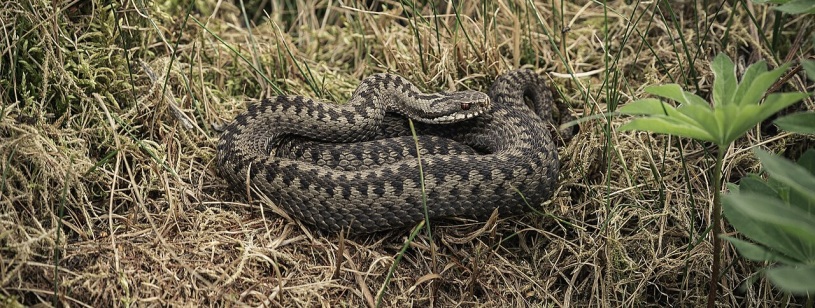
Coiled European adder among grasses, showing its zigzag pattern. · Jesper Ahlin Marceta / CC BY-SA 4.0 (https://creativecommons.org/licenses/by-sa/4.0). Cropped and resized. Source: https://commons.wikimedia.org/wiki/File:Jahlinmarceta_huggorm.jpg
The common European adder (Vipera berus) is a venomous snake, usually with a dark zigzag down its back. Its body is relatively short and stocky. It hunts small animals and normally retreats from approaching people. Its range spans Europe and Asia.
Quick facts
| Common name | Common European adder |
| Scientific name | Vipera berus |
| Lifespan | Often 5–10 years; some exceed ten years |
| Length | Usually around 60–80 cm, varying among populations |
| Weight | Commonly around 50–100 g; females tend to be heavier |
| Diet | Small mammals, lizards, amphibians and occasionally birds |
| Predators | Birds of prey, corvids and some mammals |
| Conservation status | Least Concern globally and in Europe |
| Distribution | Europe and northern Asia, reaching the Arctic Circle region |
| Habitat | Woodland edges, clearings, grassland and sheltered sunny mosaics |
| Family | Viperidae |
| Reproduction | Live-bearing; litters can reach around 20 young |
Interesting facts
- Melanistic individuals can be entirely black.
- Females give birth to live young.
- The adder dance may be combat between rival males.
- The range reaches the Arctic Circle region.
Records and extremes
Adders occupy exceptionally northerly snake habitat, extending beyond the Arctic Circle in Scandinavia. Short active seasons make winter refuges particularly important.
Adults commonly measure about 60–80 cm, with variation by population, age and sex. Females tend to be larger and heavier.
Newborns are around 16–18 cm long and resemble small adults, often with reddish colouring. Their size makes them vulnerable to numerous predators.
Characteristics
Males are often silvery-grey with strongly contrasting markings, while females commonly have brown or copper tones. Dark spots line the sides.
The pupil is vertical, the iris may be reddish and the head often bears a V or X marking. Colour alone is not a reliable identification method.
Hinged venom-injecting fangs fold against the roof of the closed mouth. This viper adaptation is central to prey capture.
Behaviour
Adders move between sunny positions and shelter. As ectotherms, they use environmental heat to regulate body temperature and may bask in the morning.
Cold-season dormancy occurs in frost-protected refuges, including abandoned burrows and ground cavities. Timing varies with local weather.
They normally retreat from people. Bites can occur when a snake is stepped on, handled or provoked, so observation should remain at a distance.
Habitat and distribution
The range extends from Europe into northern Asia, including cool lowlands and mountains. Adders are not restricted to hot, dry places.
Woodland edges, clearings and grassland provide suitable habitat when sunshine and dense cover occur together. Shelter allows escape from unsuitable temperatures.
Cold tolerance helps explain the northerly distribution, but winter-refuge availability can constrain local populations.
Diet and feeding
Small rodents and lizards form much of the diet. Frogs, newts and small birds may also be taken, depending on availability and snake size.
Hunting involves ambush or active searching. After a venomous bite, chemical cues can help locate prey; tongue-flicking delivers molecules to sensory organs.
Prey is swallowed whole. Adders also become food for birds of prey and other predators.
Reproduction and life cycle
Mating follows emergence from winter dormancy. Rival males raise their forebodies and try to wrestle each other down in the so-called adder dance.
Females retain developing embryos and give birth to live young, often in late summer. Litters range from a few offspring to around 20.
Young can feed independently. There is no larval stage or amphibian-like metamorphosis; growth involves feeding and repeated shedding.
Name and history
Linnaeus described the species in 1758 as Coluber berus. It is now assigned to Vipera, family Viperidae, order Squamata.
The common name does not cover every European viper. Distinguishing species matters when comparing their distribution, habitat and conservation needs.
Conservation and threats
Global and European assessments list Least Concern, but this does not exclude local declines. Some populations are small and isolated.
Habitat loss, fragmentation and deliberate killing are major threats. Damage to winter refuges can affect many individuals.
ARC’s conservation strategy prioritises existing populations, better habitat and connectivity. Translocation has a limited role requiring specialist assessment.
Frequently asked questions
Is the adder venomous?
Yes. Venom helps capture prey and can also be used defensively.
Does every individual show a zigzag?
No. Dark pigmentation can obscure it in black individuals.
Does it lay eggs in soil?
No. Females give birth to live young.
Does it hunt people?
No. It normally retreats; bites to people are defensive.
What should happen after a bite?
Seek emergency medical help. Do not catch the snake, cut the wound or try to suck out venom.
Does it only live in mountains?
No. Suitable lowland habitats are also occupied.