Brown shrimpCrangon crangon — habitat, diet and reproduction
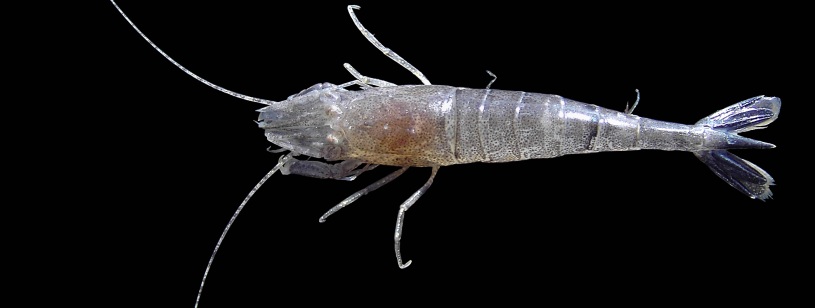
Brown shrimp (Crangon crangon) with long antennae and a segmented abdomen. · Hans Hillewaert / Wikimedia Commons / CC BY-SA 4.0 (https://creativecommons.org/licenses/by-sa/4.0/). Cropped and resized. Source: https://commons.wikimedia.org/wiki/File:Crangon_crangon.jpg
The brown shrimp (Crangon crangon) is a small crustacean of sandy and muddy coastal waters. Its translucent body and mottled colour provide concealment. It can bury itself in sediment while keeping its eyes and antennae exposed.
Quick facts
| Common name | Brown shrimp |
| Scientific name | Crangon crangon |
| Lifespan | Often around 1–3 years; varies between populations |
| Length | Up to about 8.5 cm; females generally larger |
| Diet | Omnivorous, with many small invertebrates |
| Predators | Coastal fish and seabirds |
| Conservation status | Not Evaluated globally, according to SeaLifeBase |
| Distribution | Northeast Atlantic, Baltic and Mediterranean |
| Habitat | Sandy and muddy seabeds, estuaries and lagoons |
| Family | Crangonidae |
| Activity | Mostly nocturnal; affected by light and turbidity |
| Reproduction | Eggs carried on abdominal appendages |
Interesting facts
- Buried shrimp may leave only their eyes and antennae exposed.
- Pigment cells help them match the seabed.
- Females carry eggs beneath the abdomen.
- Growth requires repeated moulting of the external covering.
Records and extremes
Research cited by MarLIN describes burial in about 9–10 seconds. Limb movements shift sediment over the body.
Experiments in Scientific Reports documented repeated colour adjustment within an hour. Light, sediment colour and individual variation influence the response.
Characteristics
The elongated body is slightly flattened, with long antennae and a fan-shaped tail. A short, blunt rostrum projects between the eyes.
Jointed limbs support walking and feeding. Abdominal appendages aid swimming and carry eggs in females. The external skeleton supports the soft tissues.
Behaviour
Brown shrimp combine walking, swimming and burial. Feeding often increases after dark, although turbid water can allow daytime activity.
Redistribution of pigment within chromatophores changes the body’s appearance. Camouflage and burial reduce visibility to both predators and prey.
Habitat and distribution
The species occupies the northeast Atlantic, Baltic and Mediterranean. Sandy and muddy coastal habitats provide feeding grounds and places to hide.
It tolerates brackish water in estuaries and lagoons. Shallow coastal areas are important for juveniles, and seasonal conditions influence distribution.
Diet and feeding
Food includes marine worms, small crustaceans, molluscs and animal remains. Algae have also been found in the digestive tract.
Brown shrimp are important prey for coastal fish and birds. In the Wadden Sea they connect small seabed organisms with larger predators.
Reproduction and life cycle
Females attach eggs to abdominal appendages and carry them until hatching. Development can take around 4–13 weeks, depending on temperature.
Larvae spend time in the water column before settling to bottom life. Juveniles grow through repeated moults, with food and temperature influencing development.
The new covering takes time to harden after moulting, leaving the shrimp temporarily more vulnerable.
Name and history
The accepted name Crangon crangon dates to Linnaeus in 1758. The species belongs to Crangonidae within Decapoda.
It is also called the common shrimp. General descriptions of tropical or freshwater shrimp do not necessarily apply to this European coastal species.
Conservation and threats
SeaLifeBase lists the species as globally Not Evaluated by IUCN. It remains common in many European coastal areas, with local and annual variation.
Intensive fishing and incidental catches can affect coastal ecosystems. Marine Conservation Society assessments differ among fisheries because methods and management vary.
Monitoring populations and maintaining shallow nursery habitats support conservation. The Wadden Sea illustrates the species’ wider ecological importance.
Frequently asked questions
Can brown shrimp live in brackish water?
They tolerate reduced salinity in estuaries and lagoons.
Why are they hard to see on sand?
Translucence, mottling and colour adjustment help them blend into the bottom.
How can an egg-bearing female be recognised?
A mass of eggs is attached beneath the abdomen.
Can they grow without moulting?
Body growth requires periodic replacement of the external covering.
Are all shrimp similar?
Shrimp include many species with different sizes, colours and habitats.
Why are they important to coastal fish?
They transfer energy from small seabed organisms to larger predators.