MollyPoecilia sphenops — habitat, diet and reproduction
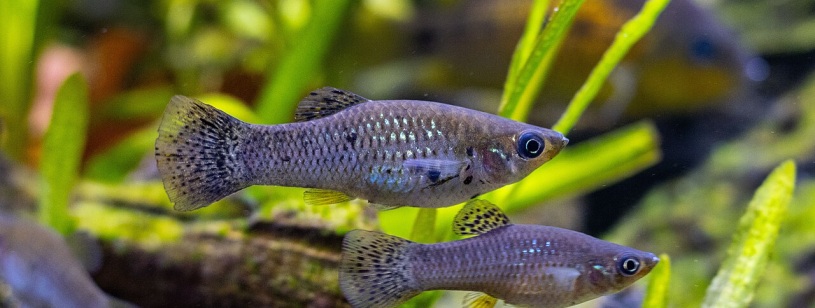
Mollies (Poecilia sphenops) with wild-type colouration. · Dnoerholm / CC BY-SA 4.0 (https://creativecommons.org/licenses/by-sa/4.0). Cropped and resized.
Mollies are familiar aquarium fish known for active behaviour, varied colours and live birth. This article focuses on Poecilia sphenops. The trade name molly also covers related species and hybrids, so appearance and size vary considerably.
Quick facts
| Common name | Molly |
| Scientific name | Poecilia sphenops |
| Lifespan | Several years with suitable care |
| Length | Up to about 7.5 cm excluding the tail fin, according to FishBase |
| Diet | Omnivore: algae, plant material and small invertebrates |
| Predators | Larger fish and other aquatic animals |
| Conservation status | Least Concern (LC), for Poecilia sphenops |
| Distribution | Mexico and Central America; reported limits differ between sources |
| Habitat | Streams and other fresh waters; also uses brackish water |
| Family | Poeciliidae |
| Reproduction | Internal fertilisation and live birth |
| Sex differences | Males have a modified anal fin called a gonopodium |
- Primary category:Fish
- Explore this animal's categories:
Interesting facts
- Young are able to swim at birth.
- Mollies forage on algae-covered surfaces.
- Black ornamental varieties differ markedly from wild grey fish.
- The name molly does not guarantee that two fish belong to the same species.
Characteristics
Poecilia sphenops has a relatively robust body, a slightly flattened head and an upturned mouth. Wild-type fish are mainly grey, with fine spots and subtle reflections. Females are usually larger.
Ornamental breeding has produced black, gold and mottled forms. Fish with especially enlarged fins may have a different origin. Males have a narrow gonopodium used in reproduction; females retain a fan-shaped, triangular anal fin.
Behaviour
Mollies actively explore and graze surfaces. Chasing and interactions between the sexes occur within groups. Plants and open water provide both retreat and swimming room.
Stocking must suit tank volume and filtration. New fry can increase numbers faster than expected. Compatible tankmates should allow access to food without persistent harassment.
Habitat and distribution
The species is native to Mexico and Central America. Sources differ over its precise range, partly because of confusion with related species. Introduced populations occur elsewhere.
It uses streams and other fresh waters, and also occurs in brackish conditions. Captive care should consider the conditions in which the fish were raised. Salt tolerance does not mean every molly aquarium automatically needs salt.
Diet and feeding
Mollies eat algae, plant material, small invertebrates and organic debris. Their mouths collect particles from surfaces and water.
Captive fish need suitable complete omnivore food with an appropriate plant component. Tank algae alone do not guarantee adequate nutrition. Portions should match the fish, since excess food harms water quality.
Reproduction and life cycle
The male transfers sperm using the gonopodium, and fertilisation occurs inside the female. Developing embryos are eventually born as live young. Brood size depends on the female’s size and condition.
Fry swim and forage independently. Adults provide no care and may eat them. Dense plants offer refuge without guaranteeing survival. Breeding requires advance planning; surplus fish should not be released into natural waters.
Name and history
Valenciennes published the name Poecilia sphenops in 1846. It belongs to Poeciliidae, a family containing several familiar live-bearing aquarium fishes.
Molly may also refer to Poecilia latipinna, Poecilia velifera or mixed-origin forms. These names are not interchangeable. Correct identification helps compare adult sizes and care requirements.
Conservation and threats
Poecilia sphenops is globally Least Concern. This category applies to the species, not automatically to every fish sold as a molly.
Introduced populations show how trade can move fish beyond natural ranges. Unwanted animals should be rehomed responsibly. Planning for reproduction is part of protecting both aquarium fish and local habitats.
Frequently asked questions
Are all mollies the same species?
No. The trade name includes Poecilia sphenops, related species and sometimes hybrids.
Do mollies lay eggs?
Females give birth to live young after internal fertilisation and development.
Do mollies need feeding if the tank contains algae?
Yes. Algae do not guarantee a complete diet; suitable food should be offered in controlled portions.
Is salt compulsory in a molly aquarium?
Not automatically. Check the actual species, its previous conditions and the needs of all tank inhabitants.