Colorado potato beetleLeptinotarsa decemlineata — habitat, diet and reproduction
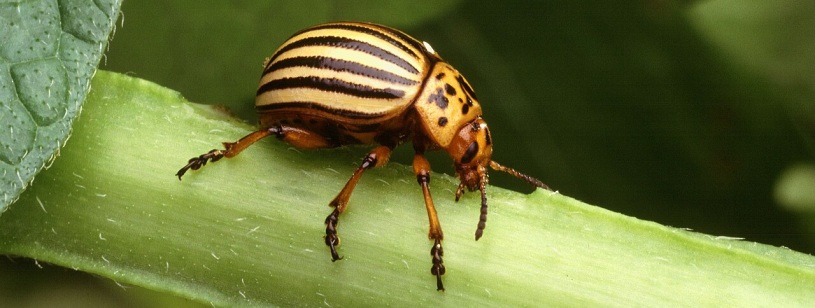
Adult Colorado potato beetle (Leptinotarsa decemlineata) on a plant. · Scott Bauer, USDA ARS / Public domain ().
The Colorado potato beetle is recognised by ten black stripes on its yellow wing covers. Adults and larvae eat leaves, especially potato foliage. Larvae look quite different: reddish, with black heads and dark side spots. Important parts of the life cycle take place out of sight in the soil.
Quick facts
| Common name | Colorado potato beetle |
| Scientific name | Leptinotarsa decemlineata |
| Diet | Herbivore, especially nightshade-family leaves |
| Predators | Various predatory insects; lady beetles also eat eggs |
| Conservation context | Widespread species mainly monitored as an agricultural pest |
| Distribution | Native to North America; widespread in Europe and parts of Asia |
| Habitat | Crops and other places with host plants |
| Adult length | About 1 cm |
| Family | Chrysomelidae |
| Development | Egg, four larval instars, pupa, adult |
| Overwintering | Adult sheltered in soil |
Interesting facts
- The ten stripes are counted across both wing covers together.
- Larvae look unlike the striped adults.
- Both adults and larvae eat foliage.
- The adult stage overwinters in soil.
Characteristics
Adults are oval and strongly rounded. Yellowish hardened forewings, called elytra, carry lengthwise black stripes. The area behind the head is orange-yellow with dark markings.
Young larvae are darker, while larger ones become reddish or pinkish. Black heads and rows of side spots remain useful features. Yellow-orange eggs occur in clusters, usually beneath leaves. Recognising all stages gives a fuller picture than identifying adults alone.
Behaviour
Adults leave winter shelters in spring and seek host plants. They walk and can also fly in suitable conditions.
New larvae initially stay close to the egg cluster. Growing larvae spread over the plant and eat increasing amounts of foliage. Temperature influences activity and development, so calendars differ between regions. Eggs, larvae and adults may all occur in one field at the same time.
Habitat and distribution
The species originated in North America. Expanding potato cultivation supplied abundant food, and the beetle spread into other regions.
It is now established in many European countries, including Romania, and parts of Asia. Its distribution is not uniform across continents or climates. Fields, gardens and patches of related host plants provide habitat, linking its expansion closely with human activity.
Diet and feeding
Leaves of potatoes and other nightshade-family plants, including eggplant, provide food. Both larvae and adults are herbivorous.
Large larvae cause substantial leaf loss. Damage to tuber production is indirect: reduced foliage limits the plant’s ability to produce and store resources. Severity depends on beetle numbers and crop stage. One adult alone cannot describe the condition of a whole field.
Reproduction and life cycle
Females place egg clusters beneath leaves and may produce hundreds of eggs, depending on conditions. Larvae pass through four growth stages before entering the soil to pupate.
The striped adult emerges from the pupa, completing full metamorphosis. Climate determines whether one or several generations occur each year. Adults entering winter dormancy reduce activity and remain sheltered underground.
Name and history
Leptinotarsa decemlineata belongs to Chrysomelidae, a family containing many plant-feeding beetles. The species epithet refers to its ten lines.
Colorado reflects a historical association with western North America rather than a restriction to one state. The shift from wild host plants to abundant crops made the beetle widely known beyond its original range.
Conservation and threats
Agricultural attention focuses on crop damage rather than rarity. Insecticide resistance has developed in some populations, complicating management.
Regular observation and correct identification of life stages matter. Responses need to suit the crop and local conditions, rather than assuming one treatment solves every situation. The beetle is now familiar in Romanian fields and gardens as well as elsewhere in its introduced range.
Frequently asked questions
How many stripes does it have?
Ten lengthwise black stripes across both wing covers together.
Does a larva look like a tiny adult?
No. It has a soft reddish body, black head and dark side spots.
Where does it spend winter?
As an adult sheltered in soil.
Does it mainly eat potato tubers?
No. It feeds on foliage and above-ground growth; tuber yield is affected through damage to the plant.