BonoboPan paniscus — habitat, diet and reproduction
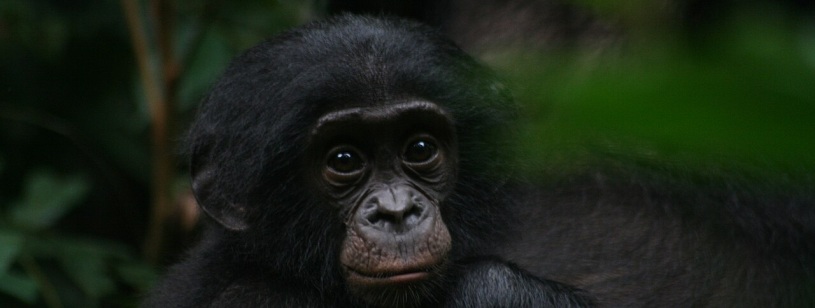
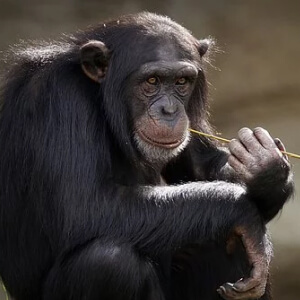
A young bonobo, Pan paniscus, with its mother in the forest at LuiKotale, Democratic Republic of the Congo. · DBeaune / CC BY-SA 4.0 (https://creativecommons.org/licenses/by-sa/4.0). Cropped and resized.
The bonobo is a great ape found naturally only in the Democratic Republic of the Congo. Closely related to the chimpanzee, it is a distinct species, Pan paniscus. Life unfolds between forest floor and trees within a complex social community, where female bonds and prolonged care of young are especially important.
Quick facts
| Common name | Bonobo |
| Scientific name | Pan paniscus |
| Longevity | Can exceed 50 years in specialist care; wild data remain limited |
| Diet | Omnivore, with fruit forming an important part |
| Conservation status | Endangered (EN) |
| Distribution | Democratic Republic of the Congo, in the Congo Basin |
| Habitat | Tropical forest, including secondary and swamp forest |
| Length | Head and trunk: approximately 70–83 cm |
| Weight | Females are usually smaller than males; often around 30–40 kg |
| Family | Hominidae |
| Reproduction | Usually one infant after about eight months of pregnancy |
| Social life | Communities temporarily divide into smaller parties |
Interesting facts
- Bonobos are a distinct species, not simply smaller chimpanzees.
- Like other great apes, they have no tail.
- Females can form important bonds and alliances.
- Infants depend on their mothers for several years.
Characteristics
Dark hair, a dark face and long arms characterise the bonobo. Its build is generally more slender than a chimpanzee’s, and head hair may show a noticeable parting.
Hands and feet grasp branches. On the ground, knuckle-walking is common, alongside other postures. Size varies by sex and individual; the older name pygmy chimpanzee misleadingly suggests that the distinction is simply a smaller body.
Behaviour
Communities divide into smaller feeding parties and later reunite. Food availability helps shape these temporary associations.
Grooming, contact and vocalisations maintain relationships. Female alliances are important, while males can retain strong maternal relationships into adulthood. Cooperation does not mean the absence of all tension. Observed behaviour is more informative than treating bonobos as a symbol of a perfect society.
Habitat and distribution
The natural range lies entirely in the Democratic Republic of the Congo, south of the Congo River. Dependence on one country’s forests makes habitat protection there crucial.
Bonobos use mature, secondary and swamp forest. They feed in trees and on the ground, often resting in constructed tree nests. Forest provides routes, food and connections between groups, rather than merely a cover of trees.
Diet and feeding
Fruit is a major dietary component, alongside leaves, other plant parts and animal food, including invertebrates.
Seasonal resources influence the menu. Finding food involves memory, exploration and coordination with companions. Bonobos should not be described as strictly vegetarian, but eating animal food does not establish its proportion in every individual or population’s diet.
Reproduction and life cycle
Pregnancy lasts around eight months and usually produces one infant. The baby clings to its mother, nurses and gradually learns movement and food selection.
Dependence lasts for years, with learning continuing beyond the first independent movements. Long birth intervals limit population recovery. Losing a mother can also threaten her dependent infant, extending the impact beyond the adult alone.
Name and history
Pan paniscus is distinct from the common chimpanzee, Pan troglodytes, although both belong to Pan. The older name pygmy chimpanzee does not capture their anatomical and behavioural differences.
Field research has clarified the importance of bonobo social relationships. The species belongs to Hominidae alongside other great apes and humans, within the mammal class.
Conservation and threats
Habitat loss, illegal hunting and the trade in young animals threaten this Endangered species. Roads opened in forest can make previously isolated groups more accessible.
Conservation combines forest protection, community cooperation and care for rescued orphans. Release requires appropriate conditions, not merely placing an animal among trees. Preserving intact communities is especially important because reproduction is slow.
Frequently asked questions
Is a bonobo a common chimpanzee?
No. Pan paniscus and the common chimpanzee, Pan troglodytes, are distinct species.
Where does it live naturally?
Only in the Democratic Republic of the Congo, in Congo Basin forests.
Does it eat only fruit?
No. Fruit is important, but leaves, other plant parts and animal food are also eaten.
Why do populations recover slowly?
Females usually raise one infant at a time, with several years between births.