TigerInteresting facts and information
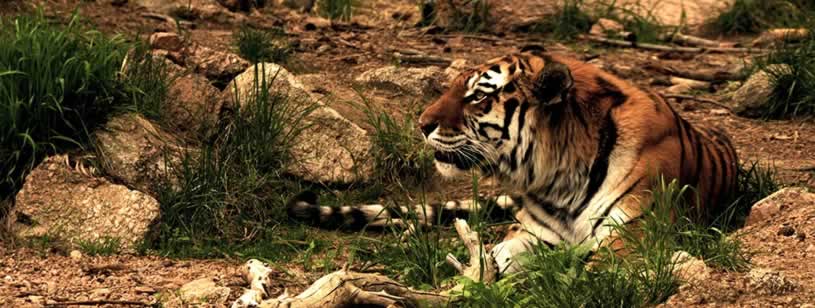
The tiger (Panthera tigris) is a large striped cat native to Asia. Tigers live in habitats ranging from tropical forests to colder woodlands. They usually hunt alone, and habitat loss, prey depletion and illegal killing threaten their survival.
Tiger populations are described using different subspecies classifications. The familiar regional names below are kept, without treating each population as a separate species.
Living tiger populations
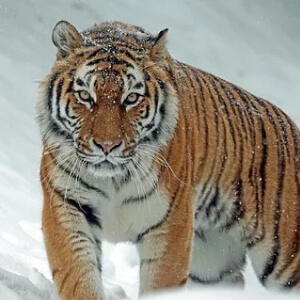
- Siberian tiger — a tiger population of cold forests in northeastern Asia.
- Bengal tiger — found in parts of the Indian subcontinent.
- Indochinese tiger — a mainland Southeast Asian tiger population.
- Malayan tiger — found on the Malay Peninsula.
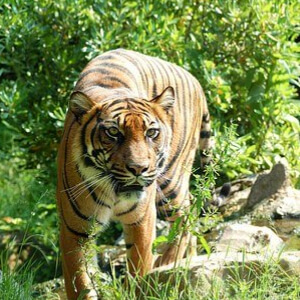
- Sumatran tiger — found on Sumatra.
- South China tiger — a severely depleted population now maintained in captivity.
Extinct regional tiger populations
- Bali tiger — an extinct island population.
- Javan tiger — an extinct island population.
- Caspian tiger — an extinct mainland population.
Quick facts
| Common name | Tiger |
| Scientific name | Panthera tigris |
| Typical lifespan | 10-15 years in the wild, up to about 26 years in captivity |
| Maximum speed | About 50-65 km/h in short bursts |
| Size | 200–350 cm total length including the tail; shoulder height varies with sex and population |
| Weight | Varies with sex and population, from about 75 kg in small island females to about 300 kg in large males; tigers are one species, not several. |
| Diet type | Carnivore (mainly large mammals; also birds, reptiles, fish) |
| Main predators | Humans (hunting, habitat destruction) |
| Conservation status | Endangered (IUCN); conservation needs differ between populations |
| Geographical distribution | South Asia, Southeast Asia, the Russian Far East and north-east China |
| Habitat | Tropical and temperate forests, grassland mosaics and mangroves; Siberian tigers live in forests, not Arctic tundra. |
| Social behaviour | Solitary, territorial |
| Special adaptations | Striped camouflage, great strength, effective night hunter |
Interesting facts
- The tiger is the largest member of the cat family - Large male Siberian (Amur) tigers can weigh around 300 kg and measure more than 3 metres from nose to tail tip.
- Its stripes are as unique as fingerprints - No two tigers have the same stripe pattern, which helps researchers identify individuals.
- Tigers are strong swimmers - Unlike many other cats, tigers like water and can swim across wide rivers and lakes.
- Its jaws are enormously powerful - A tiger can kill large prey such as deer and buffalo with a single bite to the neck or throat.
- It sees far better than we do at night - A tiger's night vision is several times better than a human's, which makes it a formidable night hunter.
- Its roar carries a long way - A tiger's roar can be heard up to about 3 km away and is used to warn rivals and find mates.
- It has immensely strong front legs - One swipe of a tiger's paw can knock down large prey.
Records and remarkable features
- The tiger is the largest living cat species.
- Its stripes continue on its skin, not just its fur.
- A tiger can eat more than 30 kg of meat in a single meal.
Characteristics
The tiger is the largest cat and one of the most powerful land predators. Its massive body, strong muscles and agility make it a formidable hunter, able to bring down prey much larger than itself.
Appearance
- Impressive size - An adult tiger can be up to about 3.5 m long including the tail and weigh up to about 300 kg.
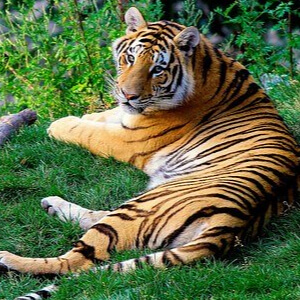
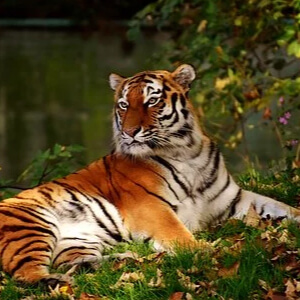
- Orange fur with black stripes - Acts as natural camouflage, helping the tiger hide in dense vegetation and long grass.
- Long tail - Helps with balance when running and turning.
- Powerful legs - Allow leaps of up to about 8-10 m, making the tiger one of the most powerful cats.
- Deadly teeth and claws - Its canine teeth can be up to about 10 cm long, and its retractable claws are ideal for gripping prey.
- Excellent night vision - A tiger's eyes are adapted to hunting in dim light and work several times better than human eyes at night.
Special adaptations
- Striped camouflage - Helps it disappear among grass, reeds and shadows.
- A good swimmer - Unlike most cats, the tiger enjoys water and uses it to cool off or to chase prey.
- Great leaping power - Its strong hind legs let it pounce on prey from several metres away.
Habits and behaviour
Tigers are solitary, territorial animals that spend much of their time patrolling and hunting.
Social behaviour
- Solitary - A male tiger holds a large territory that overlaps the ranges of several females and defends it from other males.
- Brief meetings - Males and females meet mainly to mate, and the mother raises the cubs on her own.
- Communication by scent and sound - Tigers mark their territory with scent, claw marks and loud roars.
Survival techniques
- A night hunter - Tigers hunt mainly at dawn, dusk and night, when their prey is easier to approach.
- Fierce fights between males - Males defend their territories fiercely, and fights can be fatal.
- Adaptable - Tigers live everywhere from tropical jungles and mangroves to the snowy forests of the Russian Far East.
Habitat and geographic distribution
Tigers are native to Asia and live in tropical forests, grasslands, swamps and the cold forests of the Russian Far East.
| Region | Population | Preferred habitat |
|---|---|---|
| India, Nepal, Bangladesh, Bhutan | Bengal tiger | Tropical forests, grasslands, mangroves |
| Russian Far East, north-east China | Siberian (Amur) tiger | Cold temperate and mixed forests |
| Thailand, Myanmar and nearby countries | Indochinese tiger | Dense jungle, tropical forests |
| Malay Peninsula | Malayan tiger | Tropical forests |
| Sumatra (Indonesia) | Sumatran tiger | Rainforests, peat swamps, mangroves |
Types of habitat
- Tropical forests - Favoured by Bengal, Malayan and Sumatran tigers, where dense vegetation gives excellent cover.
- Grasslands and mangroves - Bengal tigers also live in tall grasslands and in the Sundarbans mangrove forest.
- Cold northern forests - Siberian tigers survive very cold winters thanks to their thick fur and a layer of fat.
Human impact and threats
- Habitat loss - Clearing forests for farms and settlements reduces tiger territories.
- Illegal hunting - Tigers are killed for their skins, bones and other body parts, which are used in traditional medicine.
- Conflict with people - As their habitat shrinks, tigers may kill livestock and are then killed in revenge.
- Loss of prey - When deer and wild pigs are overhunted, tigers turn to other animals, including livestock.
Diet and feeding
The tiger is a top predator at the top of the food chain. It is a solitary, opportunistic hunter able to kill very large prey.
What does the tiger eat?
| Type of food | Where |
|---|---|
| Deer, wild pigs, wild cattle such as gaur and water buffalo | Across the tiger's range |
| Monkeys, birds, reptiles, fish | Especially in South and Southeast Asia |
| Wild goats, wild pigs, deer | Southeast Asia |
| Bears, wolves and other carnivores | Occasionally, especially in the Russian Far East |
| Livestock (cattle, goats, dogs) | Where wild prey is scarce |
Hunting techniques
- Ambush - The tiger creeps silently through vegetation, gets within a few metres and attacks suddenly.
- A fatal bite - It bites the back of the neck or the throat, breaking the spine or suffocating its prey.
- Great strength - A tiger can bring down animals several times its own weight, such as gaur and water buffalo.
- Dragging its kill - A tiger can drag prey weighing hundreds of kilograms into cover to hide it from scavengers.
- Huge meals - A tiger can eat 20-40 kg of meat at once and then go several days without eating.
Adapting to food supply
- When large prey is scarce, tigers hunt smaller animals such as rodents, birds and even frogs.
- In the Sundarbans mangroves, tigers also catch fish and crabs.
- When they cannot hunt, some tigers come close to villages, where they may kill livestock and, rarely, attack people.
Reproduction and life cycle
Tigers breed slowly, so populations find it very hard to recover after losses from hunting or habitat destruction.
| Feature | Details |
|---|---|
| Age at maturity | 3-4 years for females, 4-5 for males |
| Breeding season | All year, with a peak in the cooler months |
| Type of reproduction | Live birth (mammal) |
| Cubs per litter | 2-4 |
| Pregnancy | 100-110 days |
| Weight at birth | About 700-1,600 g |
| Nursing period | About 5-6 months |
| Independence | At about 2 years old |
| Lifespan | 10-15 years in the wild, up to about 26 years in captivity |
Mating
- Males and females meet only to mate - Afterwards, the male leaves.
- The female gives birth in a hidden place, such as a cave or a thick patch of vegetation.
- Cubs are born blind and helpless and depend completely on their mother for the first weeks.
Raising the cubs
- At about 2 months old, they start eating meat but are still nursed.
- At about 6 months old, they start learning to hunt, following their mother on hunting trips.
- At about 2 years old, they become independent, although they may stay near their mother's territory for a while.
Name and history
Tigers have existed for about 2 million years and are one of the oldest big cats.
Origin of the name
- The word "tiger" comes from the Greek and Latin tigris, which probably comes from an Old Iranian word meaning "sharp" or "arrow", perhaps referring to its speed.
- The scientific name Panthera tigris places it in the genus Panthera, together with lions, jaguars and leopards.
The tiger in human history
- A symbol of power in Asia - In China and India, the tiger was a royal and sacred symbol that appears in myths and temples.
- Ancient Rome - Tigers were brought to Rome and shown in the arena.
- A sign of courage - In parts of Asia, tiger skins were worn as a sign of bravery and rank.
- Heavy hunting - In the 19th and 20th centuries, tigers were hunted so intensively that they disappeared from many regions.
The tiger in folklore and superstition
Cultural significance and mythology
- The Chinese zodiac - The tiger is one of the 12 animals of the Chinese zodiac and stands for courage and strength.
- Hinduism - The goddess Durga is often shown riding a tiger or a lion.
- National symbols - The tiger is the national animal of India, Bangladesh, Malaysia and South Korea.
Conservation status and threats
Tigers are threatened by habitat loss, prey depletion and illegal killing. Older undated global totals should not be treated as a current population estimate.
| IUCN status | Populations | Regions |
|---|---|---|
| Endangered (EN) | The tiger as a species, including Bengal, Indochinese and Siberian tigers; names and subspecies boundaries vary between taxonomic treatments. | South Asia, Southeast Asia, Russian Far East |
| Critically Endangered (CR) | Sumatran tiger and Malayan tiger | Sumatra, Malay Peninsula |
| Probably extinct in the wild | South China tiger (no confirmed wild sightings for decades; survives in captivity) | Southern China |
Main threats
- Illegal hunting - Tigers are poached for their skins, bones and other body parts used in traditional medicine.
- Habitat loss - Deforestation and the spread of towns and farms destroy the forests and grasslands where tigers live.
- Conflict with people - When natural prey disappears, tigers kill livestock, and farmers kill them in return.
- Loss of genetic diversity - Small, isolated populations face a higher risk of inbreeding.
Conservation efforts
- Reserves and national parks - India, Russia, Thailand, Nepal, Indonesia and other countries have created protected areas for tigers.
- Anti-poaching patrols - Rangers work to stop the illegal hunting of tigers.
- Breeding in captivity - Zoo breeding programmes help maintain genetic diversity.
In popular culture
- "The Tyger" (William Blake, 1794) - One of the best-known poems in English, beginning "Tyger Tyger, burning bright".
- The Jungle Book (Rudyard Kipling, 1894) - Shere Khan, the tiger, is Mowgli's great enemy.
- Life of Pi (Yann Martel, 2001; film 2012) - A boy is stranded in a lifeboat with a Bengal tiger called Richard Parker.
- Tigger - The bouncy tiger from A. A. Milne's Winnie-the-Pooh stories.