DiscusSymphysodon — habitat, diet and reproduction
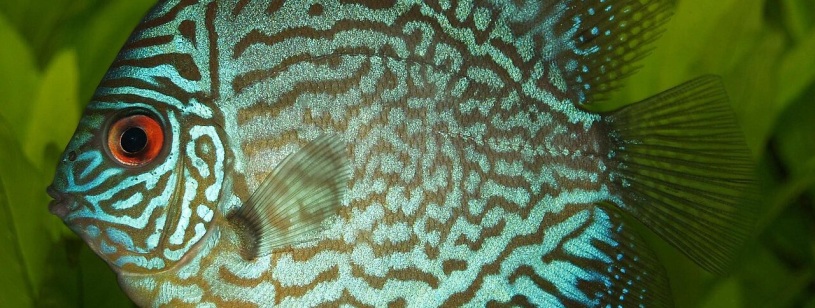
Discus (Symphysodon), a blue ornamental variety. · Patrick Farrelly / Public domain ().
Discus are fishes of the genus Symphysodon, native to the Amazon basin. Their round, laterally flattened bodies resemble discs. During early growth, young discus graze mucus from both parents’ skin, an unusual form of feeding among aquarium fishes.
Quick facts
| Common name | Discus |
| Scientific name | Symphysodon — a genus containing several species |
| Lifespan | Several years under suitable care |
| Size | Can reach about 20 cm, depending on the form |
| Diet | Omnivore: invertebrates, plant material and detritus |
| Predators | Larger fish |
| Conservation status | Assessed separately for each species |
| Distribution | Amazon basin, South America |
| Habitat | Slow waters, floodplain lakes and flooded forests |
| Family | Cichlidae |
| Reproduction | Substrate spawning with care from both parents |
| Distinctive feature | Young also feed on parental skin mucus |
- Primary category:Fish
- Explore this animal's categories:
Interesting facts
- Both parents can provide food through skin secretions.
- Fry switch between parents while feeding.
- Many aquarium colours result from ornamental breeding.
- Submerged branches provide shelter in natural habitats.
Characteristics
A discus looks almost circular from the side but narrow from the front. Its dorsal and anal fins follow the body outline. The relatively small mouth takes small food items.
Wild populations show differing bars and patterns. Captive varieties may be blue, red, yellow or mottled. A colour name alone does not identify a species. Adult size and body height must be considered when choosing an aquarium.
Behaviour
Discus live in groups but establish dominance relationships. Breeding pairs defend an area. A repeatedly chased individual may lose access to food.
Shelter and sufficient space reduce conflict. OATA uses about 300 litres for six adults as a guide; layout, filtration and actual fish size must also be assessed. Water movement should be gentle and maintenance regular. Clear-looking water can still have unsuitable chemistry.
Habitat and distribution
Discus inhabit slow waters and floodplain lakes in the Amazon basin, often gathering beside fallen trunks and branches.
Seasonal water levels change the available habitat. Flooded forests provide temporary shelter and feeding areas. Populations use waters with different properties, so no single set of conditions describes the entire genus.
Diet and feeding
Natural foods include small invertebrates, plant material and detritus, or organic debris. Discus search the bottom and submerged surfaces.
Captive fish need suitable complete food in controlled portions, with appropriate variety. Farm feeding practices do not necessarily describe wild diets. Watching each fish helps identify individuals unable to compete for food.
Reproduction and life cycle
A pair cleans a surface and lays eggs on it. Parents guard the clutch and move oxygenated water over it. After hatching and becoming free-swimming, fry begin grazing mucus from adult skin.
The secretion contains proteins and other components studied in relation to early development. Both parents participate, and fry switch between them. As the young grow, they increasingly use other foods. The mucus is not milk, and fish have no mammary glands.
Name and history
Discus refers to the cichlid genus Symphysodon. Species boundaries have been debated in scientific literature; this article describes shared features of the group.
Selective breeding has produced numerous commercial colours and patterns. Trade names alone are insufficient for species identification.
Conservation and threats
An entire genus should not automatically receive a single conservation category. Assessments must be checked by species, and local pressures depend on habitat and collection practices.
Protecting flooded forests and water quality maintains the connections on which discus depend. Ornamental fish should remain in controlled systems rather than being released.
Frequently asked questions
Do discus feed their young milk?
No. Fry graze mucus from parental skin. It provides food but is not milk.
Do both parents care for the young?
Yes. Both may guard the eggs and provide mucus to free-swimming fry.
Is discus a single species?
The name covers the genus Symphysodon, with several species and many ornamental varieties.
Why does water quality matter?
Discus need stable conditions and effective biological filtration. Waste and inadequate maintenance degrade their environment.