DugongDugong dugon — habitat, diet and reproduction
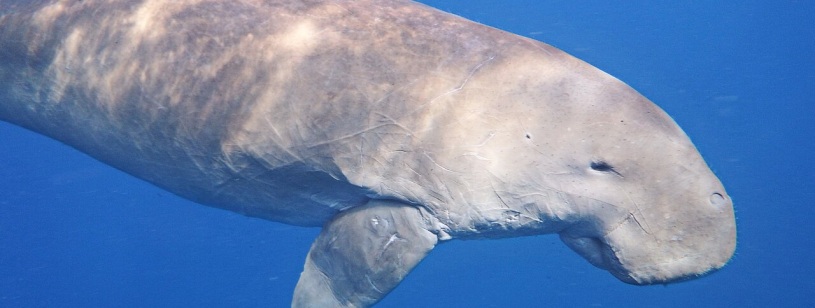
Grey dugong with a downturned muzzle in the Red Sea near Marsa Alam, Egypt. · Kora27 / Wikimedia Commons / CC BY-SA 4.0 (https://creativecommons.org/licenses/by-sa/4.0/). Cropped and resized. Source: https://commons.wikimedia.org/wiki/File:Dugong._Seekuh._%D0%94%D1%8E%D0%B3%D0%BE%D0%BD%D1%8C._Rotes_Meer.._DSCF1085WI.jpg
The dugong (Dugong dugon) is a marine mammal that feeds mainly on seagrass. It grazes coastal seabeds and surfaces regularly for air. A heavy body, downturned muzzle and two-lobed tail distinguish its shape. Together with manatees, it belongs to the order Sirenia.
Quick facts
| Common name | Dugong; sea cow |
| Scientific name | Dugong dugon |
| Lifespan | Can reach around 70 years; many individuals die younger |
| Length | Commonly approximately 2.5–3 m |
| Weight | Adults frequently around 230–400 kg |
| Diet | Predominantly herbivorous; seagrass |
| Predators | Large sharks, killer whales and saltwater crocodiles; regional risk, especially for calves |
| Conservation status | Vulnerable |
| Distribution | Tropical and subtropical Indian Ocean and western Pacific coasts |
| Habitat | Bays and coastal waters with seagrass meadows |
| Family | Dugongidae |
| Reproduction | Usually one calf; gestation 13–15 months and several years between births |
Interesting facts
- Uprooted plants leave visible feeding trails across the seabed.
- Sensitive bristles on the muzzle help locate and grasp food.
- The two-lobed tail differs from a manatee’s rounded paddle.
- It is the only surviving member of Dugongidae; Steller’s sea cow is extinct.
Records and extremes
Dugongs are among the few aquatic mammals specialised in marine plants. Seagrass meadows provide food while supporting many other coastal animals.
Longevity can reach around 70 years, though this is a possible maximum rather than a typical lifespan.
A female may give birth only every 3–7 years. Losses of breeding adults can therefore affect populations for a long time.
Characteristics
A thick, elongated body is covered in grey or brownish-grey skin. Front flippers assist balance and steering, while the tail drives movement up and down.
The broad muzzle points towards the seabed. A muscular lip and sensory bristles gather food. High nostrils close during dives.
Eyes are small and hearing is important. Visible tusks, especially in adult males, are modified incisor teeth.
Behaviour
Dugongs occur alone, in mother–calf pairs or in feeding gatherings. Associations vary with location and resources.
Movement is generally slow and feeding occupies much of the day. Typical dives last a few minutes before the animal returns to breathe.
Travels between feeding areas can cover long distances. Tides, temperature and meadow condition influence habitat use.
Habitat and distribution
The broad but fragmented range extends from East Africa and the Red Sea into the western Pacific. Australia supports especially important populations.
Sheltered coastal waters and bays provide feeding grounds. Seagrass needs light, so suspended particles that cloud the water can reduce plant growth.
Channels, estuaries and deeper waters may also be used for movement or feeding. Plant availability strongly shapes distribution.
Diet and feeding
Seagrasses are flowering marine plants with roots and leaves, distinct from seaweeds. They form the main food supply.
Dugongs can uproot whole plants, leaving furrows. In some meadows, grazing encourages regrowth of preferred species, depending on local conditions.
Other dietary components are being investigated. James Cook University researchers analyse DNA in dung to identify what else is consumed among seagrasses.
Reproduction and life cycle
Gestation lasts approximately 13–15 months, normally producing a single calf. Several years usually separate births.
Calves breathe air immediately and remain close to their mother. Mammary glands lie near the front flippers. Young can sample plants while still nursing.
Nursing commonly lasts around 14–18 months. Slow growth and late maturity limit how quickly a depleted population can recover.
Name and history
Müller described the species in 1776 as Trichecus dugon. Its accepted name is Dugong dugon, and manatees are its closest living aquatic relatives.
Dugongs have important roles in Aboriginal and Torres Strait Islander maritime cultures. Local knowledge of movements and feeding contributes to understanding the species.
Conservation and threats
Globally Vulnerable, dugongs face major risks from accidental capture in fishing gear. An entangled animal may be unable to surface for air.
Vessel strikes, habitat damage and unsustainable hunting add pressure. Coastal development, cloudy water and severe weather can damage feeding meadows.
Protection combines healthy seagrass habitat with reduced entanglement and collisions. Cooperation across communities and countries is important for animals that travel widely.
Frequently asked questions
Is it a fish?
It is a mammal that breathes with lungs and nurses its calf.
How does it differ from a manatee?
A dugong has two tail flukes, while a manatee has a broad rounded tail.
Does it mainly eat seaweed?
Its main food is seagrass, a group of flowering marine plants distinct from seaweed.
Must it reach the surface?
Yes. It returns regularly to breathe air.
How many calves are born?
Usually one at a time, with several years between births.
Why is recovery slow?
Slow growth and reproduction make losses of adult animals difficult to replace.