ArmadilloInteresting facts and information
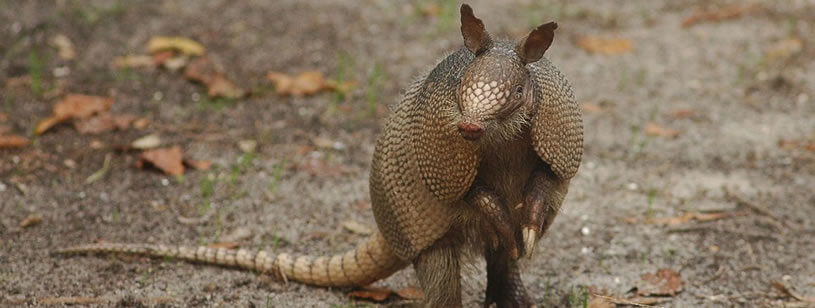
Armadillos are mammals in the order Cingulata, recognised by their protective bony armour. Their living relatives include sloths and anteaters.
Armadillos include many species with different sizes and habits. Most eat invertebrates, while some also take fruit, roots or other foods.
Long-nosed armadillos are familiar in parts of the Americas. The giant armadillo (Priodontes maximus) is much larger than most other living species.
Quick facts
| Common name | Armadillo |
| Scientific name | Cingulata (order containing the living armadillos) |
| Typical lifespan | Often 7-15 years in the wild, up to about 20 years in captivity |
| Maximum speed | Varies by species; no single maximum applies to all armadillos |
| Length | From about 10 cm to about 1.5 m (including tail), depending on the species |
| Weight | From about 120 g to about 50 kg, depending on the species |
| Diet type | Mainly insects and other invertebrates; also fruit, roots, small animals and carrion |
| Main predators | Jaguars, pumas, coyotes, bobcats, dogs, birds of prey (young), humans |
| Conservation status | Most species are Least Concern, but some are Vulnerable or Near Threatened |
| Distribution | South America, Central America, southern and central United States |
| Living environment | Rainforests, savannas, grasslands, deserts, wetlands |
Interesting facts
- Natural armour – Armadillos are the only living mammals protected by a shell of bony plates covered with tough scales.
- Rolling into a ball – Three-banded armadillos (Tolypeutes) can enclose their bodies within their armour. Other armadillos mainly rely on digging or escaping.
- Holding their breath – Nine-banded armadillos can hold their breath for about 6 minutes, which lets them walk along the bottom of streams.
- Surprise jumps – When startled, a nine-banded armadillo can jump about 1 metre straight up into the air.
- Armadillos can catch leprosy – The nine-banded armadillo (Dasypus novemcinctus) is one of the few animals besides humans that can carry the disease, and it has helped scientists study it.
- Identical young – Nine-banded armadillos typically produce four genetically identical young from a single fertilised egg.
Records and remarkable features
- The largest armadillo – The giant armadillo (Priodontes maximus) can weigh up to about 50 kg and be about 1.5 metres long, including the tail; its middle front claw is up to about 20 cm long.
- The smallest armadillo – The pink fairy armadillo (Chlamyphorus truncatus) is only about 10-12 cm long and weighs about 120 g.
- Super diggers – Giant armadillos dig large burrows that many other animals later use as shelters.
- Many babies from one egg – Some species of long-nosed armadillos give birth to litters of up to about 12 identical young.
- Delayed pregnancy – In the nine-banded armadillo, the fertilised egg can wait for months before it starts to develop, so the whole pregnancy can last up to about 8 months.
Physical characteristics and adaptations
The armadillo is the only living mammal with a bony shell, which gives it remarkable protection from predators and thorny vegetation.
Key physical adaptations
- A banded shell – Made of bony plates covered with tough scales, joined by flexible bands of skin so the animal can bend.
- A compact, muscular body – Gives strength and stamina for digging.
- Strong claws – Adapted for digging quickly in soil and tearing open termite mounds.
- A long, sensitive nose – Helps them find insects and other prey underground.
- A long, sticky tongue – Helps armadillos, especially the giant armadillo, lick up ants and termites.
- Good hearing – Helps them detect predators and the movements of insects.
- Poor eyesight – They rely more on smell and hearing to find their way.
Differences between species
| Species | Size | Special features |
|---|---|---|
| Giant armadillo (Priodontes maximus) | Up to about 1.5 m (with tail) and 50 kg | The largest armadillo; a powerful digger that eats termites and ants |
| Pink fairy armadillo (Chlamyphorus truncatus) | About 10-12 cm, about 120 g | The smallest armadillo; it has a pink shell, silky white fur and a flat rear plate |
| Nine-banded armadillo (Dasypus novemcinctus) | About 65-80 cm (with tail), up to about 6 kg | The most widespread armadillo, found from Argentina to the USA |
| Southern three-banded armadillo (Tolypeutes matacus) | About 25-30 cm, up to about 1.5 kg | Can roll up into an almost perfect ball |
Habits and behaviour
Most armadillos are solitary and active at night or at dusk, and they are famous for digging quickly to find food or escape danger.
Daily life
- Mostly nocturnal – Many armadillos rest in burrows during the day, avoiding the heat and predators, although some are active by day in cool weather.
- Solitary – They usually live alone, except during the breeding season and while mothers raise their young.
- Scent marking – They use scent glands to signal their presence.
Social interactions
- They rarely interact with other armadillos, except during the breeding season or when mothers are raising their young.
- Sounds and smells – They grunt while foraging, and some species, such as the screaming hairy armadillo, squeal loudly when handled.
Defence techniques
- Rolling into a ball (three-banded armadillos only) – Their armour closes like a box around them.
- Fast digging – In soft soil, an armadillo can dig itself into the ground in moments.
- Unexpected jumps – Nine-banded armadillos can jump about 1 metre into the air when startled, which can surprise a predator.
See also the list of all omnivorous animals.
Habitat and geographic distribution
Armadillos are adaptable animals that live in many environments, from rainforests to deserts and grasslands.
Regional distribution
| Region | Species present |
|---|---|
| South America | Almost all species, including the giant armadillo and the pink fairy armadillo |
| Central America | Dasypus novemcinctus, Cabassous centralis |
| Southern and central United States | Dasypus novemcinctus (still spreading north and east) |
Habitat types
- Rainforests – Large species, such as the giant armadillo, live where there are plenty of ants and termites.
- Savannas and grasslands – Many species dig their burrows in sandy soil.
- Deserts and dry areas – The screaming hairy armadillo (Chaetophractus vellerosus) and the pink fairy armadillo live in dry, sandy regions of Argentina.
- Wetlands – Some species live near rivers and can swim well.
Climate and habitat change
- Deforestation reduces the giant armadillo's habitat and food.
- Roads are dangerous – Armadillos are often killed by cars in Latin America and the United States.
- Armadillo activity is affected by temperature. Some populations have expanded into areas farther north; this does not mean they hibernate.
Diet and feeding
Armadillos eat mainly insects and other invertebrates, but many also eat small animals, fruit and carrion. Thanks to their keen sense of smell and strong claws, they are excellent at finding food hidden underground.
What do armadillos eat?
| Food group | Examples and context | How often |
|---|---|---|
| Insects and larvae | Ants, termites, beetle grubs, earthworms | Very often |
| Molluscs and crustaceans | Snails, freshwater crayfish | Occasionally |
| Amphibians and small reptiles | Lizards, frogs, reptile eggs | Occasionally |
| Fruit and roots | Berries, fallen fruit, tubers | Seasonal |
| Carrion | Dead animals and their maggots | Rare |
Hunting and feeding methods
- Fast digging – Armadillos use their claws to dig insects and grubs out of the soil.
- Sniffing out prey – Their sensitive nose can smell insects several centimetres underground.
- A sticky tongue – Like anteaters, armadillos use their tongue to lick up ants and termites.
- Seasonal foods – Some species eat more fruit and plant parts when insects are scarce.
Find out more about the aardvark, another insect-eating digger.
Reproduction and life cycle
Armadillos have some unusual ways of reproducing: in some species, the embryo's development can be delayed, and long-nosed armadillos give birth to identical siblings.
Mating season
- In tropical regions, many armadillos can breed at any time of year.
- In the United States, nine-banded armadillos mate in summer, usually in July and August.
- Males follow and sniff the females for some time before mating.
Pregnancy and birth
| Feature | Details |
|---|---|
| Pregnancy | About 2-5 months of development, depending on the species, sometimes after a delay of several months |
| Young per litter | 1-12 (usually 4 identical young in the nine-banded armadillo) |
| Weight at birth | About 30-100 g, depending on the species |
| Nursing | About 2-4 months |
Raising the young
- The young are born with soft, leathery skin, which hardens into a shell over the following weeks.
- For the first weeks, they stay in the burrow, where their mother nurses and protects them.
- At a few months old, they start following their mother to look for food.
- At about 6-12 months, they become independent and leave to find their own home.
Survival
- Young armadillos face threats from predators and conditions in their habitat; survival varies by species and location.
- In the wild, armadillos often live 7-15 years, and in captivity they can live about 20 years.
Name and history
Origin of the name
- "Armadillo" comes from Spanish and means "little armoured one", referring to its shell.
- In Brazil, armadillos are called tatu, a word from the Tupi language.
- In French, the armadillo is called tatou, and the Aztecs called it āyōtōchtli, "turtle-rabbit".
Taxonomic classification
| Classification | Name |
|---|---|
| Kingdom | Animalia |
| Phylum | Chordata |
| Class | Mammalia |
| Order | Cingulata ("belted ones") |
| Families | Dasypodidae and Chlamyphoridae |
| Main genera | Dasypus, Priodontes, Tolypeutes, Chlamyphorus |
Evolution and fossils
- Armadillos belong to an ancient South American mammal lineage, also represented by fossil relatives.
- Their extinct relatives include the glyptodonts, such as Glyptodon, giant armoured animals as big as a small car that lived until about 10,000 years ago.
- Fossils from South America show that armadillos and their relatives have survived many climate changes.
Cultural significance and mythology
The armadillo is an important symbol in the Americas, linked with protection, survival and adaptability. It appears in Indigenous traditions, music and modern symbols.
- Music of the Andes – The charango, a small stringed instrument, was traditionally made with the shell of an armadillo.
- Texas – The nine-banded armadillo is the official state small mammal of Texas.
- The Aztecs – They called the armadillo "turtle-rabbit", because it seemed to combine features of both animals.
Armadillo symbolism
- Protection and self-defence – Because of its shell, the armadillo is a symbol of safety and protection.
- Patience and persistence – Its constant digging stands for hard work and determination.
- Independence and survival – As a solitary, tough animal, the armadillo represents resilience.
Conservation status and threats
Most armadillo species are not threatened, but some are vulnerable because of hunting, habitat destruction and climate change.
Conservation status
| Species | IUCN status | Trend |
|---|---|---|
| Nine-banded armadillo (Dasypus novemcinctus) | Least Concern | Stable, expanding |
| Southern three-banded armadillo (Tolypeutes matacus) | Near Threatened | Declining because of habitat loss and hunting |
| Brazilian three-banded armadillo (Tolypeutes tricinctus) | Vulnerable | Declining because of hunting and habitat loss |
| Giant armadillo (Priodontes maximus) | Vulnerable | Declining because of hunting and deforestation |
| Pink fairy armadillo (Chlamyphorus truncatus) | Data Deficient | Rarely seen; little is known about its numbers |
Main pressures
- Hunting – In parts of Latin America, armadillos are hunted for their meat and shells.
- Habitat destruction – Deforestation and farming threaten giant and three-banded armadillos.
- Road accidents – Armadillos are often hit by cars, especially in the USA and Brazil.
- Climate change – Extreme temperatures can affect food and breeding.
- Living near people – Near towns and farms, armadillos can be killed by domestic dogs and other introduced animals.
Protection measures
- Nature reserves – Brazil, Argentina and other countries protect areas where giant armadillos live.
- Education – Campaigns encourage local people not to hunt threatened armadillos.
- Population monitoring – Researchers use camera traps to study rare species, such as the giant armadillo.
- Legal protection – In several countries, threatened armadillos are protected by law.
In popular culture
The armadillo has become a popular symbol in books, music, games and sport, often shown as a tough, resourceful character.
Film and animation
- Rango (2011) – Roadkill, a wise armadillo, sends the hero on his journey through the desert.
Books and literature
- Just So Stories (Rudyard Kipling, 1902) – In "The Beginning of the Armadilloes", a hedgehog and a tortoise learn each other's tricks and turn into the first armadillos.
Video games
- Sonic the Hedgehog series – Mighty the Armadillo is a strong, kind-hearted character in some Sonic games and comics.
- Red Dead Redemption – Armadillo is the name of a dusty frontier town in the games, where real armadillos also appear.
Mascots and symbols
- The 2014 FIFA World Cup – Fuleco, the official mascot of the tournament in Brazil, was a Brazilian three-banded armadillo, chosen to raise awareness of the threatened species.
- The charango – In the Andes, this small stringed instrument was traditionally made with an armadillo shell, although today most are made of wood.
Did you know? About armadillo
- There are about 20 living species of armadillos.
- Armadillos are the only living mammals with a shell made of bone.
- The nine-banded armadillo usually gives birth to four identical quadruplets.
- Only three-banded armadillos can roll up into a complete ball.
- Armadillos can hold their breath for about 6 minutes and walk along the bottom of streams.
- To cross a river, an armadillo can also gulp air to make itself float.
- The giant armadillo's middle claw is about 20 cm long, the largest claw of any living mammal relative to its size.
- Armadillos are related to sloths and anteaters.
- Fuleco, the mascot of the 2014 FIFA World Cup in Brazil, was an armadillo.