Bearded dragonPogona vitticeps — the central bearded dragon
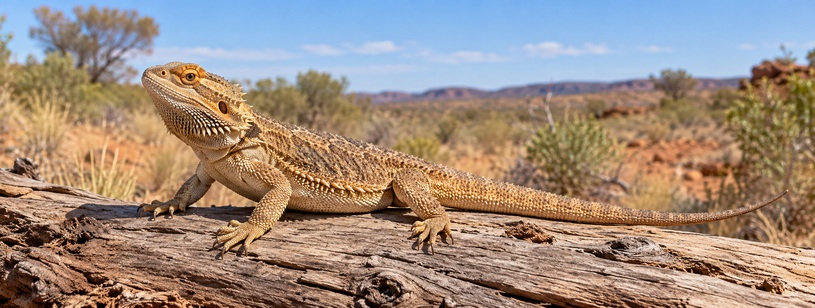
The central bearded dragon is an Australian lizard recognised by its triangular head and the elongated scales beneath its throat, which form a “beard”. The species Pogona vitticeps lives in dry habitats and is also kept as a pet.
It is active by day, eats both plants and insects, and can change its skin colour. In captivity it needs a spacious enclosure, controlled heating and UVB lighting. Its sturdy appearance does not mean it can stay healthy in an unsuitable setup.
Quick facts
| Common name | Central bearded dragon |
| Scientific name | Pogona vitticeps |
| Typical lifespan | Often described broadly as 10–15 years; not a guarantee or maximum species record |
| Length | Broadly around 45–60 cm in adults, including the tail; individuals vary |
| Weight | Several hundred grams; National Zoo & Aquarium gives around 400 g |
| Diet type | Omnivorous: plants and invertebrates, occasionally small vertebrates in the wild |
| Main predators | Birds of prey, other reptiles and mammals, including cats and foxes introduced to Australia. |
| Conservation status | Least Concern (LC), according to Museums Victoria |
| Geographical distribution | Inland central and eastern Australia |
| Habitat | Arid and semi-arid scrub, open woodland and rocky ground |
| Other names | Central bearded dragon; inland bearded dragon |
| Body length excluding tail | Up to around 25 cm snout–vent, according to Museums Victoria |
| Activity | Primarily daytime |
| Lifestyle | Ground-dwelling, with frequent climbing on branches and rocks |
| Social life | Usually solitary; individuals may be territorial |
| Defence | Inflates the body and beard; may gape and hiss |
| Reproduction | Lays eggs in a nest dug into the ground |
| Clutch size | Around 11–30 eggs; varies |
- Primary category:Reptiles
- Explore this animal's categories:
Interesting facts
- The beard is not hair. Elongated scales become more conspicuous when the lizard expands its throat.
- Colour serves several purposes. The back can become lighter or darker, while the beard and chest also signal to other lizards.
- A moving forelimb can send a message. Slow arm waving occurs in communication between lizards; it is not a greeting for people.
- It climbs as well as using the ground. Branches and rocks provide places to warm up and survey the surroundings.
- Its sex determination has an unusual feature. Under certain conditions, high temperatures during egg development can produce females with male-type chromosomes.
- Its sleep is studied in neuroscience. Researchers have described two sleep states with similarities to those of mammals and birds. This does not establish that the lizards have human-like dreams.
Characteristics
What does a bearded dragon look like?
It has a broad, flattened body, triangular head, four strong limbs and a long, gradually tapering tail. Rows of spiny scales run along the flanks, and external ear openings are visible behind the eyes.
Adult length is commonly described as around 45–60 cm including the tail. Measurements vary between individuals and sources. Snout–vent length excludes the tail and must not be confused with total length.
Why does it have a beard?
Elongated scales around the throat and jaws give the lizard its name. When threatened it can expand the throat and body to look bigger. The beard can also darken during interactions with other dragons.
The apparently sharp scales are more flexible than they look. Even so, handle the animal gently, supporting the body and limbs rather than lifting it by the tail.
Natural colours and captive varieties
Wild dragons can be brown, yellowish, grey or reddish, often resembling the ground around them. Some differences reflect population and habitat; others result from temporary colour changes.
Captive selection has produced many colour and scale variants, often called morphs. These are not automatically separate species. Colour alone does not reliably establish sex or health.
Habits and behaviour
When is it active?
Bearded dragons are primarily diurnal. They bask, forage and change position as temperatures change. During very hot weather, activity may be concentrated in the morning and late afternoon.
They are ectothermic: body temperature depends strongly on the surrounding environment. A captive animal therefore needs access to both a warm basking area and a cooler retreat.
What do head movements and arm waving mean?
| Behaviour | Meaning and context |
|---|---|
| Head bobbing | Occurs in confrontation, courtship and other interactions; speed and context matter |
| Slow forelimb waving | Can signal submission or reduce confrontation |
| Expanded, dark beard | A conspicuous signal used in defence and social interaction |
| Open mouth while basking | Can help with cooling; persistent or difficult breathing needs assessment |
A single gesture is not a diagnosis. Interpret behaviour alongside temperature, circumstances and the animal’s general condition.
Can bearded dragons live together?
They are usually solitary in the wild, although individuals may gather temporarily at favourable sites. Captive groups can develop conflict, competition for food and injuries. Individual housing is the prudent choice for a pet.
One dragon lying on another does not establish friendship; they may be competing for the best basking position. Do not add another reptile simply to provide company.
Brumation and seasonal rest
Some dragons become less active and eat less during cooler months. This seasonal reptile rest is called brumation.
Do not automatically attribute a pet’s loss of appetite to brumation. Weight loss, unusual lethargy or other changes can have medical causes. Do not trigger rest by switching off heating without a plan agreed with a reptile veterinarian.
Habitat and geographical distribution
Where does it live in the wild?
Pogona vitticeps is native to central and eastern inland Australia. Its range includes parts of Queensland, New South Wales, the Northern Territory, South Australia and Victoria.
It occupies arid and semi-arid scrub, open woodland, dry grassland and rocky ground. It uses both the ground and raised vantage points such as branches, stumps and boulders, and may shelter in burrows or beneath dry vegetation.
How big should the enclosure be?
RSPCA guidance gives at least 120 × 60 × 60 cm for one adult. This is a minimum reference, not a reason to restrict further space. The layout should allow walking, turning, climbing and temperature choice.
- Good ventilation and secure doors to prevent escape and excessive humidity.
- Hides and retreats, including in the cooler part.
- Stable branches and rocks that cannot fall onto the animal.
- Substrate suited to age and husbandry, kept clean and free of dangerous particles.
Heating, UVB and humidity
Heat and UVB lighting have different functions. A lamp that produces visible light and warmth does not automatically provide adequate UVB. UVB supports vitamin D3 production and the effective use of calcium.
| Care condition | Guidance and precautions |
|---|---|
| Basking area, according to RSPCA | Around 38–42°C; measure the area occupied by the animal |
| Cool zone, according to RSPCA | Around 22–26°C, with access to shade |
| Indicative humidity, according to RSPCA | Around 30–40%, monitored with a hygrometer |
| Lighting and safety | Species-appropriate UVB, a day–night cycle and protection from lamp contact |
Use measurements rather than judging warmth by touch. Heating needs suitable control, and the dragon must be able to move into shade.
Sunlight through window glass does not replace an appropriate UVB setup. Lamp type, distance and intervening materials affect exposure; follow manufacturer instructions and specialist veterinary advice.
Diet and feeding
What does a bearded dragon eat?
It is omnivorous, eating plants and small animals. Wild food includes leaves, flowers and other vegetation, insects and other invertebrates, with occasional small vertebrates.
Its senses help locate food, and the tongue helps draw food or prey into the mouth. The teeth and jaws break it down before swallowing.
Feeding in captivity
An appropriate menu includes safe leafy greens and vegetables alongside purpose-bred feeder insects. Depending on the feeding plan, options may include rocket, chicory, dandelion leaves, squash, crickets and locusts.
Young dragons generally need a higher proportion of animal food than adults. Plant material becomes more important as they mature. Adjust amounts to age, weight and body condition; one fixed ratio does not suit every individual.
- Feed the feeder insects properly before offering them, and choose an appropriate prey size.
- Remove uneaten live insects, because some can injure the lizard.
- Use calcium and vitamins within a suitable plan, avoiding improvised doses or overlapping supplements.
- Keep fresh water available in a stable, shallow dish cleaned regularly.
Common feeding mistakes
An insect-only diet or a menu consisting solely of lettuce is unbalanced. Sweet fruit should not become the main food. Insects collected from pesticide-treated areas bring additional risks.
Do not copy a menu from a photograph or another species. If the animal stops eating, check husbandry and health rather than offering supplements indiscriminately.
Reproduction and life cycle
Courtship and egg laying
Wild breeding is linked to the warmer season after winter cooling. Males use head movements and visual displays, and encounters between rivals may lead to fights.
The female digs a nest and lays around 11–30 eggs before covering the entrance. Clutch size varies. Egg laying places demands on the body, and captive breeding requires preparation and the ability to care for every hatchling.
Incubation and hatchlings
Development time depends on nest conditions. The Australian Museum describes 78–85 days at approximately 26°C. This is a contextual observation, not a universal timetable or an incubation recipe.
Hatchlings emerge as small lizards capable of moving and finding food. They need appropriate conditions and protection from larger individuals.
Growth and shedding
As it grows, the lizard periodically replaces the outer skin layer. Young dragons shed more frequently, and old skin may come away in patches.
Do not pull off retained skin. Persistent skin around toes or the tail needs attention because it can constrict tissue. Check husbandry and hydration when shedding is difficult, seeking veterinary help as needed.
Chromosomes and temperature
The species has genetic sex determination, but temperature can intervene under certain conditions. Research published in Nature documented females developing from embryos with male-type chromosomes, a process called sex reversal.
This does not mean that warming an adult changes its sex. The finding concerns development in the egg and does not justify heating experiments with a pet.
How long does it live?
Care guidance often describes a broad captive lifespan of around 10–15 years, with variation between individuals and sources. The Royal Veterinary College gives up to approximately 12 years, while Victoria’s conservation authority uses 10–15 years.
These are indicative figures, not promises for every animal or a verified maximum species record.
Names and history
| Classification level | Name |
|---|---|
| Class | Reptilia — reptiles |
| Order | Squamata — the group containing lizards and snakes |
| Family | Agamidae |
Where does the name come from?
The name “bearded dragon” describes the elongated throat scales, especially conspicuous when the animal expands its beard.
The scientific name is Pogona vitticeps, with the authority Ahl, 1926. It was originally described in the genus Amphibolurus. It belongs to Agamidae, a family of lizards distributed across several parts of the world.
A lizard used in research
Researchers study its colour changes, sex development and sleeping brain activity. These measurable processes help explain reptile biology.
Colour studies, for example, have distinguished the back’s role in warming from social signals around the throat. Sleep research has identified distinct states without establishing the animal’s subjective experience.
Conservation and threats
Is it endangered?
Museums Victoria lists Pogona vitticeps as Least Concern (LC). Global status does not remove the need to protect local populations and habitat.
Wild predators include birds of prey, other reptiles and mammals. Introduced cats and foxes are among those identified by the Australian Museum.
Risks for pet dragons
Inadequate UVB, unbalanced nutrition and unsuitable temperatures can seriously affect health. Metabolic bone disease is one concern: bones weaken when the animal cannot obtain or use the nutrients it needs.
Weak limbs, tremors, jaw deformity, poor appetite or difficulty walking require veterinary assessment. Treatment cannot be decided from a photograph alone.
Clean the enclosure regularly and wash hands after handling or maintenance. Reptiles may carry bacteria such as Salmonella even when they appear healthy.
Responsible sourcing
Choose a pet from a known source with information about origin and care. Do not collect animals from the wild or release a captive lizard outdoors.
Prepare the enclosure and consider lighting costs and access to an exotics veterinarian before acquiring one.
In popular culture
“Beardie”, a familiar name among keepers
English-language pet reptile material often calls the bearded dragon a beardie. The nickname even appears in educational material from Victoria’s conservation authority.
Its presence in terrariums and photographs makes it readily recognisable. A calm-looking lizard in a photograph does not reveal all the care behind it: space, lighting, heating and suitable food remain essential.
Frequently asked questions
How big does a bearded dragon get?
An adult is broadly around 45–60 cm including the tail. Individual size varies.
What does a bearded dragon eat?
It is omnivorous. Captive food includes safe plants and vegetables plus purpose-bred feeder insects, balanced for the animal’s age.
Does it need UVB lighting?
Yes. UVB supports vitamin D3 production and calcium use. Warmth and visible light do not automatically replace UVB.
How big should the enclosure be?
RSPCA guidance gives at least 120 × 60 × 60 cm for one adult, with different temperature zones, hides and room to move.
Why does the beard turn black?
Darkening can signal defence or social interaction. Colour alone does not establish the cause; context and general condition matter.
Can two bearded dragons live together?
Individual housing is the prudent choice. Conflict and competition for food, space and basking sites can occur.
Do bearded dragons hibernate?
Some undergo seasonal reptile rest called brumation. Poor appetite or lethargy in a pet should not automatically be attributed to this.
How long does a bearded dragon live?
Captive lifespan is often described broadly as 10–15 years. Health and husbandry influence longevity.
Did you know? About bearded dragons
- The beard is made of elongated scales rather than hair.
- The back and throat can change colour for different purposes.
- It climbs branches and rocks to bask and watch its surroundings.
- Arm waving is a signal between lizards rather than a greeting for people.