Giant oceanic manta rayMobula birostris — habitat, diet and reproduction
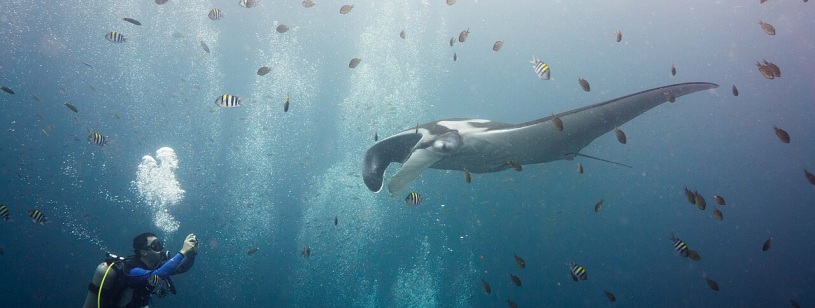
Giant oceanic manta ray, Mobula birostris, swimming near a diver with its wing-like pectoral fins extended. · Daniel Sasse / CC BY-SA 4.0 (https://creativecommons.org/licenses/by-sa/4.0). Cropped and resized.
The giant oceanic manta ray, Mobula birostris, is a cartilaginous fish with exceptionally broad pectoral fins. Underwater it appears to fly above the reef. Despite its imposing size and devil-like common names, it feeds mainly on small planktonic organisms. The two projections beside the mouth help guide water inward rather than serving as attacking horns.
Quick facts
| Common name | Giant oceanic manta ray |
| Scientific name | Mobula birostris |
| Longevity | Estimated around 40 years; direct data remain limited |
| Diet | Filter feeder, mainly zooplankton |
| Main predators | Large sharks |
| Conservation status | Endangered (EN) |
| Distribution | Tropical, subtropical and some temperate oceans |
| Habitat | Open ocean, oceanic islands and productive coastal areas |
| Dimensions | Body disc commonly around 4–5 m across |
| Family | Mobulidae |
| Reproduction | Usually one live pup |
| Distinctive feature | Cephalic lobes guide water towards the mouth |
- Primary category:Fish
- Explore this animal's categories:
Interesting facts
- Broad pectoral fins resemble two wings.
- The lobes beside the mouth assist feeding.
- Belly markings can identify individual animals.
- A female usually produces one pup at a time.
Characteristics
The body forms a broad disc with extended pectoral fins. Eyes sit on the sides of the head and the mouth opens forward, while gill slits lie underneath.
Colour is often dark above and paler below, although very dark forms occur. Belly spots can be compared in photographs for identification. Size is commonly expressed as disc width between fin tips: a span of four to five metres is not the same measurement as head-to-tail length.
Behaviour
Broad fin strokes propel the manta between feeding areas. It can appear seasonally near islands or productive coastlines.
Although often seen alone, individuals gather to feed or at cleaning stations where small fish remove parasites. Electronic tags also reveal deep dives. Its life is therefore not confined to the shallow reefs where underwater photographs are easiest to obtain.
Habitat and distribution
Mobula birostris occupies tropical and subtropical regions and also some temperate waters. The open ocean is an important part of its habitat.
Oceanic islands, seamounts and food-rich coastlines can temporarily concentrate individuals. Currents and plankton availability help shape these movements. Protecting one popular observation site cannot cover all places used by a mobile animal throughout its life.
Diet and feeding
The manta mainly filters zooplankton, small animals suspended in water, including crustaceans and larvae. Large quantities of tiny prey support its enormous body.
During feeding, the cephalic lobes unfurl and guide water into the wide mouth. Filtering structures retain food as water continues across the gills. Repeated rolls can keep the animal within a dense food patch. These movements serve feeding rather than entertaining observers.
Reproduction and life cycle
An oceanic manta usually produces one live pup. Development takes place inside the female and the young emerges fully formed and able to swim.
Such low reproductive output makes population recovery slow. Losing adult females can have major effects even where several animals are still seen together. Wild reproduction remains incompletely understood, and details from reef mantas should not automatically be transferred to this oceanic species.
Name and history
Devil-like common names can refer to several related rays. This article specifically concerns Mobula birostris, the giant or oceanic manta ray.
Older sources use Manta birostris, whereas current classification places it in Mobula. The reef manta, Mobula alfredi, is a different species. The apparent horns are cephalic lobes adapted for feeding, rather than attacking structures. Like other rays, the animal has a cartilaginous skeleton.
Conservation and threats
The species is globally Endangered. Targeted fishing and accidental capture in various fishing gears are major threats, including demand for gill plates.
Slow reproduction limits recovery from losses. Reducing catches and protecting important sites require long-term monitoring. Responsible observation maintains distance and leaves travel routes open. Conservation depends on allowing mantas to feed, move and reproduce without repeated disturbance.
Frequently asked questions
Is the giant manta a mammal?
No. It is a cartilaginous fish that breathes through gills.
What do the projections beside its mouth do?
The cephalic lobes guide water and food into the mouth during filtering.
Does it eat large animals?
Its diet consists mainly of zooplankton, small animals suspended in water.
Why do populations recover slowly?
Females produce few young, usually one at a time, and reproduction is slow.