Ara macawAra — habitat, diet and reproduction
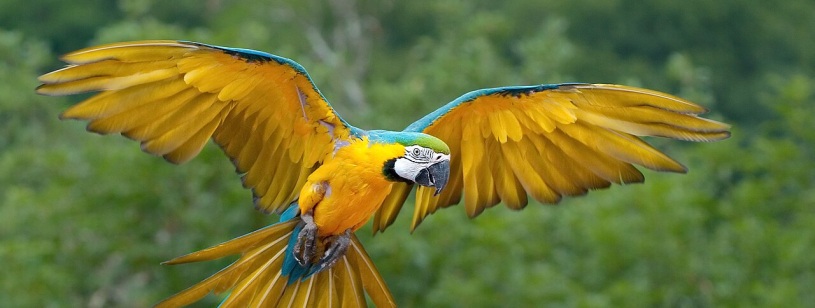
A blue-and-yellow macaw (Ara ararauna) in flight. · Luc Viatour / CC BY 2.0 (https://creativecommons.org/licenses/by/2.0). Cropped and resized.
Ara macaws are tropical parrots with long tails, powerful bills and areas of bare facial skin. They live in Central and South America, often moving in pairs or groups. The genus includes red, green and blue-and-yellow birds. The photograph shows Ara ararauna, the blue-and-yellow macaw.
Quick facts
| Common name | Ara macaw |
| Scientific name | Ara, a genus containing several species |
| Lifespan | Variable; blue-and-yellow macaws may reach around 60 years in human care |
| Length | Around 86 cm in Ara ararauna, including the tail |
| Weight | About 1–1.3 kg in Ara ararauna |
| Diet | Fruit, seeds, nuts and other plant material |
| Predators | Large birds of prey; snakes and other nest predators |
| Conservation status | Varies: Ara ararauna LC; Ara ambiguus CR |
| Distribution | Central and South America, depending on species |
| Habitat | Tropical forest and other wooded habitats |
| Family | Psittacidae |
| Nest | Usually a tree cavity |
- Primary category:Birds
- Explore this animal's categories:
Interesting facts
- Partners may fly very close together even within a larger flock.
- The bill assists climbing as well as opening food.
- Some species gather on riverbanks to eat clay-rich soil.
- Young birds spend extended periods with their parents, learning feeding locations and techniques.
Characteristics
A long tail creates the characteristic silhouette. Wings carry birds between feeding and roosting sites, while the feet grip branches. Toes can hold a fruit as the bill opens it.
Blue-and-yellow macaws have blue upperparts, yellow underparts and green foreheads. Fine feather lines cross the pale face. Great green macaws are mainly green with very large bills. Size and colour vary between species, so measurements need a specific identification.
Behaviour
Partners maintain bonds through proximity, food sharing and preening. Pairs can join larger groups while staying in contact. Loud calls help birds locate one another through vegetation.
Morning movements lead to feeding areas. Feeding alternates with resting and exploration before birds return to roost in the evening. These curious parrots manipulate and chew objects, using their bills to investigate.
Habitat and distribution
Ara species occupy different parts of tropical America. Some use humid forest; others inhabit more open landscapes or woodland along waterways.
Blue-and-yellow macaws range widely through South America and reach Panama. Flooded forests and palm-rich areas provide suitable habitat. Great green macaws depend heavily on forests containing large trees. Connected forest patches help birds reach dispersed resources.
Diet and feeding
Fruit, seeds and nuts form an important part of the diet. Strong bills open coverings that other birds find harder to process. Flowers and other plant material supplement these foods.
Some populations visit clay banks. Research considers sodium supply and binding of certain dietary compounds among possible benefits; the role varies with location and soil.
Trees produce food at different times. Birds therefore need landscapes providing resources across seasons.
Reproduction and life cycle
Many species use tree cavities, including those in palms and dead trees. Pairs may return to suitable nesting areas. Females incubate while males contribute food.
Blue-and-yellow macaws usually lay two to four eggs. Young spend roughly 90–100 days in the cavity before fledging. Both parents feed them. Early flights are followed by further learning, with feeding trees and safe roosts remaining important.
Name and history
Ara is a genus in the family Psittacidae. Common names for large, long-tailed parrots are sometimes used more broadly. The English word macaw includes birds in other genera.
This page uses Ara ararauna for the photograph and illustrative measurements. Other members of the genus have their own adaptations and conservation needs.
Conservation and threats
Blue-and-yellow macaws are Least Concern, whereas great green macaws are Critically Endangered. These categories reflect each species’ population and habitat situation.
Deforestation removes food and nesting trees. Capture for trade can intensify declines. Retaining large trees and forest connections supports these birds and other tropical wildlife.
Frequently asked questions
Are all Ara macaws blue and yellow?
The genus contains several colour combinations. Ara ararauna is the blue-and-yellow species shown here.
Why do they need old trees?
Large trees can provide nesting hollows as well as food and resting places.
Can an Ara macaw learn sounds?
Some individuals imitate sounds and words. Their natural calls remain loud, and abilities vary.
Do Ara and macaw mean exactly the same thing?
Ara is a scientific genus. Macaw is a broader common name covering several parrot genera.