YakBos grunniens — habitat, diet and reproduction
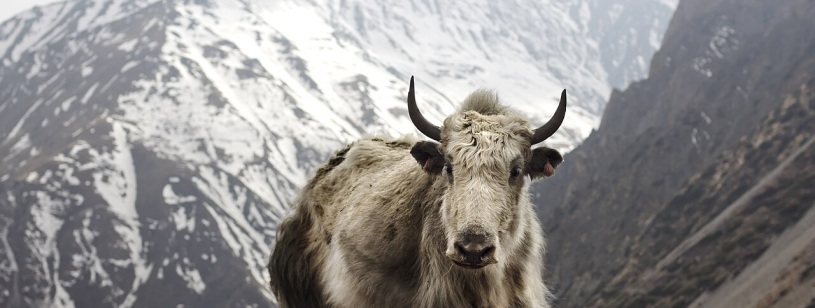
Domestic yak (Bos grunniens) in a mountain landscape. · travelwayoflife / CC BY-SA 2.0 (https://creativecommons.org/licenses/by-sa/2.0). Cropped and resized. Source: https://commons.wikimedia.org/wiki/File:Bos_grunniens_at_Letdar_on_Annapurna_Circuit.jpg
The domestic yak (Bos grunniens) is a long-haired bovine adapted to the cold mountains of Asia. It grazes short plants and provides transport, milk and textile fibres. The wild ancestor is called Bos mutus. Both are associated with highlands, but differ in size and their relationship with people.
Quick facts
| Common name | Domestic yak |
| Scientific name | Bos grunniens; wild form: Bos mutus |
| Lifespan | Can reach approximately 20 years under human care |
| Height | Around 1.1–1.3 m at the shoulder in adult populations described by FAO; varies by breed |
| Weight | Example domestic ranges: males 350–580 kg, females 225–255 kg; populations vary |
| Diet | Grasses and other pasture plants; ruminant herbivore |
| Predators | Wolves, particularly for calves or vulnerable animals |
| Conservation status | Domestic form not assessed as a wild species; wild yak Vulnerable |
| Distribution | Tibetan Plateau, Himalayas and other Asian mountain regions; raised elsewhere too |
| Habitat | Cold highland meadows and steppes |
| Family | Bovidae |
| Reproduction | Usually one calf; average gestation approximately 258 days |
- Primary category:Bovids
- Explore this animal's categories:
Interesting facts
- Long outer hairs cover a fine insulating undercoat.
- The densely haired tail has a horse-like appearance.
- Flexible lips and the tongue help gather short pasture plants.
- Herders use milk, fibres and the animal’s carrying strength.
Records and extremes
Yaks are among domestic animals particularly suited to cold highland grazing. FAO describes them commonly living at approximately 2,000–5,000 m, with suitable elevations also influenced by latitude.
A large chest and respiratory adaptations help use thin air. A compact body, small ears and insulating coat conserve heat but contribute to heat sensitivity.
Under human care, lifespan can reach around 20 years. Food, health and management influence survival.
Characteristics
The robust body has strong legs and prominent shoulders. Long hair drapes over the chest, sides and lower body, covering fine insulating fibres.
Domestic coats can be black, brown, white or pied. Horns differ between sexes and populations, and some individuals are hornless. Males are generally larger.
Wild yaks are usually larger and more uniformly dark. Measurements therefore need to distinguish domestic and wild forms, sex and population.
Behaviour
Domestic herds follow daily cycles of grazing, resting and chewing cud. Seasonal movements reflect pasture availability and herding practices.
Higher pastures may be used in warmer months. Winter snow and wind complicate access to food and shelter.
Strong limbs and suitable hooves support movement over difficult terrain. Sure-footedness makes yaks valuable pack animals.
Habitat and distribution
The Tibetan Plateau and surrounding regions form the centre of domestic distribution. Yaks are raised in the Himalayas, Pamir, Altai and other Asian highlands, as well as elsewhere.
Cold meadows, steppes and low vegetation support grazing. Water, food and accessible routes shape herd movements.
The wild form occupies a more restricted, fragmented range. Domestic herds also depend on how people manage their pastures.
Diet and feeding
Grasses, sedges and other pasture plants form the diet, sometimes supplemented by tender shrub growth. Food choices vary seasonally.
As ruminants, yaks bring partly swallowed food back to the mouth for further chewing. Stomach microorganisms help break down plant fibres.
Summer feeding rebuilds body reserves. Winter shortages can cause weight loss, affecting health and reproduction.
Reproduction and life cycle
Breeding usually occurs during warmer months. Gestation averages around 258 days and normally produces one calf.
Birth timing is linked to improving conditions and food supply. Calves stand and follow their mother soon after birth, relying initially on milk.
Under traditional highland conditions, females may calve once every two years. Nutrition and body condition strongly influence this interval.
Name and history
Linnaeus named the domestic form Bos grunniens in 1766. Bos mutus is used for the wild yak. Both belong to Bovidae.
Yak husbandry has a long history in mountain Asia. Milk becomes butter and cheese, while fibres make garments, ropes and tents. Yaks carry loads over difficult routes.
Dried dung traditionally supplies fuel in areas with little wood. The balance of products and customs differs among communities.
Conservation and threats
Domestic yaks do not share the conservation status of wild populations. The wild yak is classified as Vulnerable.
Healthy pasture, winter food and locally adapted domestic populations are important for husbandry. Heavy grazing can reduce resources, while heat creates difficulties for a cold-adapted animal.
Where domestic and wild herds meet, competition and disease transmission are concerns. Managing contact and protecting natural habitat support both.
Frequently asked questions
Is the yak domestic or wild?
Both forms exist: domestic Bos grunniens and wild Bos mutus.
Why is the coat so long?
Long outer hair and fine underfur protect the body in cold conditions.
What does it eat?
Grasses and other plants, processed through ruminant digestion.
Does it tolerate heat well?
Its cold adaptations can make high temperatures difficult.
How many calves are born?
Usually one after an average gestation of around 258 days.
Why do people keep yaks?
For milk, fibres, meat and transport, according to local needs and traditions.