Black Sea turbotScophthalmus maeoticus — habitat, diet and reproduction
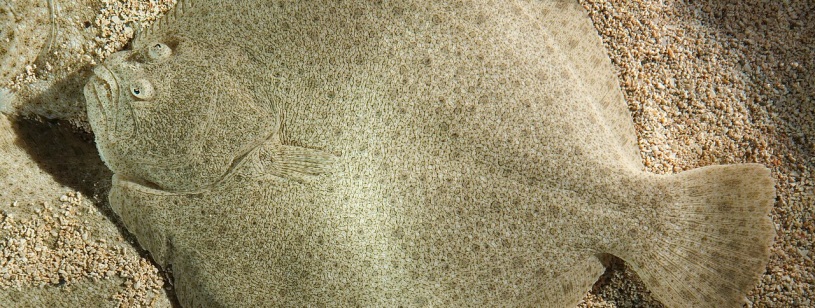
Atlantic turbot (Scophthalmus maximus), a very close relative of the Black Sea turbot, camouflaged on sand. · Luc Viatour / CC BY-SA 3.0 (http://creativecommons.org/licenses/by-sa/3.0/). Cropped and resized.
The Black Sea turbot is a flatfish that lies on the floor of the Black Sea with both eyes on the upper side of its body. Its skin bears hard bony knobs and changes shade to match the sand beneath it. It is one of the most sought-after fish on the Romanian coast.
Quick facts
| Common name | Black Sea turbot, kalkan |
| Scientific name | Scophthalmus maeoticus |
| Lifespan | Several years; large fish may exceed 10 years |
| Length | Usually a few tens of centimetres |
| Diet | Carnivore: small fish, crabs, shrimp, mussels |
| Predators | Spiny dogfish and dolphins; people through fishing |
| Conservation status | Not separately assessed on the Red List; fished under quotas |
| Distribution | Black Sea, Sea of Azov and Sea of Marmara |
| Habitat | Sand and mud bottoms, from shallow water to about 100 m |
| Family | Scophthalmidae |
| Reproduction | Eggs that float in the water |
- Primary category:Fish
- Explore this animal's categories:
Interesting facts
- A young turbot first swims like any other fish, with one eye on each side; then one eye “migrates” to the other side.
- The upper side is mottled like sand, and the underside is white.
- The bony knobs on its skin, called “buttons”, distinguish it from the Atlantic turbot.
- A turbot can bury its body in sand, leaving only its eyes showing.
Characteristics
The turbot has an almost round, very flat body with long fins along the edges. Both eyes are on the left side, which always faces up. This side is grey-brown and mottled, while the underside resting on the bottom is white.
Large, hard bony knobs are scattered on both sides of the skin. The mouth is large, suited to catching fish.
Behaviour
The turbot spends most of its time motionless on the bottom, hiding by changing shade and covering itself with a thin layer of sand.
It hunts by ambush: when a small fish passes, it rises suddenly and swallows it. During the year it moves between deeper water and areas closer to shore, especially in spring when it breeds.
Habitat and distribution
The Black Sea turbot lives in the Black Sea, the Sea of Azov and the Sea of Marmara. It was long considered the same species as the Atlantic turbot, but researchers now treat it as separate.
In Romanian waters it lives on sand and mud bottoms, from near the shore to depths of about 100 m.
Diet and feeding
The turbot is a predator, eating small fish such as anchovy, sprat, horse mackerel and gobies, as well as crabs, shrimp and mussels.
Young turbot eat mainly small crustaceans. Through its prey, the turbot sits near the top of the seabed food chain.
Reproduction and life cycle
Turbot breed in spring, when they come closer to the coast. The female releases a very large number of eggs that float in the water.
Larvae first live in open water with symmetrical bodies. As they grow, the body flattens, one eye moves to the other side and the fish settles on the bottom.
Name and history
The Romanian name “calcan” comes from the Turkish “kalkan”, meaning “shield”, after its broad body and hard knobs. The scientific name Scophthalmus maeoticus recalls Lake Maeotis, the ancient name of the Sea of Azov.
The turbot is related to other flatfish such as flounder, all of which have both eyes on the same side.
Conservation and threats
The Black Sea turbot has not been assessed separately on the Red List. Fishing in the Black Sea is limited by annual quotas, and there is a closed season in spring.
Turbot nets also catch harbour porpoises by accident, harming this endangered marine mammal.
Frequently asked questions
Why does the turbot have its eyes on one side?
The young fish has one eye on each side, but as it grows one eye moves next to the other so it can live lying on the bottom.
What does the turbot eat?
Small fish such as anchovy and gobies, plus crabs, shrimp and mussels.
When is turbot fishing banned?
There is a closed season in spring during breeding; exact dates are set each year by the authorities.
Is the Black Sea turbot the same as the Atlantic one?
They look very similar, but researchers now consider it a separate species, Scophthalmus maeoticus.