QuokkaInteresting facts and information
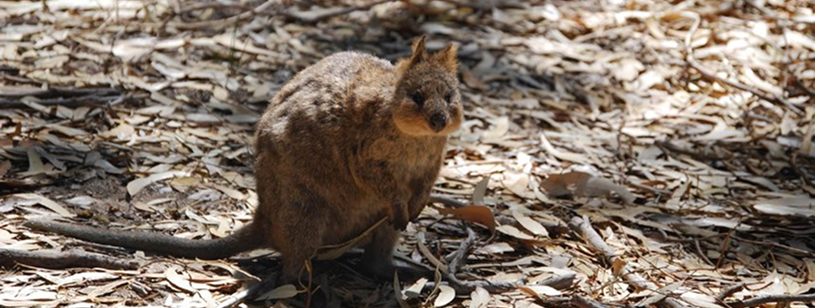
The quokka (Setonix brachyurus) is a small marsupial native to southwestern Australia. It feeds on plants and uses dense vegetation for shelter. Its apparent smile reflects its facial appearance and does not establish that it is happier than other animals.
Quokkas occur in southwestern Australia, including mainland populations and the islands of Rottnest and Bald. Introduced predators are an important threat; quokkas remain wild animals.
Quokkas face threats from habitat loss and introduced predators. Island and mainland populations need separate descriptions.
Quick facts
| Common name | Quokka |
| Scientific name | Setonix brachyurus |
| Typical lifespan | About 5-10 years in the wild, up to about 15 years in captivity |
| Maximum speed | Varies with species or individual, distance and conditions |
| Size | About 40 - 54 cm long, plus a 25 - 30 cm tail |
| Weight | About 2.5 - 5 kg |
| Diet type | Herbivore (feeds on grass, leaves, shoots, bark) |
| Main predators | Introduced foxes and cats, dogs, dingoes, birds of prey, snakes |
| Conservation status | Vulnerable (IUCN); mainland populations are small and declining |
| Habitat | Forests, dense scrub, swamps and islands of south-western Australia |
- Primary category:Mammals
- Explore this animal's categories:
Interesting facts
- The famous "smile" - The quokka's cheerful look comes from the natural shape of its mouth and face; it is not a sign that the animal is happy.
- Little need to drink - Quokkas get much of the water they need from the plants they eat.
- Surviving dry summers - On Rottnest Island, quokkas can survive long, dry summers with very little fresh water.
- Climbing - Unlike most kangaroos, quokkas can climb into low shrubs and small trees to reach leaves.
- Self-defence - Although they look harmless, quokkas can scratch, bite and kick with their hind feet if handled.
- A short tail - Their tail is much shorter than a kangaroo's and is not used as a support when standing.
- A famous myth - It is often said that quokka mothers throw their young to predators; in reality, a joey may fall out of the pouch when its mother flees, and this behaviour is poorly documented.
Records and remarkable features
- The quokka (Setonix brachyurus) is a small marsupial native to southwestern Australia. It feeds on plants and uses dense vegetation for shelter. Its apparent smile reflects its facial appearance and does not establish that it is happier than other animals.
Physical characteristics and adaptations
The quokka is a small, cat-sized member of the kangaroo family with many adaptations for life in dry coastal and island habitats.
Distinguishing physical appearance
- Compact size - The quokka's body is about 40-54 cm long, and its tail measures about 25-30 cm.
- Thick grey-brown fur - It helps the quokka blend in with dry vegetation.
- Round ears and small dark eyes - They give it a rounded, friendly face.
- Strong hind legs - Like kangaroos, quokkas hop on their hind legs.
Adaptations for survival
- Coping with drought - Quokkas can survive dry periods by getting water from plants and saving water in their bodies.
- Fat reserves - Quokkas store some fat, including at the base of the tail, which helps them through lean times.
- The pouch - The young, called a joey, stays in its mother's pouch for about six months.
- Teeth for plants - Their teeth are suited to cutting and grinding tough leaves and grasses.
- Avoiding the heat - Quokkas are most active at night and in the cooler hours of the day.
Habits and behaviour
Quokkas are curious animals that live in family groups and share feeding areas.
Social behaviour and hierarchy
- Groups - Quokkas live in groups that share a home area, especially around shelter and water.
- Dominant males - Larger males are dominant and get the best resting places in hot weather.
- Communication - Quokkas use soft calls, body language and scent.
Living mode and daily routines
- Mostly nocturnal - Quokkas usually rest by day in dense vegetation and feed at night; on Rottnest Island, many are also active by day near people.
- Shared feeding areas - Groups use the same feeding areas and paths through the vegetation.
- Tunnels in vegetation - Quokkas make runways and tunnels through dense scrub, which they use to move and hide.
Survival strategies
- The "smile" is not a sign of joy - It is simply the shape of the quokka's face.
- Fast escape - When threatened, quokkas hop quickly into dense vegetation.
- Shelter - Thick scrub protects them from heat and predators.
Habitat and geographic distribution
The quokka lives only in south-western Australia, on two islands and in scattered areas of the mainland.
Geographical distribution
| Region | Estimated population |
|---|---|
| Rottnest Island | About 10,000-12,000 animals |
| Bald Island | Several hundred to about 1,000 animals |
| Mainland south-western Australia | Small, scattered groups, in total a few thousand animals |
Habitats
- Forests and dense scrub - On the mainland, quokkas live in forests and swamps with thick undergrowth.
- Islands - On Rottnest and Bald Islands, where there are no foxes, quokkas are much more common.
- Dry areas - They cope with long, dry summers.
Habitat threats
- Habitat loss - Clearing of forests and scrub has reduced the areas where quokkas can live.
- Introduced predators - Foxes and cats are the main threat on the mainland.
- Bushfires - Large fires can destroy the dense vegetation that quokkas need.
- Climate change - Hotter, drier conditions can affect food and water.
Diet and feeding
The quokka is a herbivore that eats grasses, leaves, shoots and other plant parts. It can get much of the water it needs from its food.
What does the quokka eat?
| Food type | Examples |
|---|---|
| Grasses | Native grasses and sedges |
| Leaves | Leaves of shrubs and small trees |
| Shoots and stems | Young shoots and succulent plants |
| Bark | Bark of shrubs, in dry periods |
| Flowers and seeds | Eaten when available |
| Roots | Sometimes dug up in dry periods |
Food behaviour
- Feeding at night - Quokkas feed mainly at night, when it is cooler.
- Using their front paws - They hold leaves and stems with their front paws while eating.
- Digestion - Like kangaroos, they have a large, chambered stomach in which microbes help digest tough plants, and they bring food back up to chew again.
- Climbing for food - They climb into shrubs to reach fresh leaves.
Adaptations to arid environments
- Water from food - They get much of their water from plants.
- Resting in the shade - On hot days, they rest in shady places to avoid losing water.
- Saving water - Their kidneys help them save water during dry periods.
Reproduction and life cycle
Quokkas usually have one young a year, and like kangaroos they can keep a spare embryo in reserve.
Mating and gestation
| Characteristic | Details |
|---|---|
| Sexual maturity | About 1-2 years |
| Breeding season | Mainly late summer and autumn on Rottnest Island; all year round on the mainland |
| Pregnancy period | About 27 days |
| Number of young | 1 joey at a time |
| Time spent in the pouch | About 6 months |
| Independence | At about 8-10 months |
Survival strategies
- Embryonic diapause - After giving birth, the female can mate again and keep the new embryo dormant; if the first joey dies, the spare embryo starts to develop.
- The pouch - The newborn joey crawls into the pouch, attaches to a teat and stays there for about six months.
- Leaving the pouch - After leaving the pouch, the young stays close to its mother and still drinks her milk for a few months.
Longevity
- In the wild, quokkas usually live about 5-10 years.
- In captivity, they can live up to about 15 years.
Name and history
Origin of the name "Quokka"
- The word "quokka" comes from a Noongar word, often written gwaga, used by Aboriginal people of south-western Australia.
- In 1696, the Dutch explorer Willem de Vlamingh thought quokkas were giant rats and named their island "Rottnest", meaning "rat's nest".
Taxonomic Classification
| Kingdom | Animalia |
|---|---|
| Phylum | Chordata |
| Class | Mammalia |
| Order | Diprotodontia |
| Family | Macropodidae |
| Genus | Setonix |
| Species | Setonix brachyurus |
History and documentation
- Early European reports - Dutch sailors described quokkas on Rottnest Island in the 17th century.
- Aboriginal knowledge - Noongar people knew the quokka long before Europeans arrived.
- Decline - In the 20th century, mainland quokkas declined sharply after foxes were introduced.
Cultural significance and mythology
The quokka has become one of the best-known symbols of Western Australia and of Australian wildlife.
- Rottnest Island - The quokka is the island's most famous resident and its main tourist attraction; the island's Noongar name is Wadjemup.
- Quokka selfies - Since the 2010s, photos of tourists with smiling quokkas have become an internet trend.
- Famous visitors - Celebrities such as the tennis player Roger Federer have posed for quokka selfies, which made the animal even more famous.
Conservation status and threats
The quokka is listed as Vulnerable by the IUCN. Its numbers on the mainland have fallen sharply because of habitat loss and introduced predators.
Main threats
- Habitat loss - Clearing of land for farming and building has greatly reduced quokka habitat.
- Introduced predators - Red foxes and cats kill many quokkas on the mainland; dogs are also a threat.
- Bushfires - Large fires can wipe out small mainland groups.
- Climate change - Rising temperatures and less rain can affect quokka populations.
Conservation status
| Population | Status |
|---|---|
| Species as a whole | Vulnerable (IUCN) |
| Rottnest and Bald Islands | Relatively stable; no foxes |
| Mainland Australia | Small, scattered and declining populations |
Conservation efforts
- Protected areas - National parks and reserves protect mainland quokka habitat.
- Predator control - Programmes reduce the number of foxes and cats in areas where quokkas live.
- Rules for tourists - On Rottnest Island, it is illegal to touch or feed quokkas, and offenders can be fined.
- Education - Campaigns encourage people to respect quokkas as wild animals.
In popular culture
Quokkas online
- "The happiest animal in the world" - Because of its smiling face, the quokka is often called this in news stories and on social media.
- Quokka selfies - The hashtag #quokkaselfie made the quokka world-famous.
Quokkas as symbols
- Tourism - The quokka is used to promote Rottnest Island and Western Australia.
- Souvenirs - Quokka toys and images are popular souvenirs in Western Australia.