PigInteresting facts and information
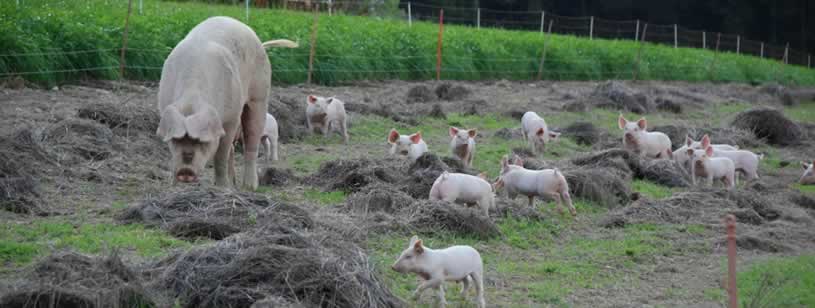
The domestic pig (Sus scrofa domesticus) is an omnivorous mammal descended from the wild boar (Sus scrofa). People have raised pigs for thousands of years. Pigs can learn tasks, remember places and interact with other members of their group, but simple rankings against other animals are misleading.
Pigs are highly adaptable and live in many environments, from industrial farms and traditional smallholdings to the wild, where feral populations have spread rapidly. In some places, wild and feral pigs have become invasive species that harm local ecosystems.
In many cultures, the pig is both an important source of food and a cultural or religious symbol. In some traditions it is considered unclean (Islam, Judaism), while in others it is a symbol of prosperity and plenty (China, parts of Europe).
Quick facts
| Common name | Pig |
| Scientific name | Sus scrofa domesticus |
| Typical lifespan | Can live well into its teens or longer in suitable care; farm slaughter age is not its natural lifespan |
| Maximum speed | About 17 km/h for domestic pigs |
| Height | 50-110 cm (at the withers) |
| Length | 100-180 cm |
| Weight | 50-350 kg (depending on breed) |
| Diet type | Omnivore; a managed diet must meet nutritional and animal-health requirements |
| Main predators | Piglets can be taken by large carnivores; predators vary by region |
| Conservation status | Domestic animal; some traditional breeds need conservation of their genetic diversity |
| Geographic distribution | Worldwide; adapts to many climates |
| Social behaviour | Lives in groups; intelligent and communicative |
| Special adaptations | Excellent sense of smell, very good memory, quick learning |
- Primary category:Mammals
- Explore this animal's categories:
Interesting facts
- Pigs are among the most intelligent domestic animals – Studies show they have an excellent memory, can learn to respond to words and signals, and learn tricks about as quickly as dogs.
- They recognise faces and remember others – Pigs remember other individuals and can form complex social relationships.
- They have an extremely good sense of smell – That is why pigs have been used for truffle hunting and, in some places, for detecting other substances.
- Pigs barely sweat – They have very few working sweat glands, so they cool down by wallowing in mud or water, which also protects them from the sun and insects.
- They are clean animals – Despite their reputation, pigs keep their sleeping and feeding areas separate from their toilet area when they have enough space.
- A wide range of sounds – Pigs use more than 20 different calls to express emotions, warn of danger or call their piglets.
- They can solve problems – Experiments show that pigs can use a mirror to find hidden food, solve simple puzzles and learn by watching others.
- Some small breeds are kept as pets – Pot-bellied pigs and so-called "mini" pigs are popular in some countries, although many grow much larger than expected.
Records and remarkable features
- Small breeds – Some miniature pig breeds stand under about 40 cm tall, although "teacup" pigs often grow bigger than buyers expect.
- Long-lived pigs – Some pet pigs have lived for more than 20 years.
- Huge litters – Sows usually have 8-12 piglets, but some modern breeds have litters of 30 or more on record.
- Surprisingly fast – Although heavy, domestic pigs can run at about 17 km/h over short distances, and wild boar much faster.
Characteristics
The pig is a sturdy animal with a compact, strong body that adapts to many environments. Although it is usually associated with farms, its body also allows it to survive in the wild.
Physical appearance
- Variable size – Pigs stand about 50 cm to 1.1 m tall and weigh from about 50 kg (small breeds) to more than 350 kg (large breeds).
- Heavy body and strong legs – Their build helps them dig and turn over the soil in search of food.
- A large head with a long, sensitive snout – The snout is full of touch and smell receptors, so pigs can find food buried in the ground.
- Thick skin with sparse hair – Some breeds, such as the Mangalica, have a thick, woolly coat, but most have thick skin with sparse bristles.
- Mobile ears – Many breeds have large ears that can turn towards sounds.
- A short, curly tail – Can show a pig's mood: a curled or wagging tail often means a relaxed pig, while a tucked tail can signal stress.
Special adaptations
- A superb sense of smell – Pigs can detect food and other smells from far away, which is why they are used for truffle hunting.
- An efficient digestive system – They can eat a wide variety of foods, including food waste, which made them ideal for domestication.
- Intelligent and easy to train – Pigs learn tricks and commands quickly.
- Health depends on many factors – Genetics, living conditions, nutrition and veterinary care all influence disease risk.
Habits and behaviour
Pigs are highly social and intelligent animals with a wide range of behaviours linked to feeding, social life and defence.
Social behaviour
- They live in groups – In the wild, pigs form groups of about 5-20, usually made up of related females and their young; adult males often live alone.
- Complex communication – They grunt, squeal and make low sounds, each with a particular meaning, for example calling piglets, warning of danger or asking for food.
- A strong social memory – They recognise other pigs, people and familiar places after months or even years.
- They form hierarchies – When feeding and resting, there is a clear pecking order, and larger pigs dominate smaller ones.
Defence and survival techniques
- Running and hiding – Although they are heavy, domestic pigs can run at about 17 km/h and hide in thick vegetation.
- Tusks for defence – Boars and wild male pigs have long, sharp tusks that they use to defend themselves.
- Protective mothers – Sows guard their piglets and can become aggressive if they sense danger.
- Mud baths – Covering the body with mud protects against insect bites and helps lower body temperature.
Habitat and geographic distribution
Domestic and wild pigs are found on every continent except Antarctica, thanks to their adaptability.
| Region | Species or breeds | Habitat examples |
|---|---|---|
| Europe | Domestic pigs, Mangalica, wild boar (Sus scrofa) | Forests, farms, pastures |
| North America | Feral pigs and hybrids, domestic pigs | Pastures, farmland |
| Asia | Vietnamese pot-bellied pig, Asian wild boar | Forests, wetlands |
| Africa | Bushpig (Potamochoerus larvatus), warthogs, domestic pigs | Savannas, forests |
| Australia | Feral pigs | Dry areas, tropical forests |
Habitat types
- Forests and wetlands – Wild boar prefer dense areas where they can find food and shelter.
- Farms and pastures – Domestic pigs are raised on industrial farms or outdoors on pasture.
- Jungles and savannas – Feral pigs can survive in very hot or very cold areas thanks to their adaptability.
Human pressures and threats
- Deforestation and farming – Habitat loss affects wild pig species.
- Feral pigs as an invasive species – In Australia, the USA and South America, feral pigs damage crops and natural habitats.
- Intensive farming – Domestic pigs are raised intensively for meat and other products, which raises animal welfare concerns.
Diet and feeding
The pig is an opportunistic omnivore, which means it can eat a wide range of foods, from plants to meat, and adapts easily to what is available.
What do pigs eat?
| Type of food | Examples |
|---|---|
| Plants | Grass, roots, tubers, leaves |
| Fruit and nuts | Acorns, apples, pears, chestnuts |
| Cereals | Maize, barley, wheat, oats |
| Vegetables | Potatoes, beets, carrots |
| Animal food | Insects, worms, small animals such as mice |
| Food scraps | Leftovers (now restricted in many countries for disease reasons) |
| Farm feed | Balanced feed, mineral supplements |
Feeding techniques
- Rooting – Using their powerful snout, pigs dig for roots, tubers and insects.
- Efficient eating – They eat quickly and digest efficiently, getting nutrients from a wide range of foods.
- Food preferences – Although they are omnivores, pigs have clear food preferences and learn to avoid unsuitable food.
Adapting to food supply
- Seasonal food – In summer, wild pigs eat more fresh fruit and plants, and in autumn and winter more roots and acorns.
- Surviving lean times – Feral pigs can eat bark or even carcasses when food is scarce.
- Food memory – They remember where they found food and return to the same places.
Reproduction and life cycle
Pigs are prolific animals with large litters and frequent breeding cycles.
| Feature | Details |
|---|---|
| Age at maturity | 5-8 months |
| Mating season | All year round on farms; mainly autumn and winter in wild boar |
| Type of reproduction | Live birth (mammal) |
| Piglets per litter | Litter size varies with breed, age and condition of the sow |
| Pregnancy | About 114 days ("three months, three weeks and three days") |
| Nursing | 4-6 weeks on farms; longer in natural conditions |
| Lifespan | About 15-20 years as pets; wild boar usually much less |
Reproduction
- Mating – Sows come into heat about every 3 weeks, and males (boars) compete for the chance to mate.
- Short pregnancies – On farms, sows can have more than two litters a year, which makes pigs among the most prolific domestic animals.
- Well-developed piglets – Piglets can stand and suckle within minutes of birth.
- Nursing and protection – The sow nurses her piglets for several weeks and defends them fiercely.
- Social bonds – Piglets form close bonds with their littermates and learn from their mother which foods are safe.
Survival strategies
- Fast growth – On farms, a piglet can reach about 100 kg in 6 months.
- Safety in numbers – Sows and their young stay together in groups.
- Frequent breeding – Lets wild populations recover quickly, even when they are hunted.
Name and history
The pig was domesticated about 9,000-10,000 years ago and was one of the first animals raised by people.
Origin of the name
- The word "pig" appeared in English in the Middle Ages and its origin is uncertain; the word "pork" comes from Latin porcus, "pig", through French.
- The scientific name Sus scrofa domesticus comes from Latin and shows that the domestic pig descends from the wild boar, Sus scrofa.
The pig in human history
- The Neolithic – Pigs were domesticated separately in the Middle East and China, where they became an important source of food.
- The Roman Empire – The Romans raised pigs for meat and fat and developed ways of preserving meat, such as ham and sausages.
- The Middle Ages – In Europe, pigs were often allowed to roam in forests and villages, where acorns and chestnuts were an important food.
- The 20th century – Industrialisation led to pigs being raised on large farms, with breeding focused on productivity.
The pig in folklore and superstition
- A symbol of plenty – In China, the pig is a sign of good luck and fertility and is one of the zodiac animals.
- Forbidden in some religions – In Islam and Judaism, pork is forbidden and considered unclean.
- European traditions – In parts of Europe, eating pork on New Year's Day is said to bring good luck for the year ahead.
- Norse mythology – The god Freyr had a golden boar, Gullinbursti, a symbol of fertility.
Cultural significance and mythology
Throughout history, the pig has been both honoured and despised. In some societies it is a symbol of luck and fertility, while in others it is associated with impurity and greed.
The pig in mythology and religion
- Norse mythology – The pig was a symbol of fertility and plenty. The god Freyr had a boar called Gullinbursti, whose golden bristles lit up the darkness.
- China and the Chinese zodiac – In Chinese culture, the pig is a symbol of luck, prosperity and plenty. People born in the Year of the Pig are traditionally described as hard-working, kind and generous.
- The Bible and the Quran – In Judaism and Islam, pork is considered unclean and is forbidden. Scholars have proposed various explanations for the origin of this rule.
- Ancient Egypt – The sky goddess Nut was sometimes shown as a sow suckling piglets, which stood for the stars.
The pig in folklore and superstition
- The lucky pig – In Germany and Austria, marzipan pigs are given at New Year to bring luck and plenty.
- "Lucky as a pig" – In German, "Schwein haben" (literally "to have a pig") means to be lucky.
- Pigs and the weather – Old country sayings link the way pigs behave with changes in the weather.
- Dreams – In some cultures, dreaming of a pig is said to be a sign of coming wealth.
- Bad omens – In some rural traditions, a pig escaping from the yard was seen as a sign of bad luck.
Conservation status and threats
The domestic pig is not threatened, but some traditional breeds and several wild pig species are at risk from habitat loss, hunting and hybridisation.
| Status | Species or breeds | Regions |
|---|---|---|
| Least Concern (LC) | Wild boar (Sus scrofa); the domestic pig is a domestic animal and is not assessed | Worldwide |
| Vulnerable (VU) | Sulawesi babirusa (Babyrousa celebensis) | Indonesia |
| Endangered (EN) | Javan warty pig (Sus verrucosus), pygmy hog (Porcula salvania) | Indonesia, India |
| Critically Endangered (CR) | Visayan warty pig (Sus cebifrons) | Philippines |
Main threats
- Habitat loss – Deforestation threatens wild pig species in Asia and Africa.
- Overhunting – In many countries, wild pigs are heavily hunted for meat and trophies.
- Hybridisation – In some regions, wild pigs interbreed with feral domestic pigs, which threatens the genetic identity of rare species.
- Disease – African swine fever is a serious threat to both domestic and wild pigs.
Conservation work
- Protecting rare breeds – Organisations such as the Rare Breeds Survival Trust work to preserve traditional breeds.
- Parks and reserves – Threatened wild pig species are protected in reserves in the Philippines, Indonesia and India, and some are bred in captivity.
- Controlling invasive pigs – In Australia and the USA, authorities work to control feral pigs, which harm local ecosystems.
In popular culture
The pig is one of the most common animals in books, films and cartoons, often shown as cute, clever or mischievous.
Literature and stories
- "The Three Little Pigs" – A classic tale about three pig brothers who build houses to protect themselves from the wolf.
- Animal Farm (George Orwell, 1945) – The pigs stand for power and corruption.
- Charlotte's Web (E. B. White, 1952) – The story of the friendship between a pig called Wilbur and a clever spider.
- The Sheep-Pig (Dick King-Smith, 1983) – The novel behind the film Babe, about a piglet who learns to herd sheep.
Film and animation
- Babe (1995) – A film about a piglet who learns to herd sheep.
- Spirited Away (Studio Ghibli, 2001) – The heroine's parents are turned into pigs as a punishment for their greed.
- Miss Piggy (The Muppets) – One of the best-known pig characters in popular culture.
- Piglet (Winnie-the-Pooh) – A small, shy and loyal character, one of Pooh's best friends.
Video games
- Angry Birds – Green pigs are the enemies of the famous birds.
- Minecraft – Pigs are farm animals that players can also ride.
- The Legend of Zelda – The villain Ganon is often shown as a giant boar-like beast.
The pig as a commercial symbol
- The piggy bank – A worldwide symbol of saving money.
- Logos and branding – Pigs appear in advertising for restaurants, food products and farms.
- Advertising – Some banks and insurance companies use pigs as symbols of saving and security.