TarsierTarsiidae — habitat, diet and reproduction
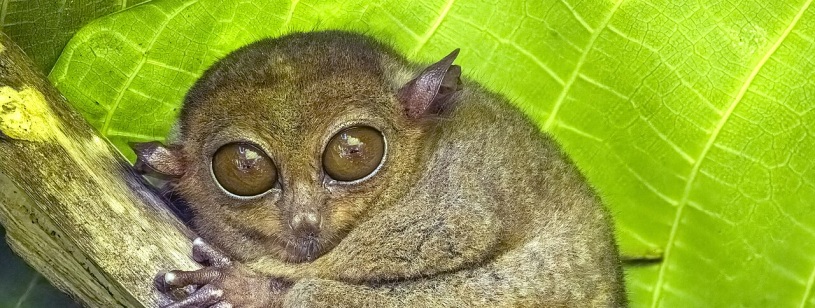
A Philippine tarsier, Carlito syrichta, on Bohol; one member of the Tarsiidae family. · Charles J. Sharp / CC BY-SA 4.0 (https://creativecommons.org/licenses/by-sa/4.0). Cropped and resized.
The tarsier is a small nocturnal primate from Southeast Asian forests, recognised by its enormous eyes and elongated hind limbs. The name covers several species in the Tarsiidae family, rather than one animal with a uniform range. The photograph shows a Philippine tarsier, Carlito syrichta, an insect hunter that leaps between branches.
Quick facts
| Common name | Tarsier |
| Scientific name | Tarsiidae — a family containing several species |
| Diet | Carnivore; insects and other small animals |
| Conservation status | Varies among species and populations |
| Distribution | Southeast Asia: the Philippines and islands in Indonesia, Malaysia and Brunei |
| Habitat | Tropical forest and dense vegetation, depending on species |
| Length | Philippine tarsier head and body around 12 cm; the tail is longer |
| Family | Tarsiidae |
| Activity | Nocturnal |
| Movement | Leaping and clinging to branches |
| Reproduction | Usually one infant; pregnancy lasts about five–six months |
- Primary category:Primates
- Explore this animal's categories:
Interesting facts
- Large eyes support a nocturnal way of life.
- Powerful hind limbs help with leaps between narrow supports.
- Tarsiers eat animal prey rather than relying on fruit.
- The family includes Carlito, Cephalopachus and Tarsius.
Characteristics
A round head, mobile ears and forward-facing eyes create the characteristic appearance. Fur is generally greyish or brown, with differences among species and individuals.
Long digits and gripping surfaces help the animal cling to branches. Powerful hind limbs and elongated ankle-region bones support leaping. The long tail extends the outline of a tiny body. Measurements should always be tied to a species rather than applied to every tarsier.
Behaviour
Tarsiers are mainly active after dark. During daylight they rest within protective vegetation, emerging at night to search among branches and leaves.
Good hearing and careful observation reveal small movements. Leaping allows both travel and prey capture. Social arrangements differ: some species associate in pairs or family groups, while others forage separately. A photograph of one isolated animal cannot describe its entire social system.
Habitat and distribution
The family occurs on Southeast Asian islands. Philippine tarsiers live on islands including Bohol, Samar, Leyte and Mindanao; other species inhabit Borneo, Sumatra or Sulawesi.
Forest and dense vegetation provide supports and resting places. A Mt. Matutum study documented sleeping sites in bamboo and secondary vegetation. Use of modified habitat does not imply that forest destruction is harmless: connected cover remains important for movement and shelter.
Diet and feeding
Tarsiers hunt animal prey. Insects are important, but spiders and small vertebrates can also be taken, depending on the species and available opportunities.
The hunter tracks its target before a rapid capture. Large eyes, hearing and leaping ability work together after dark. Despite being primates, tarsiers do not fit the familiar image of a fruit-eating monkey. Their animal-based diet is a defining feature.
Reproduction and life cycle
A female usually produces one infant after roughly five to six months of pregnancy. The infant nurses and depends on maternal care.
Philippine tarsier newborns already have fur and open eyes. Development continues as they acquire movement and hunting skills. Reproductive schedules and family behaviour differ between species. Suitable resting cover matters for mothers and young as well as for feeding adults.
Name and history
The name refers to elongated tarsal bones in the ankle region, part of the anatomy supporting leaps.
Modern classification divides Tarsiidae into Carlito, Cephalopachus and Tarsius. Older accounts call the Philippine species Tarsius syrichta; its current name is Carlito syrichta. Tarsiers are primates, not rodents, despite their tiny size and discreet habits.
Conservation and threats
Habitat loss and fragmentation reduce feeding and resting opportunities. Conservation categories must be checked species by species: the whole family does not share one risk assessment.
Forest monitoring, protected sleeping sites and cooperation with local people support conservation. Mt. Matutum researchers also recommend visitor controls around sleeping areas. Responsible observation preserves distance and quiet, allowing the animal to remain in its own vegetation rather than handling it for a photograph.
Frequently asked questions
Is there only one tarsier species?
No. The name covers several species within Tarsiidae.
Why are its eyes so large?
Large eyes support hunting and movement in low light.
Does it eat fruit?
Tarsiers are predators that feed on insects and other small animals.
Is it a rodent?
No. A tarsier is a primate despite its very small body.