SlugGastropoda — terrestrial slugs — habitat, diet and reproduction
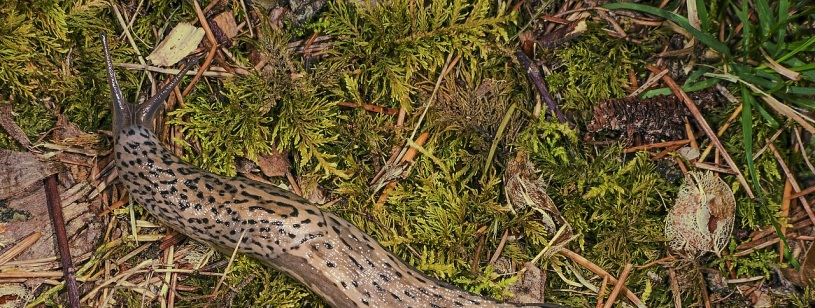
Limax maximus on moss, one of the many terrestrial slugs. · Didier Descouens / CC BY-SA 4.0 (https://creativecommons.org/licenses/by-sa/4.0). Cropped and resized.
A slug is a soft-bodied land mollusc resembling a snail without a large visible shell. The name covers several groups rather than one species. Some eat plants, while others consume fungi, decaying material or animals. Limax maximus, shown here, is a relatively large, spotted example.
Quick facts
| Common name | Slug; terrestrial slugs |
| Scientific group | Several gastropod groups; photograph shows Limax maximus |
| Diet | Plants, fungi, decaying material or animals, depending on species |
| Main predators | Birds, frogs, hedgehogs and ground beetles, depending on habitat |
| Conservation status | Varies by species |
| Distribution | Many world regions, including Romania |
| Habitat | Gardens, woodland and other places with damp shelters |
| Length | Limax maximus: approximately 10–20 cm; other species differ |
| Class | Gastropoda |
| Shell | Reduced, internal or absent, depending on the group |
| Reproduction | Eggs laid in sheltered places |
- Primary category:Molluscs
- Explore this animal's categories:
Interesting facts
- Slugs are molluscs, not insects.
- A body without a large shell evolved more than once.
- Not every species eats living plants.
- Limax maximus can mate while hanging from a mucus thread.
Characteristics
A broad muscular foot supports the body and moves over the ground. Mucus assists movement and protects the delicate surface.
Behind the head lies the mantle, a region with a different texture. In many species a breathing opening is visible on the right side; its position can help identification. Limax maximus has dark mantle spots and markings farther back. Its 10–20 cm length is not typical of every slug.
Behaviour
Slugs are easier to find when humidity is high. Many emerge at night or after rain, retreating when the ground surface dries.
Movement often leaves a shining trail. Tentacles, touch and chemical cues help the animal explore; vision does not provide human-like detail. Losing a bulky external shell allows access to narrow spaces, but suitable shelter remains essential.
Habitat and distribution
Woodland, gardens and grassland can all provide food and moisture. Fallen leaves, timber and stones create sheltered conditions that differ from exposed ground nearby.
Limax maximus originated in Europe and has been transported elsewhere. Human activity helps some species spread. Different slugs may occupy the same garden while feeding on different materials, so location alone cannot reveal their ecological role.
Diet and feeding
Some species eat leaves and seedlings; others take algae, lichens, fungi or decomposing vegetation. Predatory slugs also exist.
Food is processed with a radula, a structure bearing numerous tiny teeth that acts as a rasp. Finding a slug beside a damaged plant does not by itself identify the culprit. Species feeding on dead material contribute to decomposition and the movement of nutrients through the garden.
Reproduction and life cycle
Eggs are laid in sheltered places, including beneath wood or stones. Moisture and temperature influence development, and timing varies between species and regions.
Limax maximus has a striking courtship behaviour in which a pair hangs from a mucus thread. This is not a universal slug trait. Young resemble smaller adults and grow gradually; egg numbers and lifespan cannot be summarised by one figure for every species.
Name and history
The everyday word slug covers several groups of molluscs with reduced shells. Limax is also a particular scientific genus, including Limax maximus.
Shell reduction arose in different evolutionary lineages. Some species retain a small shell inside the mantle, while others show different reductions. Slugs should therefore not be imagined as one species with a range of colours.
Conservation and threats
Slugs feed birds, frogs, hedgehogs and ground beetles, supporting food webs close to the soil. Some damage crops, but treating every species alike overlooks differences in diet and decomposition roles.
Identifying the cause of damage and protecting vulnerable plants is more useful than assuming all slugs are pests. Conservation needs vary by species and depend on maintaining suitable habitat.
Frequently asked questions
Is a slug a snail without a shell?
It is a gastropod mollusc with a reduced, internal or absent shell, depending on its group.
Do all slugs damage plants?
No. Some mainly eat fungi, decaying matter or other animals.
Why do they appear after rain?
Moist conditions allow surface movement with less risk of drying out.
How large is Limax maximus?
The pictured species can measure approximately 10–20 cm; other slugs differ.