ZebraInteresting facts and information
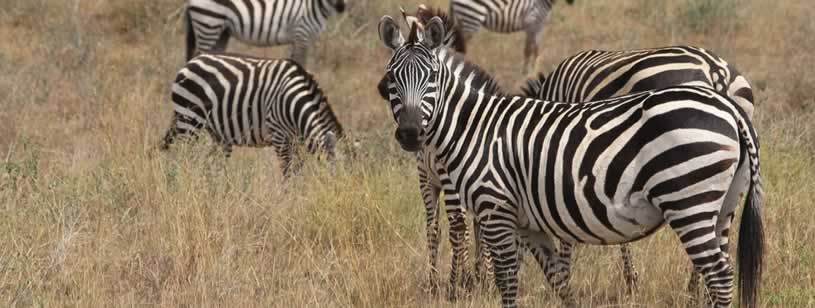
Zebras are African members of the horse family with striped coats. Three living species are recognised: plains zebra (Equus quagga), mountain zebra (Equus zebra) and Grevy's zebra (Equus grevyi). Their habitats, social behaviour and conservation needs differ.
- Plains zebra (Equus quagga)
- Mountain zebra (Equus zebra)
- Grevy's zebra (Equus grevyi)
Zebras are wild equids and have not been domesticated in the way horses and donkeys have. They feed mainly on plants and are prey for several African predators.
Quick facts
| Common name | Zebra |
| Scientific name | Equus quagga, Equus zebra and Equus grevyi |
| Typical lifespan | About 20-25 years in the wild, up to about 40 years in captivity |
| Maximum speed | Up to about 65 km/h over short distances |
| Size | About 1.1-1.6 m at the shoulder |
| Length | About 2-2.6 m (without tail) |
| Tail length | 40-60 cm |
| Weight | About 220-450 kg, depending on the species |
| Diet | Herbivore (mainly grass, with some leaves, shoots and bark) |
| Main predators | Lions, hyenas, leopards, African wild dogs and crocodiles; risks vary with region and age |
| Conservation status | Varies by species (IUCN): plains zebra Near Threatened, mountain zebra Vulnerable, Grevy's zebra Endangered |
| Geographic distribution | Eastern and southern Africa |
| Habitat | Savanna, grassland, open woodland, dry mountains and scrub |
| Social behaviour | Plains and mountain zebras live in family groups (harems) that may join large herds; Grevy's zebras form looser groups |
| Special adaptations | Unique striped coats, efficient digestion of tough grass, speed and stamina |
- Primary category:Mammals
- Explore this animal's categories:
Interesting facts
- Every zebra's stripes are unique - Like human fingerprints, no two zebras have exactly the same stripe pattern.
- Stripes may keep flies away - The best-supported idea is that stripes put off biting flies; other suggested functions include cooling and confusing predators.
- Zebras can doze standing up - Like horses, they can lock their legs so they do not fall, although they lie down for deep sleep.
- They have excellent eyesight and spot danger from far away - Their eyes are on the sides of the head, giving them a wide field of view.
- They are fast and have great stamina - Zebras can reach about 65 km/h over short distances and keep up a steady pace for much longer.
- Zebras communicate with sounds, ear movements and tail position - For example, ears pointing forward show that a zebra is alert.
Records and remarkable features
- Zebras are African members of the horse family with striped coats.
Characteristics
The zebra is a sturdy mammal, well adapted to life on the African savanna, where it has to cope with predators and harsh weather.
Appearance
- A muscular, compact body - Allows fast running and long-lasting endurance.
- Black-and-white stripes - May help protect zebras from biting flies and possibly help with cooling and confusing predators.
- Strong legs - With hard hooves, ideal for running and self-defence.
- Mobile, expressive ears - Pick up sounds from all directions and show the zebra's mood.
- A short, stiff mane - Unlike a horse's mane, a zebra's mane stands upright along the neck.
Special adaptations
- Coping with dry conditions - Grevy's zebras can go several days without drinking, while plains zebras need to drink most days.
- An efficient digestive system - Can get energy from tough, dry grass that many other grazers avoid.
- A strong bite - Although they eat plants, zebras bite hard when defending themselves against predators or rivals.
- A powerful kick - A well-aimed kick can seriously injure a lion or hyena.
Habits and behaviour
Zebras are social animals. Living in groups protects them from predators and improves their chances of survival.
Social behaviour
- Family groups and herds - Plains and mountain zebras live in harems: one stallion, several mares and their young. Many harems may come together in large herds, especially during migration.
- Grevy's zebras are different - Their males defend territories, and females and young move more freely between groups.
- Stallions defend their families - A stallion fights other males to keep his mares.
- Strong bonds - Zebras groom each other by nibbling, which helps remove parasites and strengthens bonds.
Defence and survival
- A shared alarm system - When a zebra spots a predator, it calls to warn the rest of the herd.
- Zigzag running - Zebras run in zigzags to make it harder for predators to catch them.
- Fighting back - When attacked, a zebra can bite and kick hard.
Habitat and geographic distribution
Zebras live only in Africa, in a range of open habitats.
| Region | Preferred habitat | Species |
|---|---|---|
| East Africa (Kenya, Tanzania, Uganda) | Savanna, open grassland | Plains zebra (Equus quagga) |
| Southern Africa (Botswana, Zimbabwe, South Africa) | Savanna, open woodland | Plains zebra (Equus quagga) |
| Southwestern Africa (South Africa, Namibia, Angola) | Mountains, dry rocky areas | Mountain zebra (Equus zebra) |
| Kenya, Ethiopia | Dry grassland and scrub | Grevy's zebra (Equus grevyi) |
Types of habitat
- Savanna and grassland - The most common habitat, with plenty of grass and a good view of approaching predators.
- Dry areas - Mountain and Grevy's zebras can live in dry, rocky or scrubby regions.
- Open woodland - Some populations live in open woodland, but they avoid thick vegetation, where predators can ambush them.
Human impact and threats
- Habitat loss - Farms and towns reduce the land that zebras can use for feeding and migration.
- Poaching - Zebras are hunted illegally for their skins and meat.
- Competition with livestock - In many areas, cattle and other livestock compete with zebras for grazing and water.
Diet and feeding
The zebra is a herbivore that feeds mainly on grass, with some leaves, shoots and bark. Its digestive system lets it live on tough, low-quality plants that other grazers avoid.
What do zebras eat?
| Type of food | Share of diet | Benefits |
|---|---|---|
| Grasses | Most of the diet | Main source of energy |
| Leaves and shoots | A small part | Extra nutrients, especially in the dry season |
| Bark and twigs | Occasional | Fibre and minerals when grass is scarce |
| Fruit and seeds | Rare | Eaten now and then |
How they feed
- Grazing for long hours - Zebras spend much of the day grazing to make up for the low nutritional value of grass.
- Seasonal changes - In the dry season, they eat more leaves, shoots and bark.
- Fast digestion - Unlike ruminants such as antelopes, zebras pass food through quickly, so they can eat large amounts of poor-quality grass.
- Needing water - Most zebras, especially plains zebras, need to drink regularly and rarely stray far from water.
Reproduction and life cycle
In plains and mountain zebras, a stallion mates with the mares in his harem.
| Feature | Details |
|---|---|
| Age at maturity | Females about 2-3 years; males usually breed later |
| Breeding season | All year, with a peak in the rainy season |
| Type of reproduction | Viviparous (gives birth to live young) |
| Pregnancy | About 12-13 months |
| Young per birth | 1 foal |
| Birth weight | About 25-40 kg |
| Nursing period | About 6-12 months |
| Age at independence | 1-3 years |
| Lifespan | About 20-25 years in the wild, up to about 40 years in captivity |
Mating
- In harems, one stallion mates with the mares and defends them from other males.
- Young stallions without a harem fight or try to win over young mares to start their own family group.
- Mating can happen at any time of year, but births are most common in the rainy season, when food is plentiful.
Birth and development of the young
- Zebra foals are well developed at birth and can stand and follow their mothers within about an hour.
- Zebra mothers nurse their foals and stay close to them; how long nursing lasts varies.
- Young zebras stay with their family group for 1-3 years before leaving.
Name and history
Origin of the name
- The word "zebra" comes from Portuguese, where it was first used for a wild ass that once lived in Iberia, and was later given to the striped African animals.
- The genus name Equus means "horse" in Latin. The three species are Equus quagga (plains zebra), Equus zebra (mountain zebra) and Equus grevyi (Grevy's zebra).
Discovery and scientific study
- The Romans knew a zebra they called hippotigris, "horse-tiger".
- Portuguese explorers met zebras in Africa from the 15th century onwards.
- The quagga, a half-striped form of the plains zebra from South Africa, was hunted to extinction; the last one died in Amsterdam Zoo in 1883.
- Zebras, horses and asses share a common ancestor that lived about 4 million years ago.
Zebras in folklore
Cultural significance and mythology
- The national animal of Botswana - Two zebras support the shield on Botswana's coat of arms.
- Ancient rock art - Zebras appear in rock paintings made by the San people of southern Africa.
- Zebra crossings - The black-and-white striped pedestrian crossings in the UK and many other countries are named after the zebra.
Conservation status and threats
The conservation status of zebras varies by species, from stable populations to endangered species.
| Species | IUCN status | Population estimate | Main range |
|---|---|---|---|
| Plains zebra (Equus quagga) | Near Threatened | About 500,000 | East and southern Africa |
| Mountain zebra (Equus zebra) | Vulnerable | About 35,000 | South Africa, Namibia, Angola |
| Grevy's zebra (Equus grevyi) | Endangered | About 2,000-3,000 | Kenya, Ethiopia |
Main threats
- Habitat loss - Farming and towns reduce the land available for grazing.
- Poaching - Zebras are hunted illegally for their skins and meat.
- Climate change - More frequent droughts reduce water and food.
- Competition with livestock - In many regions, grazing land is used by cattle, leaving less for zebras.
Conservation efforts
- Reserves and national parks - The Serengeti, Maasai Mara and Etosha are among the places where zebras are protected.
- Community conservation - Especially for Grevy's zebra, the rarest species, local people help monitor and protect herds.
- Tracking populations - Researchers use GPS collars to follow zebra migrations.
- Education and awareness - Campaigns help reduce conflict between people and zebras.
In popular culture
- Marty (Madagascar, 2005) - A talkative zebra who escapes from New York's Central Park Zoo with his friends.
- Racing Stripes (2005) - A film about a zebra raised on a farm who dreams of becoming a racehorse.
- Zecora (My Little Pony: Friendship Is Magic) - A wise zebra who lives in the Everfree Forest and speaks in rhyme.