LionfishPterois — habitat, diet and reproduction
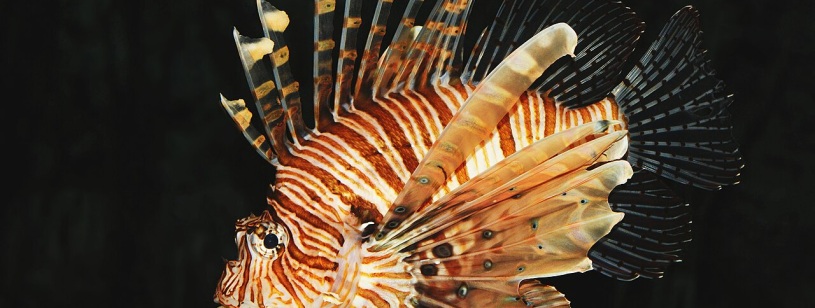
Red lionfish (Pterois volitans) in an aquarium. · Michael Gäbler / CC BY 3.0 (https://creativecommons.org/licenses/by/3.0). Cropped and resized.
The lionfish is a marine fish with red, brown and white stripes and long fins spread like a mane. The spines on its back and fins carry venom that causes intense pain. It is native to the Indo-Pacific but has become invasive in the Atlantic, the Caribbean and, more recently, the Mediterranean.
Quick facts
| Common name | Lionfish, turkeyfish |
| Scientific name | Pterois (genus) |
| Lifespan | About 10–15 years |
| Length | Up to about 38–47 cm, by species |
| Diet | Carnivore: small fish, shrimp, crabs |
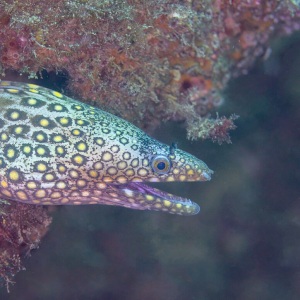
| Predators | Few; sometimes sharks, large groupers and moray eels |
| Conservation status | Least Concern (LC) |
| Distribution | Native to the Indo-Pacific; invasive in the Atlantic, Caribbean and Mediterranean |
| Habitat | Coral reefs, rocky areas, shipwrecks |
| Family | Scorpaenidae |
| Venom | In spines on the back, belly and tail |
Interesting facts
- A female can release about two million eggs a year.
- Lionfish reached the Mediterranean through the Suez Canal and are now found off the coasts of Greece.
- The venom is very painful, but stings are rarely fatal to people.
- In the Caribbean and Florida, fishing contests are held to reduce lionfish numbers.
Characteristics
The lionfish is covered in vertical red, brown or black stripes on a white or cream background. Its pectoral fins are huge, like fans, and the dorsal spines are long and thin.
Above the eyes and on the snout it has small skin flaps like tentacles. Bright colours warn predators that it is venomous.
Behaviour
The lionfish is most active at dusk and night, hiding by day in crevices, under corals or in wrecks.
It hunts slowly, approaching prey with spread fins that corner it, then swallows it in one rapid gulp. It defends itself by pointing its venomous spines at attackers.
Habitat and distribution
Lionfish are native to the reefs of the Indian and Pacific Oceans. Since the 1980s, fish released from aquariums have founded populations on the US East Coast, then in the Caribbean and Gulf of Mexico.
A related species, Pterois miles, reached the Mediterranean through the Suez Canal and spread to Cyprus, Turkey, Greece and Italy.
Diet and feeding
Lionfish eat small fish, young reef fish, shrimp and crabs, swallowing prey up to half their own length.
Where they are invasive, local fish do not recognise them as predators and do not flee, so lionfish can greatly reduce numbers of small reef fish.
Reproduction and life cycle
Lionfish breed year-round in warm water. The female releases eggs in a floating jelly mass carried far by currents.
A single female can lay about two million eggs a year, which explains how quickly the species spread to new regions.
Name and history
The scientific name Pterois comes from the Greek “pteron”, wing or feather, after the long fins. The name lionfish refers to the fins spread like a mane.
It is also called “turkeyfish” because the fins resemble a turkey’s fanned tail.
Conservation and threats
In their native range lionfish are assessed as Least Concern. The main problem is their spread outside that range, where they harm reefs and fisheries.
Divers and fishers catch them to reduce numbers, and the meat is edible once the spines are carefully removed.
Frequently asked questions
Is the lionfish dangerous?
Its spines carry venom that causes intense pain and swelling. Stings are rarely fatal but need medical care.
Are there lionfish in Greece?
Yes. A lionfish species reached the Mediterranean through the Suez Canal and now occurs in Greek waters.
What should you do if stung?
Leave the water, soak the area in water as hot as you can bear without burning, and seek medical help.
Can lionfish be eaten?
Yes. The meat is not venomous, but the spines must be removed carefully.