LlamaInteresting facts and information
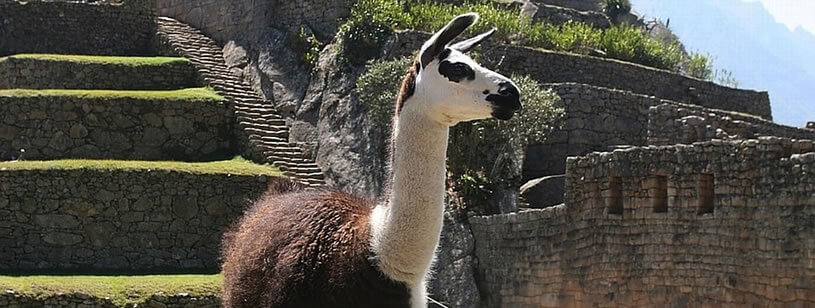
The llama (Lama glama) is a domestic South American camelid associated with the Andes. It has long been used as a pack animal and for its fibre. Llamas, alpacas, guanacos and vicuñas are related but distinct animals.
Llamas were domesticated from the wild guanaco thousands of years ago and are well adapted to life at more than 4,000 metres. Known for their strength, calm nature and famous spitting, South American camelids are still an important part of the economy and culture of the Andes.
Quick facts
| Common name | Llama |
| Scientific name | Lama glama |
| Typical lifespan | 15-25 years |
| Maximum speed | About 55 km/h in short bursts |
| Height | About 110-120 cm at the shoulder |
| Length | About 1.7-1.8 metres (without tail) |
| Weight | About 130-200 kg |
| Diet type | Herbivore (grasses, leaves, shrubs) |
| Main predators | Pumas, Andean foxes and dogs |
| Conservation status | Domestic animal, not threatened |
| Geographic distribution | Andes of South America (Bolivia, Peru, Argentina, Chile, Ecuador); kept worldwide |
| Social behaviour | Social, lives in herds |
| Special adaptations | Efficient use of water and food, life at high altitude, spitting |
- Primary category:Mammals
- Explore this animal's categories:
Interesting facts
- Llamas spit - When annoyed, llamas can spit a mix of saliva and stomach contents, usually at other llamas and only rarely at people.
- Soft feet - Llamas have two toes with tough nails and soft, leathery pads underneath, so they walk steadily on rocky ground and do little damage to the soil.
- Pack animals - A llama can carry about 25-30% of its body weight, roughly 25-45 kg, over long mountain trails.
- Tidy toilets - Llamas use shared dung piles, which makes them easier to keep clean on farms.
- Built for the high mountains - Their blood carries oxygen very efficiently, helping them live at altitudes of 4,000 metres or more.
- Clever and easy to train - Llamas learn commands quickly and are used as pack animals, show animals and therapy animals.
- Guards for sheep - On some farms, llamas guard flocks of sheep and goats, chasing away foxes and dogs.
Records and remarkable features
- The llama (Lama glama) is a domestic South American camelid associated with the Andes. It has long been used as a pack animal and for its fibre. Llamas, alpacas, guanacos and vicunas are related but distinct animals.
Characteristics
The llama (Lama glama) is a large, sturdy domestic animal of the camel family, well adapted to the Andes mountains. Its thick coat and efficient body help it cope with high altitudes, cold and poor food.
Physical aspect
- Size and weight - Adult llamas stand about 110-120 cm at the shoulder and up to about 1.8 m at the head, and weigh about 130-200 kg.
- Long neck - The llama's long, flexible neck lets it graze and look out for danger.
- Strong legs - Their legs are strong and their feet have soft pads that help them grip rocky slopes.
- Woolly coat - The llama's coat is thick and protects it from the cold; its fibre is used to make ropes, rugs and clothing. Llamas can be white, brown, grey, black or a mix of colours.
- No true hooves - Each foot has two toes with nails and a soft pad, instead of a hard hoof.
Special adaptations
- Efficient digestion - Llamas get a lot of nutrition from tough, poor-quality plants that many other animals could not live on.
- Saving water - Llamas use water efficiently, but unlike camels, they need to drink regularly.
- Spitting - When threatened or annoyed, llamas spit to keep rivals away.
- Living in thin air - Their red blood cells and special haemoglobin carry oxygen very well at high altitudes.
Habits and behaviour
Llamas are social herd animals. They are curious, alert and communicate with sounds and body language.
Social behaviour
- Herds - Llamas live in herds; in free-roaming groups, a male usually lives with several females and their young, while young males form bachelor groups.
- Sounds and body language - Llamas hum softly to each other and give a loud alarm call when they see danger. The position of their ears and tail shows their mood.
- Spitting and fighting - Males compete by spitting, pushing with their necks and biting.
Territorial and Defence
- Avoiding conflict - Llamas usually prefer to avoid fights, but they can chase, kick and spit at intruders.
- Warning the herd - Llamas have good eyesight and spot predators from far away; they give an alarm call to warn the others.
Interaction with people
- Domesticated thousands of years ago - Llamas were domesticated from the wild guanaco in the Andes at least 4,000-5,000 years ago and were essential to the Inca Empire.
- Friendly and trainable - Llamas can learn commands and are used for trekking, in shows and as therapy animals.
Habitat and geographic distribution
Llamas come from the Andes of South America. They are domestic animals and are still raised there in large numbers, but they are now also kept in many other parts of the world.
| Region | Species Present | Population information |
|---|---|---|
| Bolivia | Lama glama | The largest population, with around two million or more llamas |
| Peru | Lama glama | The second-largest population; kept for transport, fibre and meat |
| Ecuador and Colombia | Lama glama | Smaller numbers, kept at high altitudes |
| Argentina and Chile | Lama glama | Kept in the northern Andes for fibre and meat |
| United States, Canada, Europe, Australia | Lama glama (introduced) | Kept on farms, for trekking and as pets |
Types of Habitat
- The high Andes - Llamas are mainly raised at about 2,500-4,500 m, where it is cold and plants are scarce.
- Mountain grasslands and dry plains - They graze on tough grasses and shrubs in the puna and altiplano.
- Farms around the world - In North America, Europe and Australia, llamas are kept on farms, for trekking and as guard animals.
Human Impact and Threats
- Safe as a domestic animal - Llamas are not threatened, because millions are kept by people.
- Climate change - Changes in rainfall and melting glaciers can reduce the quality of mountain pastures.
- Competition from other animals - In some areas, herders keep more alpacas, sheep or cattle instead of llamas.
Diet and feeding
Llamas are herbivores that eat mainly grasses, along with leaves and shrubs. They make very good use of their food, which helps them live on the poor pastures of the Andes.
| Food type | Examples |
|---|---|
| Mountain grasses | Fescue (Festuca), ichu (puna grass) |
| Leaves and shrubs | Shrubs and low bushes of the puna |
| Wetland plants | Plants of the high Andean bogs (bofedales) |
| Farm food | Hay, alfalfa (lucerne), oats |
| Treats on farms | Carrots and other vegetables, in small amounts |
Feeding methods
- Grazing - Llamas graze for many hours a day, picking plants with their split upper lip.
- Chewing the cud - Llamas are not true ruminants, but they have a stomach with three compartments and chew the cud, which helps them digest tough plants.
- Water - Llamas drink regularly, but they need less water than many other farm animals.
Reproduction and life cycle
Llamas have an unusual way of breeding: the female ovulates only after mating, instead of on a regular cycle.
| Characteristic | Details |
|---|---|
| Breeding maturity | About 1-2 years (females), 2-3 years (males) |
| Mating season | Can breed all year, but in the Andes births are mainly in the rainy season |
| Gestation | About 350 days (almost one year) |
| Number of young | 1 young, called a cria (twins are very rare) |
| Birth weight | About 9-14 kg |
| Nursing period | About 5-6 months |
| Life Expectancy | 15-25 years |
Breeding process
- Mating - Llamas mate lying down, which is unusual for hoofed animals; the male makes a gurgling sound called "orgling".
- Long pregnancy - At almost a year, it is one of the longest pregnancies among farm animals.
- Morning births - Crias are usually born in the morning, so they have time to dry and warm up before the cold night.
- Quick to stand - Crias stand up within about an hour of birth and soon follow their mother.
Name and history
The llama was one of the first animals domesticated in South America, and it has been part of Andean life for thousands of years.
Origin and etymology of the name
- The word "llama" comes, through Spanish, from Quechua, the language of the Inca Empire.
- The llama was scientifically described by Carl Linnaeus in 1758, as Camelus glama; today it is called Lama glama.
- The llama is descended from the wild guanaco (Lama guanicoe), while the alpaca is descended from the wild vicuña (Vicugna vicugna).
The llama in Andean culture
- The Inca Empire (about 1438-1533) - Llamas were essential to the Inca economy, carrying goods along mountain roads and providing fibre, meat and dung for fuel.
- Spiritual importance - The Incas offered llamas in religious ceremonies to the mountain spirits (apus) and to the sun.
- After the Spanish conquest - The Spanish brought horses, mules, sheep and cattle, and the number of llamas fell sharply.
Discovery of the llama by Europeans
- Sixteenth-century accounts — Pedro de Cieza de León described Andean camelids in his chronicles. His first part of the Chronicle of Peru was published in 1553.
- Llamas abroad - From the 19th century, zoos and collectors brought llamas to Europe and North America; llama farming became popular there in the late 20th century.
Cultural significance and mythology
The llama has been very important to the peoples of the Andes for thousands of years, as a working animal, a source of wealth and a sacred offering.
The llama in Andean culture
- Sacred offerings - In the Inca Empire, llamas were sacrificed in ceremonies to ask for rain, good harvests and healthy herds.
- Mountain spirits - Andean peoples believe that the spirits of the mountains (apus) protect their herds, and they still make offerings to them.
- Art - Llamas appear on Inca pottery and textiles, and the Incas made small gold and silver llama figures as offerings.
The llama in folklore and legends
- The llama in the sky - Andean peoples see a llama, called Yacana, in the dark clouds of the Milky Way; its eyes are the bright stars Alpha and Beta Centauri.
- The flood story - In one Andean legend, a llama warned a herder of a coming flood, so he could escape to a mountain top.
- Herd festivals - In many Andean villages, llamas are decorated with coloured wool tassels during traditional festivals.
Modern Symbolism
- A symbol of the Andes - The llama is a symbol of Andean and indigenous identity in Peru and Bolivia.
- Calm and fun - Today, the llama is a popular symbol of fun and calm, appearing on clothes, posters and toys.
Conservation status and threats
The llama is a domestic animal and is not threatened. Its wild relatives, the guanaco and the vicuña, were once heavily hunted but have recovered thanks to protection.
| Assessment scope | Species Examples |
|---|---|
| Domestic (not assessed by the IUCN) | Lama glama (llama) |
| Least Concern (LC) | Lama guanicoe (guanaco) |
| Least Concern (LC) | Vicugna vicugna (vicuña), after recovering from near extinction |
Main threats
- Climate change - Changes in rainfall and the loss of glaciers can harm the mountain pastures where llamas graze.
- Fewer llama herders - In some areas, herders keep more alpacas or other animals instead of llamas.
- Moving to cities - As young people leave the countryside, fewer families keep traditional llama herds.
Conservation efforts
- Protecting wild relatives - The vicuña and guanaco are protected by law and by international trade rules.
- Protected areas - National parks in the Andes protect the grasslands where wild camelids live.
- Supporting herders - Programmes help Andean families improve their llama herds and sell llama fibre and products.
In popular culture
Films and animation
- The Emperor's New Groove (2000, Disney) - The selfish emperor Kuzco is turned into a llama.
- Llamas with Hats (2009-2015) - A popular animated web series about two llamas, Carl and Paul.
Books and video games
- Llama Llama Red Pajama (Anna Dewdney, 2005) - A popular picture book that started a whole series about Llama Llama.
- Minecraft - Llamas were added in 2016; they can carry chests and spit at enemies.
- Fortnite - Supply llamas, shaped like piñatas, contain useful items.
The llama as a commercial symbol
- Fashion - T-shirts, socks and bags with llama pictures are very popular.
- Internet fame - In 2015, two llamas that escaped in Arizona became a viral internet sensation, known as "llama drama".