DingoInteresting facts and information
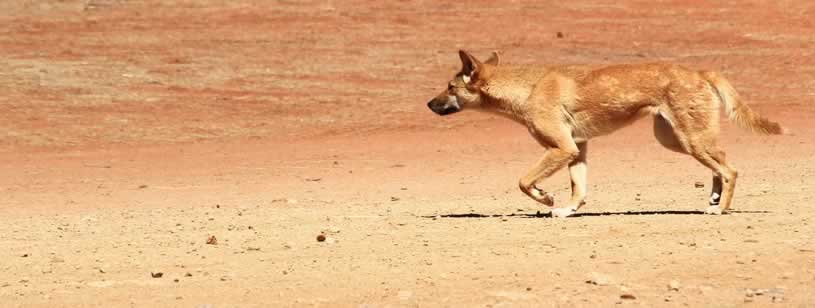
The dingo is an Australian wild dog descended from dogs brought to the continent thousands of years ago. It belongs to the genus Canis, but scientists disagree about whether it should be treated as a separate species or as a form of the domestic dog.
Dingoes communicate using howls, growls and body signals. They can also bark, although barking is less typical than in many domestic dogs.
Dingoes can come into conflict with livestock farming, and many populations have mixed with domestic dogs. At the same time, they play an important role in Australian ecosystems as top predators.
Quick facts
| Common name | Dingo |
| Scientific name | Canis familiaris (dingo); also called Canis lupus dingo or Canis dingo in other taxonomic treatments |
| Typical lifespan | 5-10 years in the wild, up to about 15 years in captivity |
| Maximum speed | Up to about 60 km/h |
| Length | 90-120 cm (without tail) |
| Weight | About 10-20 kg (males are larger than females) |
| Diet type | Mainly carnivorous (small and large mammals, birds, reptiles), with some fruit |
| Main predators | Adults have few: humans, sometimes crocodiles; pups can be taken by eagles and other dingoes |
| Conservation status | Debated; protected in some areas and controlled as a pest in others |
| Distribution | Mainland Australia; closely related dogs live in New Guinea and Southeast Asia |
| Habitat | Deserts, woodland, grassland and mountain habitats |
- Primary category:Mammals
- Explore this animal's categories:
Interesting facts
- They rarely bark - Dingoes can bark, but much less often than domestic dogs; they communicate mainly by howling, like wolves.
- Fast runners - A dingo can run at up to about 60 km/h and can leap or climb over fences about 2 metres high.
- Great survivors - Dingoes live in deserts, grasslands, tropical forests and even snowy mountains.
- Mixing with domestic dogs - Many dingo populations, especially near towns and farms, now carry some domestic dog DNA.
- One of the longest fences in the world was built because of them - The Dingo Fence, about 5,600 km long, keeps dingoes away from sheep in south-eastern Australia.
- They can go a long time without drinking - Dingoes get some of the water they need from their prey.
- Alone or in packs - Depending on the food supply, dingoes live alone, in pairs or in packs of up to about 10-12 animals.
- A famous court case - In 1980, baby Azaria Chamberlain disappeared at Uluru; her mother said a dingo had taken her, but she was wrongly convicted of murder before being cleared.
- Agile climbers and swimmers - Dingoes can rotate their wrists more than most dogs, which helps them climb rocks and fences, and they can swim across rivers.
- Australia's top land predator - Since the thylacine (Tasmanian tiger) disappeared from the mainland, the dingo has been the largest meat-eating land mammal in Australia.
Records and remarkable features
- Dingoes are wild-living dogs descended from animals introduced to Australia thousands of years ago.
- The Dingo Fence, built to protect sheep farms, is one of the longest structures in the world.
Characteristics
The dingo is a wild dog with features that set it apart from both wolves and most domestic dogs. Adapted to the harsh conditions of Australia, it has an agile body, strong muscles and a keen sense of smell.
Main physical characteristics
- Medium size - Body length is about 90-120 cm, and weight is usually about 10-20 kg.
- Short, dense fur - Usually ginger or sandy, but sometimes black and tan or creamy white, often with white feet and a white tail tip.
- A bushy tail - Helps with balance and signalling.
- Long, lean legs - Make them excellent runners and jumpers.
- Large, upright ears - Give them excellent hearing.
- Almond-shaped eyes - Usually amber or brown.
- Strong jaws and sharp teeth - Can crush small bones and tear meat efficiently.
Special adaptations for survival
- Coping with heat - Dingoes keep cool by panting, resting in the shade during the day and being active at dawn, dusk and night.
- Flexible joints - They can rotate their wrists and turn their heads further than most dogs, which helps them climb and squeeze through gaps.
- Saving water - In dry areas, they get much of their water from their prey.
- Howling - Instead of barking, dingoes mainly use howls, growls and other sounds to communicate.
Habits and behaviour
Dingoes are opportunistic predators that may live alone or in packs. Their behaviour depends on the food available, and their way of life is very adaptable.
Social behaviour
- Packs or a solitary life - Where food is plentiful, dingoes often live in packs of about 3-12 animals; where food is scarce, they may live alone or in pairs.
- A breeding pair - In a pack, usually only the dominant pair breeds, and the other members help raise the pups.
- Teamwork - Packs work together to hunt large prey, such as kangaroos and emus.
- Territories - Dingoes mark their territory with urine, droppings, scratches and howls.
Breeding season
- Usually only the dominant pair breeds in a pack.
- Breeding season - Once a year, mainly between March and June.
- Litters - The female usually gives birth to 4-6 pups after a pregnancy of about 63 days.
Defence and survival methods
- Avoiding danger - Dingoes are wary and quick to run away, and they rest in dens among rocks, in hollow logs or in burrows.
- Constant alertness - Their upright ears pick up the faintest sounds.
- A flexible diet - When meat is scarce, they also eat fruit, insects and carrion.
Habitat and geographic distribution
The dingo is one of the most widespread predators in Australia and lives in almost every type of habitat, from dry deserts to tropical forests and mountains.
Habitat types
- Deserts and dry areas - Dingoes survive in very harsh conditions, as long as they can find water every few days.
- Tropical and temperate forests - They live in coastal forests, where they hunt birds, reptiles and small mammals.
- Mountains - "Alpine" dingoes live in the high country of south-eastern Australia.
- Farmland - Sometimes they come close to farms and settlements in search of food.
Geographic distribution
| Region | Situation |
|---|---|
| Mainland Australia (especially the north and centre) | Widespread; many populations mix with domestic dogs, especially in the south and east |
| K'gari (Fraser Island, Queensland) | A protected population of about 100-200 dingoes, with little mixing with domestic dogs |
| New Guinea and Southeast Asia | Home to closely related dogs, such as the New Guinea singing dog |
Impact of human activities
- Mixing with domestic dogs - Interbreeding with dogs changes the genetic make-up of dingo populations.
- Habitat loss - Spreading towns and farms reduce dingo territory.
- Conflict with farmers - Dingoes are killed because they attack sheep and calves.
- Effects on ecosystems - Dingoes help control kangaroos, rabbits, feral cats and foxes, and removing them can upset the balance of nature.
The dingo is one of Australia's most adaptable predators, able to survive in many environments, but its future depends on how people manage it.
Diet and feeding
The dingo is an opportunistic predator that eats a wide range of food, from small mammals and birds to fruit and carrion. Because it can hunt alone or in a pack, it survives in many harsh environments.
Main food
- Small mammals - Rabbits, rodents, possums.
- Birds and reptiles - Birds, emus, lizards, snakes.
- Larger marsupials - Wallabies and kangaroos (often hunted by packs).
- Fruit and plants - Occasionally, they eat fruit and seeds.
- Carrion - They also eat dead animals, especially when food is scarce.
Diet by habitat
| Habitat | Type of food |
|---|---|
| Desert | Rodents, lizards, rabbits, small birds, kangaroos |
| Forests | Wallabies, possums, birds, fruit, carrion |
| Farmland | Rabbits, sometimes sheep and calves, food scraps |
| Coasts | Fish, crabs, seabirds, washed-up animals |
Hunting methods
- Hunting alone - Used for small prey, such as rodents, rabbits and lizards.
- Pack hunting - Used for large prey, such as kangaroos, which the dingoes chase, surround and tire out.
- Speed and agility - Dingoes can reach about 60 km/h and are quick to pounce.
- Storing food - When they kill more than they can eat, dingoes sometimes bury the leftovers and come back for them later.
Reproduction and life cycle
Unlike domestic dogs, which can breed at any time of year, dingoes breed only once a year. In a pack, usually only the dominant pair has pups.
Mating
- One breeding pair - In a pack, usually only the dominant male and female breed.
- Breeding season - Mainly between March and June.
- Competition - Males may fight for females during this time.
Pregnancy and birth
- Pregnancy - About 63 days.
- Number of pups - Usually 4-6, sometimes up to 10.
- Newborn pups are blind and deaf and stay in the den for the first few weeks.
Development of the pups
- Weaning - At about 8-10 weeks.
- Learning to hunt - At about 3 months, pups start following adults on hunting trips.
- Maturity - Dingoes can breed at about 1-2 years old, but in packs many do not breed until later.
- Independence - Young dingoes may leave the pack when they are under a year old, or stay to help raise the next litter.
Longevity
- In the wild - Usually 5-10 years.
- In captivity - Up to about 15 years or more.
Name and history
Dingoes descend from dogs brought to Australia thousands of years ago; their scientific naming remains debated.
Origin of the name
- The word "dingo" comes from the Dharug language of the Sydney area, where din-go meant a camp dog; a wild dingo was called warrigal.
- Scientists have used several scientific names for the dingo, including Canis dingo, Canis lupus dingo and Canis familiaris, reflecting the debate about whether it is a separate species or a form of dog.
Taxonomic classification
| Taxonomic category | Name |
|---|---|
| Kingdom | Animalia |
| Phylum | Chordata |
| Class | Mammalia |
| Order | Carnivora |
| Family | Canidae |
| Genus | Canis |
| Scientific names used | Canis dingo, Canis lupus dingo or Canis familiaris, depending on the source |
Discovery and documentation
- Arrival in Australia - The oldest dingo fossils are about 3,500 years old, and dingoes were probably brought by seafarers from Southeast Asia.
- Life with Aboriginal people - Aboriginal Australians kept some dingoes as companions and hunting partners, while most lived wild.
- The first European descriptions - British settlers described dingoes in the late 18th century.
- An ancient lineage - Genetic studies show that dingoes belong to an old dog lineage that separated from most other dogs thousands of years ago.
The dingo in mythology and culture
- Aboriginal traditions - The dingo appears in many Dreaming stories of Aboriginal peoples.
- Rock art - Dingoes appear in Aboriginal rock paintings and engravings.
- Conflict with farmers - After European settlement, dingoes were seen as enemies of farmers because they attacked sheep.
- The Dingo Fence - One of the longest fences in the world, about 5,600 km long, was built mainly in the late 19th and 20th centuries to protect sheep farms.
The dingo remains a symbol of wild Australia, seen both as a dangerous predator and as an important part of the ecosystem.
Cultural significance and mythology
The dingo is an important symbol in Australian culture, with a place both in Aboriginal traditions and in the more recent history of the continent.
The dingo in mythology and religion
- Aboriginal Dreaming - The dingo appears in many Dreaming stories about the creation of the land and its features, sometimes as an ancestral being.
- Companions - Aboriginal people often raised dingo pups as companions, which helped with hunting and kept people warm at night.
- Free spirits - Tame dingoes often returned to the wild when they grew up, a sign of their independent nature.
Dingo symbolism
- Freedom and wildness - The dingo is a symbol of Australia's untamed nature.
- A guardian - In some Aboriginal traditions, dingoes are linked with protecting people and places.
- A pest - For many farmers, the dingo has long been seen as a dangerous predator of livestock.
"A dingo took my baby"
One of the most famous cases in Australian history happened in 1980, when Lindy Chamberlain said that her baby daughter, Azaria, had been taken by a dingo during a camping trip at Uluru. Many people did not believe her, and in 1982 she was convicted of murder. In 1986, a piece of the baby's clothing was found near a dingo den, and she was released and later cleared. In 2012, an official inquest confirmed that a dingo had taken Azaria. The case inspired films, books and the famous phrase "A dingo took my baby".
Conservation status and threats
Dingoes are not extinct. Their status and management differ between regions, and scientific naming and genetic ancestry require careful interpretation.
Conservation status
- Debated status - Because scientists disagree about the dingo's classification, its global conservation status is unclear; populations with little dog ancestry are becoming rarer in some regions.
- K'gari (Fraser Island) - This island in Queensland is home to one of the best-known dingo populations, protected within a national park.
Main threats
- Mixing with domestic dogs - In many regions, dingoes have interbred with domestic dogs.
- Hunting, trapping and poisoning - Many dingoes are killed to protect sheep and cattle.
- The Dingo Fence - It keeps dingoes out of large areas of sheep country.
- Habitat loss - Clearing land and expanding towns reduce dingo territory.
- Conflict with people - On K'gari, some dingoes have attacked visitors, which has led to strict rules for tourists and the removal of some animals.
Conservation efforts
- Genetic studies - Scientists test dingo DNA to learn more about their ancestry and how much they mix with dogs.
- Protected areas - National parks, such as those on K'gari, protect dingo populations.
- Rules for dog owners - Some areas limit domestic dogs near dingo habitats.
- Education - Campaigns explain the dingo's role in controlling feral cats and foxes and teach visitors how to behave safely around dingoes.
In popular culture
The dingo has become a symbol of wild Australia and appears in books, films and documentaries.
The dingo in literature
- Dingo: The Dog Who Conquered a Continent (Jackie French, 2009) - A book about the history of the dingo and its relationship with people in Australia.
- Children's stories - Dingoes often appear in Australian children's books as clever, wild characters.
The dingo in film and television
- Evil Angels (1988, also known as A Cry in the Dark) - A film about the Azaria Chamberlain case, starring Meryl Streep.
- Nature documentaries - Dingoes are often shown as important predators for the balance of Australian ecosystems.
The dingo as a symbol
- Tourism - Dingoes appear on souvenirs and in campaigns promoting Australia's wildlife.
- "A dingo took my baby" - The phrase from the Chamberlain case is widely known around the world.
The dingo in music and art
- Dingo (1991) - A film starring the jazz legend Miles Davis, about a young Australian trumpeter; its soundtrack was composed by Michel Legrand and Miles Davis.
- Aboriginal art - The dingo appears in the traditional art of Aboriginal peoples.