EchidnaInteresting facts and information
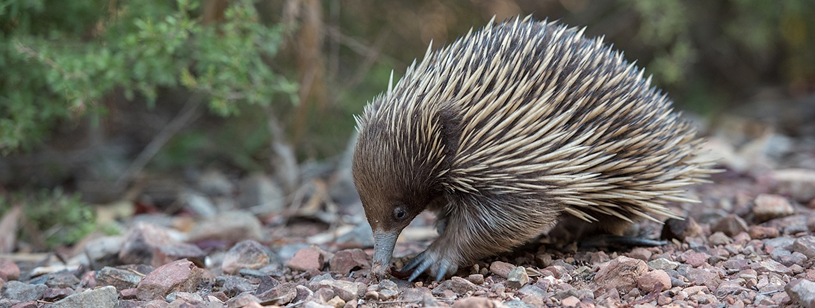
Echidnas are egg-laying mammals in the family Tachyglossidae. They include the short-beaked echidna and long-beaked species of New Guinea. Their young receive milk, but the mother has no nipples; diet and conservation status differ between species.
Echidnas have spines and a long snout. Short-beaked and long-beaked species differ in their diets and distribution; long-beaked echidnas are not simply Australian ant-eaters.
Echidnas disturb soil while foraging and occupy a range of habitats in Australia and New Guinea.
Quick facts
| Common name | Echidna |
| Scientific name | Tachyglossidae |
| Typical lifespan | Often 10-15 years or more in the wild; up to about 50 years in captivity |
| Maximum speed | Slow; walks at about 2-3 km/h |
| Length | About 30-45 cm (short-beaked); long-beaked species larger |
| Weight | About 2-7 kg (short-beaked); up to about 16 kg (long-beaked) |
| Diet type | Insectivore (ants, termites, larvae); long-beaked species mainly earthworms |
| Main predators | Dingoes, foxes, cats, goannas, Tasmanian devils, humans |
| Conservation status | Short-beaked echidna: Least Concern; all three long-beaked species: Critically Endangered (IUCN) |
| Distribution | Australia, Tasmania, New Guinea |
| Habitat | Forests, grasslands, deserts, mountains, farmland |
- Primary category:Mammals
- Explore this animal's categories:
Interesting facts
- An ancient lineage - Echidnas and the platypus are monotremes, a group of mammals that split from all other living mammals well over 150 million years ago, in the age of dinosaurs.
- Eggs and milk - The female lays a single soft egg into a temporary pouch, where it hatches after about 10 days; the baby, called a puggle, then drinks milk.
- The male echidna has a four-headed penis. This anatomical feature should not be described as four heads each operating independently.
- Electric sense - Echidnas have electroreceptors in their snout that may help them find prey in moist soil, although this sense is much weaker than in the platypus.
- No teeth - Instead, they crush their food between hard spines on the back of the tongue and the roof of the mouth.
- Tough in hot and cold places - Echidnas live everywhere from snowy mountains to deserts.
- Spiky defence - When in danger, an echidna curls into a spiky ball or quickly digs itself into the ground.
- Hibernation - In cold areas, echidnas hibernate for several months in winter.
- Long-lived - Echidnas live a long time for their size; one lived about 50 years in a zoo.
- A cool body - Their body temperature, around 32 °C, is one of the lowest of any mammal, and they use very little energy.
Records and remarkable features
- Echidnas lay eggs and feed their young with milk, which is released without nipples.
- Monotremes (echidnas and the platypus) are the only living mammals that lay eggs.
- Long-beaked echidnas can weigh up to about 16 kg, making them the largest living monotremes.
Characteristics
The echidna is a very unusual mammal. It looks a little like a hedgehog and eats like an anteater, but it lays eggs and belongs to a completely separate group of mammals.
Main physical characteristics:
- Size - The short-beaked echidna is about 30-45 cm long and weighs about 2-7 kg; long-beaked echidnas are larger.
- Fur and spines - Its body is covered with fur and sharp spines made of keratin, used for defence.
- A long, sensitive snout - Used to smell and feel for prey, and to poke into ant and termite nests.
- A long, sticky tongue - It can stick out about 15-18 cm from the snout to pick up ants and termites.
- Short, strong legs - With powerful claws for digging and breaking open nests; the long claws on the back feet point backwards and are used for grooming between the spines.
- No external ears - Its ear openings are hidden under the fur, but its hearing is good, especially for low sounds.
- No teeth - Food is crushed by hard spines on the tongue and palate.
- Slow metabolism - It has one of the lowest metabolic rates of any mammal, so it needs little energy.
Special adaptations for survival:
- Defence - When in danger, the echidna curls into a ball or digs straight down into the soil, leaving only its spines showing.
- Hibernation - In cold areas, echidnas hibernate for several months.
- Coping with heat - Echidnas cannot sweat or pant, so in hot weather they shelter in burrows, logs and caves and are active at night.
- Electroreception - Receptors in the snout can sense weak electrical signals from prey in moist soil.
Habits and behaviour
The echidna is a shy, solitary animal. Its activity depends on temperature: in cool weather it is active during the day, and in hot weather it comes out at night.
Social behaviour:
- Living alone - Echidnas live alone and meet other echidnas mainly in the breeding season.
- Home ranges - Each echidna has a home range, which overlaps with those of its neighbours; they do not defend territories.
- Active when it is cool - Echidnas avoid heat and feed when temperatures are mild.
Breeding season:
- Winter (about June-September) - Males follow a female in "echidna trains", lines of up to about 10 males following one female, sometimes for weeks.
- The female lays a single egg into a temporary pouch, where it hatches after about 10 days.
Defence and survival methods:
- Fast digging - If attacked, the echidna digs into the soil so that only its spines are exposed.
- Curling up - On hard ground, it curls into a ball of spines that few predators can open.
- Wedging - It can wedge itself into a crack or log, holding on with its strong legs.
Habitat and geographic distribution
Echidnas are very adaptable and live in many habitats, from rainforests and mountains to deserts and farmland.
Habitat types:
- Forests and woodlands - Give them shelter and plenty of food.
- Grasslands and open country - Echidnas can live in areas with sparse vegetation, as long as there are ants and termites.
- Mountains and cold areas - In Tasmania and the Australian Alps, they hibernate in winter.
- Deserts and dry areas - They shelter from the heat in burrows, caves and under rocks, and get much of their water from food.
Geographic distribution and estimated population:
| Region | Species present | Estimated population |
|---|---|---|
| Australia | Short-beaked echidna (Tachyglossus aculeatus) | Widespread and common |
| Tasmania | Short-beaked echidna (Tachyglossus aculeatus setosus) | Widespread and common |
| New Guinea | Long-beaked echidnas (Zaglossus spp.) and the short-beaked echidna | Long-beaked species are Critically Endangered |
Impact of climate change and human activities:
- Habitat loss - Land clearing and bushfires affect echidnas in some areas.
- Road deaths - Echidnas are slow and are often hit by cars on Australian roads.
- Predators - Dingoes, foxes, cats and goannas can kill echidnas, especially young ones.
- Hunting - In New Guinea, long-beaked echidnas are hunted for meat.
The echidna is one of the most adaptable mammals, but its habitats still need protection.
Diet and feeding
The short-beaked echidna eats mainly ants and termites, which is why it is also called the "spiny anteater". Long-beaked echidnas eat mainly earthworms.
Main food:
- Ants and termites - The main food of the short-beaked echidna.
- Larvae - Beetle and moth larvae are an important, nutritious part of the diet.
- Earthworms - The main food of long-beaked echidnas, and sometimes eaten by short-beaked echidnas.
- Soil and plant material - Echidnas swallow a lot of soil and bits of plants along with their prey.
Diet by habitat:
| Habitat | Type of food consumed |
|---|---|
| Temperate forests | Ants, termites, beetle larvae |
| Deserts and dry areas | Termites and ants |
| Mountain forests of New Guinea | Earthworms (long-beaked echidnas) |
| Grasslands and farmland | Ants, termites, larvae |
Feeding methods:
- Finding prey - Echidnas find prey mainly by smell, and possibly also with electroreceptors in the snout.
- A long, sticky tongue - It can flick in and out up to about 100 times a minute to collect insects.
- No teeth - Food is ground between hard spines on the tongue and the roof of the mouth before it is swallowed.
- Digging - They use their strong claws to break open ant nests, termite mounds and rotting logs.
Reproduction and life cycle
The echidna has one of the most unusual ways of reproducing of any mammal. Instead of giving birth to live young, the female lays a single egg, which hatches in a temporary pouch.
Mating:
- It takes place in winter, mainly from about June to September - Several males follow a female in an "echidna train".
- Unusual courtship - Males may dig a trench around the female and push each other away until only one is left to mate.
Gestation and birth:
- The female lays a single egg - About 3 weeks after mating, she lays it straight into a temporary pouch that forms on her belly.
- A small, soft egg - It is only about 1.5 cm long and has a soft, leathery shell.
- Incubation lasts about 10 days - The tiny baby, called a puggle, then stays in the pouch.
The development of the puggles:
- For about 7-8 weeks, the puggle stays in the pouch, drinking milk that seeps from milk patches on the mother's skin, as echidnas have no nipples.
- When its spines start to grow, the mother leaves it in a burrow and returns every few days to feed it.
- At about 6-7 months, the young echidna is weaned and becomes independent.
Longevity:
- In the wild - Often 10-15 years or more; some live much longer.
- In captivity - Up to about 50 years.
Name and history
The echidna is named after Echidna, a monster from Greek mythology that was half woman and half snake, because the animal seemed to mix the features of mammals and reptiles.
Origin and etymology of the name:
- The name "echidna" comes from ancient Greek, where it also meant "viper"; European scientists gave it to the animal in the late 18th century.
- The family name Tachyglossidae means "fast tongues", referring to the way they feed.
Taxonomic classification:
| Taxonomic category | Name |
|---|---|
| Kingdom | Animalia |
| Phylum | Chordata |
| Class | Mammalia |
| Order | Monotremata |
| Family | Tachyglossidae |
| Main species | Tachyglossus aculeatus, Zaglossus spp. |
Discovery and Documentation:
- First scientific description - In 1792, the British zoologist George Shaw described the short-beaked echidna, thinking it was a kind of anteater.
- Egg-laying mammals - It was only in 1884 that scientists confirmed that echidnas and the platypus lay eggs.
Role of echidna in mythology and culture:
- Aboriginal stories - The echidna appears in the stories of many Aboriginal peoples, including stories that explain how it got its spines.
- A modern symbol - The echidna is a symbol of Australia's unique wildlife and appears on the Australian 5-cent coin.
Echidnas are living monotremes with an ancient evolutionary lineage, not species that have remained unchanged since the age of dinosaurs.
Cultural significance and mythology
The echidna has an important place in Aboriginal culture and is recognised as a symbol of Australia's unique wildlife.
Echidnas in the mythology and beliefs of Aboriginal Australians:
- Traditional knowledge - Aboriginal peoples have long hunted echidnas for food and know their habits well.
- How the echidna got its spines - In one Aboriginal story, a greedy man who would not share food was driven away with spears, which stuck in his back and turned into spines.
- Totems - For some Aboriginal groups, the echidna is a totem animal.
The symbolism of echidna:
- Protection - Its spines make it a symbol of self-defence.
- Persistence - The echidna is seen as a patient, careful animal that survives in harsh conditions.
- A living link to the past - As an egg-laying mammal, it reminds people of the long evolutionary history of mammals.
Conservation status and threats
Conservation status differs between echidna species. Short-beaked echidnas are more widespread, while long-beaked species face serious threats.
Conservation status
- Short-beaked echidna (Tachyglossus aculeatus) - Least Concern (IUCN); widespread in Australia and New Guinea.
- Long-beaked echidnas (Zaglossus) in New Guinea have species-specific conservation assessments; hunting and habitat loss are important pressures. All three species are listed as Critically Endangered.
Main threats:
- Habitat loss - Clearing land for farming and towns reduces safe places for echidnas.
- Road deaths - Echidnas are slow and are often hit by cars.
- Introduced predators - Foxes, cats and dogs attack echidnas, especially young ones.
- Hunting - In New Guinea, long-beaked echidnas are hunted for meat, often with trained dogs.
- Bushfires - Large fires in Australia can kill echidnas and destroy their habitat and food.
Conservation efforts:
- Protected areas - Echidnas are protected in national parks and reserves in Australia and New Guinea.
- Rediscovery - In 2023, Attenborough's long-beaked echidna was filmed for the first time in Indonesia's Cyclops Mountains, after decades without a confirmed record.
- Citizen science - In the EchidnaCSI project, people in Australia send photos and droppings of echidnas to help scientists study them.
- Working with local communities - In New Guinea, researchers work with local people to protect long-beaked echidnas.
In popular culture
The echidna is a symbol of Australia and appears in books, television, video games and sport.
Echidna in literature:
- Aboriginal stories - Traditional stories explain the origin of the echidna's spines.
- Children's books - The echidna is a popular character in Australian children's books about wildlife.
Echidna in cinematography and television:
- Nature documentaries - Echidnas often appear in documentaries about Australia's strange and unique animals.
- Knuckles (2024) - A TV series about the video-game character Knuckles the Echidna.
Echidnas in video games and comic books:
- Knuckles the Echidna (Sonic the Hedgehog, Sega) - The most famous echidna character, first seen in Sonic the Hedgehog 3 (1994); he also appears in the Sonic films from 2022.
- Educational games - Echidnas appear in children's games about Australian wildlife.
Echidnas in sport and emblems:
- Millie - An echidna named Millie was one of the three mascots of the Sydney 2000 Olympic Games.
- Coins and souvenirs - The echidna appears on the Australian 5-cent coin and on many souvenirs.
Echidnas in music and art:
- Aboriginal art - The echidna is often painted in traditional Aboriginal art.
- Wildlife art - Echidnas are popular subjects for Australian artists and photographers.