EarwigInteresting facts and information
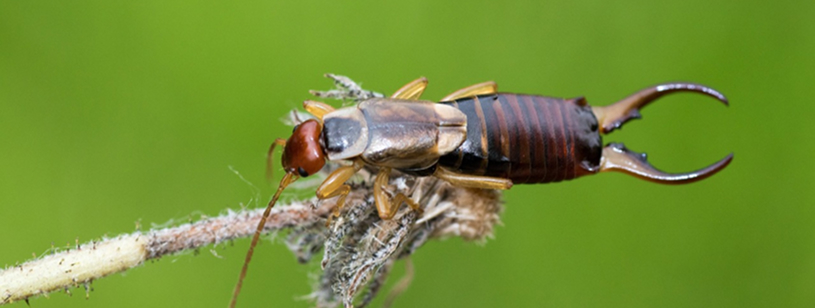
The European earwig (Forficula auricularia) is an omnivorous insect recognised by the pincers at the end of its abdomen, used in defence and other interactions, including mating.
Earwigs do not seek out human ears to lay eggs, despite the familiar myth. They eat small invertebrates, including aphids, as well as plant material and decaying matter.
They can be garden pests when eating living plants, but also act as predators and scavengers. Their effect depends on food, abundance and local conditions.
Quick facts
| Common name | European earwig |
| Scientific name | Forficula auricularia |
| Typical lifespan | About one year in temperate regions |
| Length | Usually about 10–20 mm, including the pincers |
| Weight | A few tens of milligrams |
| Diet type | Omnivorous: small invertebrates, plant material, fruit and decaying matter |
| Main predators | Birds, spiders, toads, ground beetles and other insect-eating animals |
| Conservation status | Not threatened; widespread and common |
| Distribution | Native to Europe, western Asia and North Africa; introduced to the Americas, Australia and New Zealand |
| Living environment | Gardens, grassland, woodland litter and sheltered cracks, especially in damp places |
- Primary category:Insects
- Explore this animal's categories:
Interesting facts
- Caring mothers - Female earwigs guard and clean their eggs and protect the newly hatched nymphs, which is unusual among insects.
- Harmless to people - Earwigs can give a small pinch with their pincers, but they have no venom and do not seek out human ears.
- Folded wings - The European earwig has large hindwings folded many times under its short forewings, but it is much more often seen walking than flying.
- Different pincers - Males usually have strongly curved pincers, while females have straighter ones.
- Winter shelters - In cold regions, earwigs spend the winter in sheltered places, such as burrows in the soil.
Records and remarkable features
- Forficula auricularia is a familiar earwig originally from Europe that has been introduced to many other parts of the world, including North America, Australia and New Zealand.
- Male pincer size varies a lot between individuals; males with long pincers often win more contests over females.
- Some other earwig species are much larger: the Australian Titanolabis colossea can reach about 5 cm, and the Saint Helena giant earwig, now extinct, was up to about 8 cm long.
- Temperate populations overwinter in sheltered sites, often with the female guarding her eggs in a burrow.
- Defensive secretions can produce an unpleasant smell, helping discourage predators.
Physical characteristics and adaptations
Earwigs are small insects with long, flat bodies. Their most distinctive feature is the pair of pincers, or cerci, at the end of the abdomen, used in defence, handling prey and mating.
Key physical adaptations
- Flattened, elongated body: allows them to squeeze under bark and into narrow cracks.
- Distinctive pincers: usually strongly curved in adult males and straighter in females.
- Long antennae: help them feel their way and find food in the dark.
- Folded wings: thin hindwings are folded like a fan and then folded again, to fit under short, hard forewings.
- Brown colouring: blends with soil, bark and leaf litter.
Differences between sexes
| Characteristic | Males | Females |
|---|---|---|
| Size | Similar to females; varies between individuals | Similar to males; varies between individuals |
| Pincers | Usually strongly curved, like calipers | Usually straighter and closer together |
| Behaviour | Use their pincers in contests with other males and in courtship | Guard eggs and young nymphs |
Habits and behaviour
Earwigs are mainly nocturnal and hide by day in damp, dark places. Many may share the same shelter, but they do not form organised colonies like ants or bees.
Daily life
- By day they hide under stones, leaves and bark or inside cracks.
- At night they come out to look for food.
- Many earwigs can gather in the same hiding place, attracted by each other's scent.
Communication and defence
- Chemical signals help earwigs gather together and find mates.
- They raise and use their pincers to defend themselves.
- Glands on the abdomen can release a smelly liquid that deters predators.
Survival strategies
- Hiding among leaves, in soil and in sheltered cracks.
- Staying in damp places to avoid drying out.
- Spending the winter underground or in other sheltered places.
Habitat and geographic distribution
There are about 2,000 species of earwigs, found on every continent except Antarctica. The European earwig is native to Europe, western Asia and North Africa and has been introduced to many other regions.
Distribution context
| Region | Population information | Habitat examples |
|---|---|---|
| Europe | Native and very common | Woodland, gardens and grasslands |
| North America | Introduced in the early 20th century; now widespread | Gardens, orchards and buildings |
| Asia | Native in western Asia; many other earwig species further east | Wooded and cultivated habitats |
| Africa | Native in North Africa; many other earwig species elsewhere | Damp, sheltered sites |
| Australia and New Zealand | Introduced | Gardens, orchards and grassland |
Habitat types
- Woodland and grassland: plants and leaf litter provide hiding places.
- Gardens and farms: soil and plants offer food and shelter.
- Damp places: earwigs need humid shelters and avoid dry conditions.
- Cracks and man-made shelters: they hide under pots and stones and sometimes enter houses.
Environmental change
- Gardens and towns: offer many hiding places, and earwigs are common in them.
- Pesticides: can reduce earwig numbers along with other insects.
- Climate: temperature and moisture affect their development and where they can live.
Diet and feeding
Earwigs are omnivores that eat both plants and small animals, as well as dead and decaying matter.
What do earwigs eat?
| Food group | Examples |
|---|---|
| Small invertebrates | Aphids, mites, insect eggs and small larvae |
| Plants and fruit | Petals, young leaves, seedlings and soft or damaged fruit |
| Decaying matter | Dead and rotting plant material |
| Fungi | Mould and other fungi |
Feeding methods
- Hunting: they catch small invertebrates, sometimes holding them with their pincers.
- Scavenging: they eat dead and damaged organic matter.
- Eating plants: where earwigs are numerous, they can damage flowers such as dahlias, seedlings and soft fruit.
Reproduction and life cycle
Earwigs develop by incomplete metamorphosis: from egg, through several nymph stages, to adult, without a pupa. The care given by the mother is unusual among insects.
Mating season
- In the European earwig, mating usually takes place in autumn, and the female lays her eggs in a burrow in winter.
- Males use their pincers in contests and courtship.
- A female usually lays a few dozen eggs and may lay a second, smaller batch in spring.
Developmental stages
| Stage | Duration | Characteristics |
|---|---|---|
| Egg | From about a week to several months, depending on temperature | Laid in a burrow and cared for by the female |
| Nymph | Several weeks | Looks like a small, pale adult without fully developed wings; moults four times |
| Adult | Usually several months; many live about a year in total | Mates and, in females, lays eggs |
Maternal behaviour
- The female licks and turns her eggs, which helps protect them from mould.
- After hatching, she protects the young nymphs and may feed them with regurgitated food.
- After a few weeks, the nymphs leave the nest and live on their own.
Name and history
Origin of the name
- The English name comes from Old English ēarwicga, "ear insect", from an old belief that earwigs crawl into people's ears. Earwigs do not seek out human ears.
- In the scientific name, Forficula means "small scissors", after the pincers, and auricularia means "of the ear".
Taxonomic classification
| Classification | Name |
|---|---|
| Kingdom | Animalia |
| Phylum | Arthropoda |
| Class | Insecta |
| Order | Dermaptera |
| Family | Forficulidae |
| Genus | Forficula |
| Species | Forficula auricularia |
Evolution and fossils
- Earwigs have an ancient fossil history; early relatives of earwigs are known from the Jurassic period.
- The order name Dermaptera means "skin wings", referring to their leathery forewings.
Cultural significance and mythology
The best-known belief about earwigs is that they crawl into people's ears. It appears in the earwig's name in many languages.
Myths and beliefs
- The ear myth: old stories say that earwigs crawl into ears, even into the brain, to lay eggs. This is not true, although any small insect can occasionally crawl into an ear by accident.
- Names in other languages: the French perce-oreille ("ear piercer"), the German Ohrwurm ("ear worm") and the Romanian urechelniță all refer to the ear.
- "Earworm": the German word Ohrwurm also means a catchy tune that gets stuck in your head, which gave English the word "earworm".
Conservation status and threats
The European earwig is widespread and common and is not threatened. Some other earwig species are rare, and the Saint Helena giant earwig was declared extinct in 2014.
Main pressures
- Pesticides: insecticides can harm earwigs and other non-target animals.
- Habitat change: removing leaf litter, bark and stones takes away their shelter.
- Introduced predators: on islands such as Saint Helena, introduced mice, rats and centipedes, together with habitat loss, are thought to have contributed to the giant earwig's extinction.
Ecological benefits
- Pest control: eating aphids and other small insects helps control some pests, especially in orchards.
- Decomposition: by eating dead plant matter, earwigs help recycle nutrients.
Supporting useful garden wildlife
- Avoid unnecessary pesticides where earwigs help control pests.
- Provide shelters, such as pots filled with straw in fruit trees, which gardeners use to attract earwigs that eat aphids.
- Check the damage before treating earwigs as pests; in many gardens they do more good than harm.
Earwigs in popular culture
Their pincers and unusual name make earwigs familiar and slightly feared insects.
Books and films
- "Earwig and the Witch" - A children's book by Diana Wynne Jones (2011), made into a Studio Ghibli film in 2020; the heroine is a girl called Earwig.
- Horror stories - The old ear myth has inspired several horror tales, including an episode of the American television series "Night Gallery".
Public perceptions
- A mixed garden reputation: some gardeners value earwigs as predators of aphids, while others dislike them for damaging flowers and fruit.