ZebrafishDanio rerio — habitat, diet and reproduction
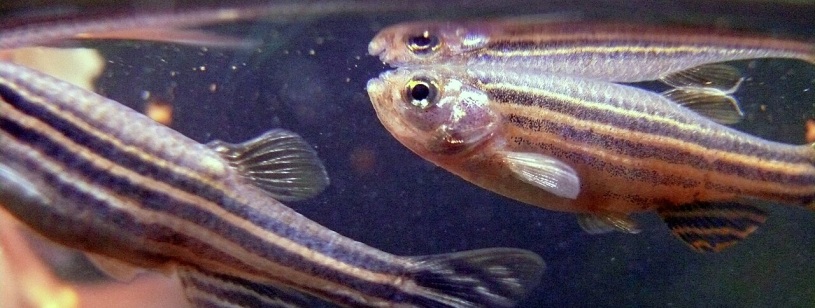
Zebrafish (Danio rerio) in an aquarium. · Pogrebnoj-Alexandroff / CC BY-SA 3.0 (https://creativecommons.org/licenses/by-sa/3.0). Cropped and resized.
The zebrafish is a small freshwater fish from South Asia with blue stripes along its body. It is loved in aquariums for being active and hardy. It is also one of the most important laboratory animals, used to study development, disease and regeneration.
Quick facts
| Common name | Zebrafish, zebra danio |
| Scientific name | Danio rerio |
| Lifespan | About 2–3 years, sometimes up to 5 |
| Length | About 4–5 cm |
| Diet | Omnivore: small insects, larvae, zooplankton, algae |
| Predators | Larger fish, waterbirds |
| Conservation status | Least Concern (LC) |
| Distribution | India, Bangladesh, Nepal, Pakistan |
| Habitat | Slow or still waters, rice paddies, channels, streams |
| Family | Danionidae |
| Reproduction | Eggs scattered on the bottom, no care |
- Primary category:Fish
- Explore this animal's categories:
Interesting facts
- Zebrafish embryos are transparent, so researchers can watch organs grow under a microscope.
- The zebrafish can regrow part of its heart, its fins and its retina.
- Fluorescent “GloFish” are zebrafish genetically modified with genes from jellyfish and corals.
- An embryo becomes a swimming larva in just two to three days.
Characteristics
The zebrafish has a slim, elongated body with five horizontal blue stripes on a silver or golden background, continuing onto the tail fin.
Females are slightly larger with rounder bellies, while males have more golden tones between the stripes. Two pairs of small barbels sit near the mouth.
Behaviour
It is a very active schooling fish that swims quickly, mostly near the surface, and often chases others playfully.
Groups form a hierarchy, and aquarists recommend at least six fish together so they feel calmer.
Habitat and distribution
The species naturally lives in South Asia, in the Ganges and Brahmaputra basins of India, Bangladesh, Nepal and Pakistan.
It favours slow or still, shallow, vegetated waters: rice paddies, irrigation channels, ponds and streams.
Diet and feeding
Zebrafish eat small insects that fall on the water, mosquito larvae, zooplankton and algae.
In aquariums they get tropical flakes and live or frozen food such as daphnia or mosquito larvae, fed little and often.
Reproduction and life cycle
Females spawn at first light in the morning, scattering hundreds of transparent eggs on the bottom. Males fertilise them, and parents give no care and may even eat them.
Larvae hatch after 2–3 days, and fish mature in about three months, so researchers can study several generations quickly.
Name and history
The scientific name Danio rerio comes from a local name used in Bengal. The English name refers to its zebra-like stripes.
Since the 1970s, researchers have used the zebrafish as a “model organism”. Many of its genes resemble human genes, and studies have improved understanding of heart disease, cancer and embryo development.
Conservation and threats
The species is assessed as Least Concern. Nearly all traded and laboratory fish are captive-bred.
Wild populations are locally affected by pollution and land-use change. Like any aquarium fish, it must not be released into nature.
Frequently asked questions
Why are zebrafish used in laboratories?
Their embryos are transparent and develop quickly, and many of their genes resemble human genes.
How big does a zebrafish get?
Usually 4–5 cm.
What are GloFish?
Zebrafish genetically modified to glow in fluorescent colours.
How many zebrafish should be kept together?
At least six, because they are schooling fish.