Giant pandaInteresting facts and information
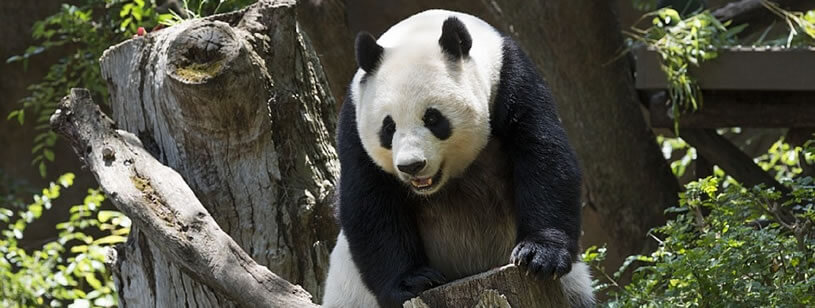
The giant panda (Ailuropoda melanoleuca) is a bear native to China. Bamboo makes up most of its diet, although its digestive system retains many features of a carnivore. Its enlarged wrist bone helps it grip bamboo stems.
The giant panda belongs to the bear family, Ursidae, and lives in cool, damp mountain forests in central China, where bamboo grows thickly.
IUCN moved the giant panda from Endangered to Vulnerable in 2016. Continued habitat protection remains important.
Quick facts
| Common name | Giant panda |
| Scientific name | Ailuropoda melanoleuca |
| Typical lifespan | About 15-20 years in the wild, up to about 30-38 years in captivity |
| Maximum speed | Usually walks slowly, but can trot or run for short distances |
| Height | About 60-90 cm at the shoulder; body length 120-150 cm |
| Weight | About 70-160 kg (males), 60-125 kg (females) |
| Diet | Mainly bamboo; occasional animal foods do not make it an obligate herbivore |
| Main predators | Leopards, dholes and martens (for cubs); humans in the past |
| Conservation status | Vulnerable (IUCN) |
| Geographic distribution | China (Sichuan, Shaanxi, Gansu) |
| Habitat | Bamboo forests in mountains at about 1,200-3,500 m |
| Social behaviour | Solitary |
| Special adaptations | Enlarged wrist bone for gripping bamboo and strong jaws for chewing; digestion retains carnivore-like features |
- Primary category:Mammals
- Explore this animal's categories:
Interesting facts
- A bear that eats bamboo - A giant panda can eat about 12-40 kg of bamboo a day, although its digestive system is still much like that of a meat-eater.
- A false thumb helps giant pandas grip bamboo. It is formed from an enlarged wrist bone.
- Tiny babies - Newborn panda cubs weigh only about 90-130 grams, about 1/900 of their mother's weight.
- No hibernation - Unlike many other bears, pandas stay active all year, because bamboo is always available.
- Eating most of the day - Because bamboo has few nutrients, a panda spends up to about 14 hours a day eating.
- The black-and-white coat may help with camouflage, but its functions are still being studied.
Records and remarkable features
- The giant panda (Ailuropoda melanoleuca) is a bear native to China.
- Compared with its mother, a newborn giant panda is one of the smallest babies of any placental mammal.
- Jia Jia, a giant panda in Hong Kong, lived to 38, one of the oldest pandas ever recorded.
Characteristics
The giant panda (Ailuropoda melanoleuca) has a unique set of features that allow it to survive in the bamboo forests of China's mountains. Although it belongs to the bear family, Ursidae, it differs from other bears in its diet and behaviour.
Appearance
- Black-and-white fur - The giant panda has thick, woolly, slightly oily fur that keeps it warm and dry in cool, damp mountain forests.
- A sturdy body - Although it looks heavy, the panda is a good climber and surprisingly flexible.
- Strong paws and curved claws - Its claws help it climb trees and grip bamboo.
- An enlarged wrist bone acts as a false thumb, helping the panda grip bamboo stems.
- A big head with strong jaw muscles - These give the panda a powerful bite for crushing tough bamboo stems.
- Black eye patches - Scientists think they may help pandas recognise each other and signal to rivals.
Special adaptations
- A carnivore's gut eating plants - Its digestive system is short and simple, like a carnivore's, so it digests only a small part of the bamboo it eats.
- Saving energy - Pandas move slowly and rest a lot, which helps them survive on a low-energy diet.
- Camouflage - Research suggests that the white parts help pandas blend into snow and the black parts help them hide in shade.
Habits and behaviour
Giant pandas are usually calm and live alone, except during the breeding season and when mothers raise their cubs.
Social behaviour
- Solitary - Adults mark their home ranges with scent from glands under the tail and usually avoid other pandas, except when mating.
- Overlapping ranges - Pandas' home ranges often overlap, and fights are rare.
- Sounds and scents - Pandas communicate with bleats, honks, barks and growls, and by leaving scent marks on trees.
- Active at dawn and dusk - Pandas eat and rest throughout the day and night, with peaks of activity in the early morning and evening.
Survival techniques
- Eating a lot - Because bamboo has few nutrients, pandas spend many hours a day eating.
- Coping with cold - Their thick fur protects them in mountain forests, where they live at altitudes of about 1,200-3,500 metres or more.
- Climbing and swimming - Pandas are good climbers and can swim, which helps them escape danger.
- Playful cubs - Young pandas are very playful, which helps them develop strength and coordination.
Habitat and geographic distribution
The giant panda lives only in China, in bamboo-rich forests in a few mountain ranges.
| Region | Wild population (2014 census) | Preferred habitat |
|---|---|---|
| Sichuan (China) | About 1,390 pandas | Mountain bamboo forests |
| Shaanxi (China) | About 345 pandas | Mixed forests of the Qinling Mountains |
| Gansu (China) | About 130 pandas | Mountain forests with dense bamboo |
Types of habitat
- Bamboo forests - Pandas live in cool, damp mountain forests with plenty of bamboo, mostly at altitudes of about 1,200-3,500 metres.
- Mountain areas - They prefer steep, remote slopes away from people.
- Mixed forests - Some live in forests of conifers and broadleaved trees, but always where bamboo grows.
Human impact and threats
- Habitat loss - Clearing forests for farming and settlements once caused the panda's range to shrink greatly.
- Fragmented populations - Roads and villages have split pandas into small, isolated groups, reducing their genetic diversity.
- Climate change - Rising temperatures may reduce the areas where the bamboo that pandas eat can grow.
- Poaching - Pandas are strictly protected today, but in the past they were hunted for their fur.
Diet and feeding
The giant panda has one of the most specialised diets of any bear: it eats almost only bamboo. Although most bears eat both plants and meat, the panda has become a near-vegetarian.
What do giant pandas eat?
| Type of food | Share of the diet |
|---|---|
| Bamboo (stems, leaves and shoots) | About 99% |
| Other plants, such as grasses and wild fruit | Occasionally |
| Eggs, insects, small animals or carrion | Rarely |
Feeding techniques
- The false thumb helps a giant panda hold and manipulate bamboo.
- Strong teeth - Pandas have large, flat molars for crushing and grinding tough bamboo.
- Eating large amounts - Because pandas digest only a small part of what they eat, they must eat about 12-40 kg of bamboo a day.
- Choosing the best parts - Pandas prefer young shoots and leaves, which are more nutritious and easier to chew, and they switch between parts of the plant with the seasons.
Reproduction and life cycle
The giant panda breeds very slowly, which makes its population vulnerable. Females usually give birth every 2-3 years, and the cubs depend on their mother for about 1.5-2 years.
| Feature | Details |
|---|---|
| Age at maturity | About 4-7 years |
| Breeding season | March - May |
| Type of reproduction | Live birth |
| Cubs per birth | 1-2 (in the wild, usually only one is raised) |
| Pregnancy | About 95-160 days (including delayed implantation) |
| Birth weight | About 90-130 g |
| Age at independence | About 1.5-2 years |
| Lifespan | About 15-20 years in the wild, up to about 30-38 years in captivity |
Mating
- Females can conceive on only 2-3 days a year, which makes breeding difficult.
- Males may compete for a female, calling and fighting.
- Delayed implantation - After mating, the embryo may wait before it starts to develop, so the length of pregnancy varies.
Birth and raising cubs
- Tiny newborns - At birth, a cub is pink, blind and almost hairless and weighs about 1/900 of its mother's weight.
- A devoted mother - The mother holds her cub close almost all the time for its first weeks and nurses it for many months.
- Growing up - Cubs open their eyes at about 6-8 weeks, start walking at about 3-4 months and begin eating bamboo at about 6 months.
- Independence - At about 1.5-2 years old, young pandas leave their mother to live alone.
Name and history
Western scientists first described the giant panda in 1869, but people in China have known it for thousands of years.
Origin of the name
- "Panda" was first used for the red panda, and the word may come from a Nepali name for that animal; the giant panda was named later because of their similar diets.
- The scientific name Ailuropoda melanoleuca means "black-and-white cat-foot".
- In China, the giant panda is called dà xióngmāo, "giant bear-cat".
The giant panda in human history
- Ancient China - A panda skull was found in the tomb of a Chinese empress of the Han dynasty, from the 2nd century BC.
- 1869 - The French missionary and naturalist Armand David sent the first panda specimen to Europe.
- 1936 - Su Lin, a panda cub, became the first live giant panda taken outside China, to a zoo near Chicago.
- Panda diplomacy - In 1972, China gave two pandas to the United States, and since then pandas have been loaned to zoos around the world as symbols of friendship.
The giant panda in folklore
Cultural significance and mythology
- A national treasure - The giant panda is one of China's best-loved national symbols.
- A legend of mourning - A Chinese folk tale tells that pandas were once all white, but when they mourned the death of a kind shepherd girl, they wore black armbands, and the black dye ran onto their eyes, ears and legs.
- The WWF logo - Since 1961, a giant panda, inspired by a panda called Chi Chi at London Zoo, has been the symbol of the conservation organisation WWF.
Conservation status and threats
The giant panda was listed as Endangered for many years, but thanks to conservation efforts its wild population has grown. In 2016, the IUCN moved it to Vulnerable, but it still needs protection.
| Status | Population | Regions |
|---|---|---|
| Vulnerable (IUCN) | About 1,860 pandas in the wild (2014 census) | Mountains of Sichuan, Shaanxi and Gansu, China |
| In captivity | More than 600 pandas in breeding centres and zoos | China and zoos around the world |
Main threats
- Habitat loss - Clearing land for farming, roads and building reduces bamboo forests.
- Climate change - Warming may shrink the areas where bamboo can grow.
- Fragmented populations - Many pandas live in small, separate groups, which reduces genetic diversity and breeding chances.
- Bamboo die-offs - Bamboo plants of the same species flower and die at the same time every few decades, which can leave pandas short of food.
Conservation efforts
- Reserves and a national park - China has created more than 60 panda reserves, and in 2021 it established the Giant Panda National Park, covering much of the panda's range.
- Captive breeding - Centres such as those at Wolong and Chengdu have greatly increased the number of pandas in captivity.
- Release into the wild - Some young pandas raised in captivity are trained to survive in nature and released into protected forests.
- Logging bans - China has banned logging in many panda areas.
- Wildlife corridors - Bamboo corridors are planted to connect separate panda populations.
In popular culture
- Kung Fu Panda (2008) - Po, a clumsy but brave giant panda, becomes a kung fu master in this popular animated film series.
- Olympic mascots - Jingjing, one of the mascots of the 2008 Beijing Olympics, and Bing Dwen Dwen, the mascot of the 2022 Beijing Winter Olympics, are pandas.
- Zoo stars - Panda cubs born in zoos around the world attract huge crowds and media attention.