SeahorseInteresting facts and information
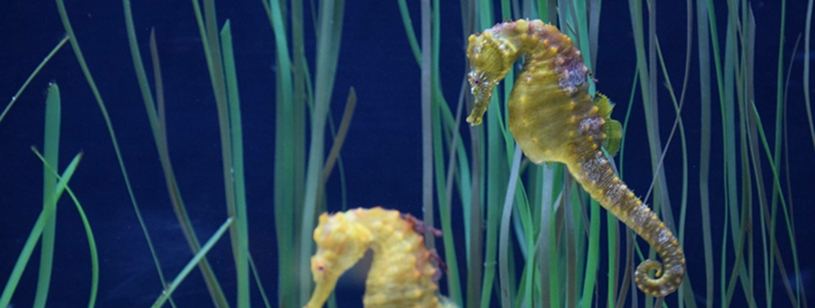
Seahorses (Hippocampus) are fish in the family Syngnathidae, together with pipefish and seadragons. They usually swim upright and use a long snout to suck in small prey. In seahorses, males carry developing young in a specialised brood pouch.
Seahorses suck small prey into their mouths through a tubular snout. They use fins to move and often grip vegetation or other structures with the tail.
Colour and body form can help seahorses blend into their surroundings. Habitat use differs between species.
Quick facts
| Common name | Seahorse |
| Scientific name | Hippocampus |
| Typical lifespan | 1 to 5 years (depending on species) |
| Maximum speed | Very slow; the dwarf seahorse moves about 1.5 m per hour |
| Dimensions | About 1.5 - 35 cm (depending on species) |
| Weight | From less than 1 g to about 100 g |
| Diet type | Carnivore (zooplankton, small crustaceans) |
| Main predators | Large fish, crabs, rays, seabirds, humans (by excessive collection) |
| Conservation status | Assess separately by species; some are threatened and others have insufficient data |
| Distribution | Shallow tropical and temperate seas: Atlantic, Pacific and Indian Oceans, Mediterranean |
| Habitat | Coral reefs, estuaries, seaweed beds, seagrass meadows, mangroves |
- Primary category:Fish
- Explore this animal's categories:
Interesting facts
- Male brooding – Male seahorses carry developing young in a brood pouch. Male brooding also occurs in related pipefishes and seadragons.
- No stomach - Seahorses have no true stomach; food passes through quickly, so they must eat often.
- Upright swimmers - Unlike most fish, seahorses swim with their bodies upright.
- Pair bonds – Some seahorses form lasting pair bonds, but lifelong monogamy is not universal.
- Colour change - Seahorses can change colour to blend in with their surroundings or during courtship.
- No scales - Instead of scales, their bodies are covered by skin stretched over bony plates.
- Very slow - The dwarf seahorse is one of the slowest fish in the world, moving only about 1.5 metres per hour.
Records and remarkable features
- Small seahorses – Hippocampus satomiae is a tiny pygmy seahorse; later discoveries mean a smallest-species ranking should not be assumed.
- Large species – The big-bellied seahorse, Hippocampus abdominalis, is among the larger seahorses.
- Masters of disguise - The pygmy seahorse Hippocampus bargibanti lives on sea fans and looks almost exactly like their pink or yellow polyps.
- Seahorses have a body supported by bony plates and a flexible grasping tail; vertebral counts vary between species.
- Brood size – The number of young varies greatly with species and individual size.
Characteristics
Seahorses are bony fish with a stiff, armoured body and a horse-like head. They have no tail fin and swim mainly by fluttering their small dorsal fin.
Main physical characteristics:
| Characteristic | Details |
|---|---|
| Length | About 1.5-35 cm (depending on species) |
| Weight | From less than 1 g to about 100 g |
| Body Structure | Bony plates under the skin instead of scales |
| Fins | Dorsal fin for propulsion; pectoral fins for steering and balance |
| Tail | Prehensile, for gripping plants and corals |
| Camouflage | Can change colour; some grow skin filaments that look like seaweed |
| No stomach | Food passes through quickly, so they need to eat often |
Special adaptations:
- A bent neck - Seahorses can flick their heads upward very fast to catch prey.
- The prehensile tail - It grips seaweed, seagrass and coral, helping them stay in place in currents.
- Suction feeding - Their tube-shaped snout sucks in small crustaceans with a rapid movement of the head.
- Independent eyes - Each eye can move separately, so a seahorse can look in two directions at once.
Habits and behaviour
Seahorses spend most of their time holding on to seaweed, seagrass or coral with their tails, waiting for prey to drift by.
Social behaviour:
- Pairs - Many species form pairs that stay together at least for a breeding season.
- Communication by colour - They change colour to signal to partners or when stressed.
- Morning greetings - In some species, partners meet every morning, change colour and swim together with linked tails.
Food and hunting techniques:
- Carnivores - They eat small crustaceans and other tiny animals.
- Ambush hunters - They wait still until prey comes close and then suck it in.
- Frequent eating - Because they have no stomach, they need to feed many times a day.
Defense and Survival:
- Camouflage - They can match the colour and texture of plants and corals, becoming almost invisible.
- Holding on - Gripping seaweed and coral with their tails helps them avoid being carried away by currents.
- Armour - Their bony plates make them hard to eat for many predators.
Habitat and geographic distribution
Seahorses live in shallow tropical and temperate seas around the world, in places with plenty of cover, such as seagrass, seaweed, mangroves and coral reefs.
Habitat types:
| Habitat | Predominant species |
|---|---|
| Coral reefs | Hippocampus bargibanti, Hippocampus kuda |
| Seaweed beds | Hippocampus guttulatus, Hippocampus hippocampus |
| Estuaries and coastal waters | Hippocampus erectus, Hippocampus reidi |
| Seagrass meadows and mangroves | Hippocampus zosterae, Hippocampus whitei |
Geographic distribution:
- Pacific and Indian Oceans - Most species live in the Indo-Pacific, for example around Indonesia, the Philippines and Australia.
- The western Atlantic - Species such as Hippocampus erectus and Hippocampus reidi live along the coasts of North and South America.
- The Mediterranean and the eastern Atlantic - Species such as Hippocampus guttulatus and Hippocampus hippocampus live in European waters.
Impact of climate change and human activities:
- Habitat loss - The destruction of coral reefs, seagrass meadows and mangroves affects seahorses.
- Fishing - Seahorses are caught for traditional medicine and the aquarium trade, and many are caught by accident in shrimp trawls.
- Pollution - Coastal pollution damages their habitats and food supply.
- Climate change - Warming and acidification of the oceans affect the plants and corals on which they depend.
Although international trade in seahorses is regulated, their populations are declining in many areas.
Diet and feeding
Seahorses are carnivores that feed on tiny animals, which they catch by rapid suction.
Types of food consumed:
| Food group | Examples |
|---|---|
| Small crustaceans | Copepods, amphipods, mysid shrimps |
| Zooplankton | Fish larvae and other tiny animals |
| Other invertebrates | Small worms and other tiny creatures |
Feeding methods:
- Ambush - They stay still, hidden among plants, and wait for prey to approach.
- Rapid suction - They flick their heads up and suck the prey into their snout in a fraction of a second.
- Frequent feeding - Because they have no stomach, young seahorses in particular eat thousands of tiny animals a day.
Seahorses need a steady supply of small prey.
Reproduction and life cycle
Male seahorses carry embryos in a brood pouch after the female transfers eggs to the male. Similar male brooding occurs in other members of the family Syngnathidae.
Life cycle stages:
| Stage | Approximate duration | Characteristics |
|---|---|---|
| Courtship | Hours to days | Pairs perform dances, changing colour and moving together. |
| Egg transfer | A few seconds | The female places her eggs in the male's pouch, where he fertilises them. |
| Pregnancy | About 10-45 days | The male's pouch supplies oxygen and controls the salt level for the embryos. |
| Birth | Hours | The male releases the young, from a few to more than a thousand, depending on species. |
| Juvenile | Weeks to months | The young feed alone and drift with the plankton before settling. |
Reproductive behavior:
- Pairs - Many species form pairs and repeat daily greetings during the breeding season.
- The male carries the eggs - The pouch protects the embryos and provides oxygen.
- Birth - The young are pushed out by muscle contractions of the male.
After birth, the young receive no care and must survive on their own; only a very small number reach adulthood.
Name and history
The word hippocampus has also been used for a mythical sea creature; the legend should not be confused with the biology of real seahorses.
Origin and etymology of the name:
- "Hippocampus" comes from ancient Greek (hippos = horse, kampos = sea monster), referring to their horse-like head.
- A part of the human brain, the hippocampus, is named after the seahorse because of its curved shape.
Taxonomic classification:
| Taxonomic category | Name |
|---|---|
| Kingdom | Animalia |
| Phylum | Chordata |
| Class | Actinopterygii |
| Order | Syngnathiformes |
| Family | Syngnathidae |
| Genus | Hippocampus |
Sea horse in history and culture:
- Classical art includes mythical hippocamps with a horse-like front and a fish-like tail; these are not zoological depictions of Hippocampus.
- Traditional medicine - Dried seahorses are used in traditional Chinese medicine, although there is no proof that they work.
- Heraldry - Seahorses and hippocamps appear on coats of arms and seals as symbols of the sea.
The seahorse continues to fascinate people, both in science and in culture.
Cultural significance and mythology
Seahorses and their mythical cousins, the hippocamps, have long been linked with the sea and with sea gods.
The seahorse in mythology and popular beliefs:
- The hippocamp of classical mythology is a fictional horse-and-fish creature, distinct from a real seahorse.
- Greek and Roman sea gods such as Poseidon (Neptune) were shown riding in chariots pulled by hippocamps.
- Seahorses have been collected for traditional medicine. This is not evidence of medical effectiveness, and harvesting can threaten wild populations.
Sea horse symbolism:
- Patience and calm - Because they move slowly and gracefully, seahorses are often a symbol of calm.
- Fatherhood - Because males carry the young, seahorses are sometimes used as a symbol of devoted fathers.
- The ocean - The seahorse is a popular symbol of the sea in art and design.
Conservation status and threats
Many seahorse species are threatened by overfishing, bycatch, habitat destruction and trade.
Conservation status
| Species | Status (IUCN) |
|---|---|
| Knysna seahorse (Hippocampus capensis) | Endangered |
| Tiger tail seahorse (Hippocampus comes) | Vulnerable |
| Spotted seahorse (Hippocampus kuda) | Vulnerable |
| Pygmy seahorse (Hippocampus bargibanti) | Data Deficient |
Main threats:
- Fishing for traditional medicine - Tens of millions of seahorses are traded every year, most of them dried.
- Bycatch - Many seahorses are caught by accident in shrimp trawls.
- Habitat destruction - Pollution, coastal building and damage to reefs, seagrass and mangroves reduce their habitats.
- The aquarium trade - Wild seahorses are caught and sold as pets, although many die in captivity.
- Climate change - Warming and acidification of the oceans affect the plants and corals they depend on.
Conservation efforts:
- CITES - Since 2004, international trade in all seahorse species has been controlled under CITES Appendix II.
- Marine reserves - Protected areas in places such as Australia, the Philippines and the Mediterranean give seahorses safe habitats.
- Captive breeding - Breeding seahorses for aquariums can reduce pressure on wild populations.
Seahorse populations still need close monitoring and stronger protection.
In popular culture
Seahorses appear in art, films, books and games as symbols of the mystery and beauty of the oceans.
Seahorses in literature:
- "Sea Horse: The Shyest Fish in the Sea" (Chris Butterworth) - A children's book about the life of seahorses.
- Ocean encyclopedias - Seahorses are popular subjects in books about marine life.
- Myths - In classical stories, hippocamps pull the chariots of sea gods.
Sea horses in cinematography and television:
- "Finding Nemo" (2003, Pixar) - Sheldon is a young, curious seahorse in Nemo's class.
- Nature documentaries have filmed seahorse courtship dances and male "pregnancy".
Seahorses in video games and comic books:
- "Animal Crossing" - The sea horse is one of the fish players can catch.
- "Pokémon" - Horsea is based on a seahorse and evolves into Seadra and Kingdra.
Seahorse as a cultural symbol:
- Design - The seahorse is a popular motif in jewellery, tattoos and graphic design.
- Conservation - Ocean conservation groups use the seahorse as a symbol.
- Decoration - The image of the seahorse often appears in sea-themed decorations.