European bee-eaterMerops apiaster — habitat, diet and reproduction
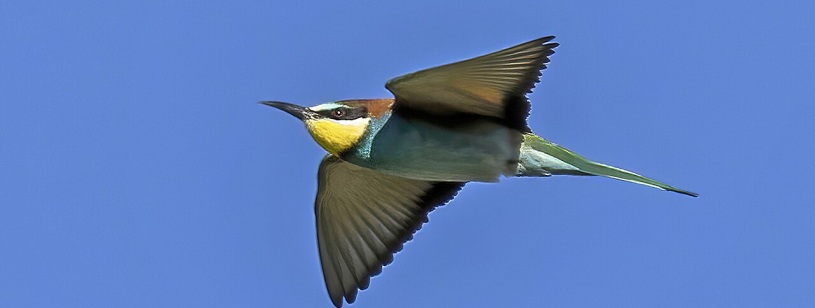
European bee-eater flying with a yellow throat, blue underparts and spread wings. · Charles J. Sharp / Sharp Photography / Wikimedia Commons / CC BY-SA 4.0 (https://creativecommons.org/licenses/by-sa/4.0/). Cropped and resized. Source: https://commons.wikimedia.org/wiki/File:European_bee-eater_(Merops_apiaster)_in_flight.jpg
The European bee-eater (Merops apiaster) is a colourful bird that catches insects in flight. Its yellow throat, blue underparts and curved bill are distinctive. It often nests in colonies inside earth tunnels. Romanian breeding birds migrate to Africa for winter.
Quick facts
| Common name | European bee-eater |
| Scientific name | Merops apiaster |
| Lifespan | AnAge records 5.9 years in the wild; a documented age rather than an average |
| Length | 25–29 cm |
| Weight | 44–78 g |
| Diet | Flying insects |
| Predators | Birds of prey; snakes and lizards may take nestlings in some regions |
| Conservation status | Least Concern globally |
| Distribution | Europe, Africa and parts of Asia |
| Habitat | Sunny open land with banks or slopes suitable for tunnels |
| Family | Meropidae |
| Reproduction | One annual brood; commonly 6–7 eggs |
- Primary category:Birds
- Explore this animal's categories:
Interesting facts
- Stinging insects are processed against a perch before swallowing.
- Some breeding pairs receive help with feeding chicks.
- Tracking has revealed social bonds maintained through migration.
- Abandoned nest burrows can provide shelter for other animals.
Records and extremes
A 2018 study followed 29 birds through the annual cycle, describing a journey of approximately 14,000 km. Some individuals kept the same social companions throughout.
The distance describes the tracked birds; routes vary between populations. Romanian nest tunnels are reported as around 70–150 cm long.
Characteristics
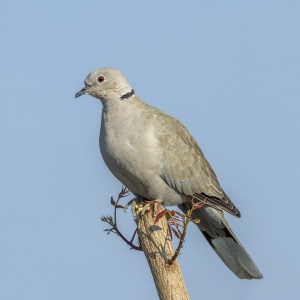
Chestnut, yellow, blue and green combine in the plumage. A dark eyestripe contrasts with the yellow throat, and the long bill curves slightly downwards.
Adults have elongated central tail feathers. The sexes look similar, while young birds are duller. Long wings create a recognisable flight silhouette.
Behaviour
Bee-eaters gather in groups and use repeated calls. They launch from perches or pursue insects in open air, while nesting colonies may contain many nearby tunnel entrances.
The 2018 tracking study documented coordinated travel and foraging beyond the breeding season. Some birds reunited after separating during migration.
At some nests, an additional bird helps the parents deliver food.
Habitat and distribution
Breeding occurs in warmer parts of Europe, North Africa and Asia. In Romania the range extends from the Danube and Delta into hill country.
Open sunny areas supply flying insects. Exposed sandy or clay banks provide material for burrows.
Romanian birds usually arrive in late April or early May and leave in August. Winter is spent south of the Sahara.
Diet and feeding
Prey includes bees, wasps, bumblebees, dragonflies and other flying insects. Captured prey is often taken back to a perch, where stinging insects are struck and rubbed before swallowing.
A study in Murcia, Spain, found dietary variation between colonies and breeding stages. Under the studied conditions, apiary impact was limited and related to alternative prey availability.
Sardinian research measured effects on worker bees and drones separately. Such findings support local assessment instead of assuming that every apiary experiences the same losses.
Reproduction and life cycle
The pair excavates a tunnel with a nesting chamber at its end. A suitable bank or exposed slope is important.
A clutch commonly contains 6–7 eggs. Both adults incubate, with BTO giving around 20 days. Insects are delivered to the growing young.
Chicks leave at roughly a month old and continue receiving food while learning to hunt. One brood is normally raised annually.
Name and history
Apiaster is related to the Latin apis, meaning bee. Linnaeus described the species in 1758, and it belongs to Meropidae.
Modern researchers use small sensors to reconstruct movements and associations between birds.
Conservation and threats
The species is globally Least Concern. Nesting banks and insect-rich feeding areas support colonies.
Conflict with beekeepers can lead to persecution. Diet studies provide a firmer basis for understanding local effects.
Watch colonies from a distance; excavation or blocked entrances can directly harm eggs and young.
Frequently asked questions
Does it eat only bees?
Wasps, bumblebees, dragonflies and other flying insects are also eaten.
How does it handle stinging prey?
It strikes and rubs the insect against a support before swallowing.
Where do Romanian bee-eaters winter?
In sub-Saharan Africa.
Why are there several holes in one bank?
A colony may contain multiple nearby nesting tunnels.
Can other birds help the parents?
Some pairs receive assistance with chick feeding.
Is every apiary affected equally?
Effects depend on local conditions and alternative prey; individual studies cannot represent all apiaries.