European robinErithacus rubecula — habitat, diet and reproduction
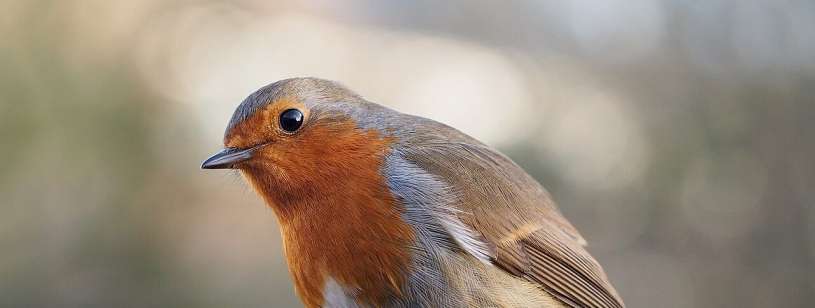
European robin (Erithacus rubecula) perched on a branch. · Francis C. Franklin / CC BY-SA 3.0 (https://creativecommons.org/licenses/by-sa/3.0). Cropped and resized. Source: https://commons.wikimedia.org/wiki/File:Erithacus_rubecula_with_cocked_head.jpg
The European robin (Erithacus rubecula) is a small bird with an orange face and breast. It searches for invertebrates close to the ground in wooded and shrubby places. Song helps defend feeding territories, including during winter. Some populations migrate while others remain year-round.
Quick facts
| Common name | European robin |
| Scientific name | Erithacus rubecula |
| Lifespan | Around 2 years in BTO estimates for birds reaching breeding age; exceptional birds exceed 8 |
| Length | 12–14 cm |
| Weight | 14–25 g |
| Diet | Invertebrates, fruit and seeds |
| Predators | Birds of prey and cats |
| Conservation status | Least Concern globally |
| Distribution | Europe, western Asia and North Africa |
| Habitat | Woodland undergrowth, scrub, parks and gardens |
| Family | Muscicapidae |
| Reproduction | Often two broods annually; usually 4–5 eggs |
- Primary category:Birds
- Explore this animal's categories:Animals of AfricaAnimals of AsiaAnimals of EuropeAnimals of RomaniaAnimals of Romania’s forestsAnimals of Romania’s gardens and parksBirdsBirds of RomaniaBirds that winter in RomaniaEEgg-laying animalsFeathered animalsFlying animalsForest animalsInsect-eating animalsMigratory birdsOmnivoresSolitary animalsVertebratesWild animals
Interesting facts
- Females also sing and can defend winter feeding territories.
- Juveniles are brown and spotted before developing the orange breast.
- Song may be heard at night, including near street lighting.
- Some garden birds follow soil disturbance to find exposed worms and larvae.
Records and extremes
A British ringing record documents an individual reaching 8 years, 4 months and 30 days. This exceptional age greatly exceeds typical survival estimates.
Robins are early contributors to the dawn chorus and may sing late into the evening. They sing during much of the year, with a quieter moulting period.
Characteristics
Adults have brown backs, pale bellies and orange extending over the face and breast. The bill is slender and the dark eyes appear large. The sexes look alike.
Juveniles have brown plumage with pale golden spots. Their shape and fine bill help identification before the familiar orange patch develops.
Behaviour
Robins advertise territories from visible perches and chase intruders. The coloured breast forms part of these territorial encounters.
Males and females can hold separate winter territories, while breeding pairs share an area. Song therefore remains useful outside courtship.
Artificial light and other disturbances can trigger nocturnal singing. Season, location and song structure help identify a bird heard after dark.
Habitat and distribution
The species occupies Europe, western Asia and North Africa. Dense vegetation close to ground level provides cover in woods, hedges, riverside growth and natural-looking parks.
Romanian populations are partially migratory, with more birds remaining in the south. Migrants mainly winter around the Mediterranean. Undergrowth and leaf litter provide shelter and feeding places.
Diet and feeding
Robins take insects, spiders, worms and other invertebrates. They watch for movement and make short attacks on prey near the ground.
Small fruit and seeds supplement the diet. Romanian accounts mention elderberries, blackberries and bilberries. Varied vegetation provides resources at different times of year.
Reproduction and life cycle
The female builds a cup from leaves, moss and plant fibres, adding a soft lining. It is usually hidden low in vegetation or a cavity. Unusual garden supports may also be used.
A typical clutch has 4–5 eggs. The female incubates for around 14–16 days, and both parents help care for the young.
Chicks leave at roughly 13–16 days and remain dependent afterwards. Two broods can be raised in a season.
Name and history
Rubecula is associated with a Latin word for red or reddish. Linnaeus described the species in 1758; it belongs to the Old World flycatcher family, Muscicapidae.
British Christmas cards frequently feature robins. The Natural History Museum connects this tradition to Victorian postmen nicknamed robins for their red uniforms.
Conservation and threats
The European robin is globally Least Concern. Prolonged freezing weather can reduce survival because keeping warm requires substantial energy.
Removing dense cover and all leaf litter reduces shelter and feeding opportunities. Work near the ground can disturb hidden nests.
Retain varied vegetation and leave occupied nests undisturbed.
Frequently asked questions
How can I distinguish males from females?
Their plumage is very similar; the orange patch alone is not a reliable guide.
Can a young robin lack the orange breast?
Yes. Juveniles are brown with pale spots.
Why do robins sing in winter?
Song helps defend territories and feeding resources.
Do female robins sing?
Yes, including in defence of winter territories.
Why might one follow a gardener?
It may exploit worms and larvae exposed by disturbed soil.
Do Romanian robins migrate?
Some move towards the Mediterranean, while others remain, especially in southern areas.