KiwiInteresting facts and information
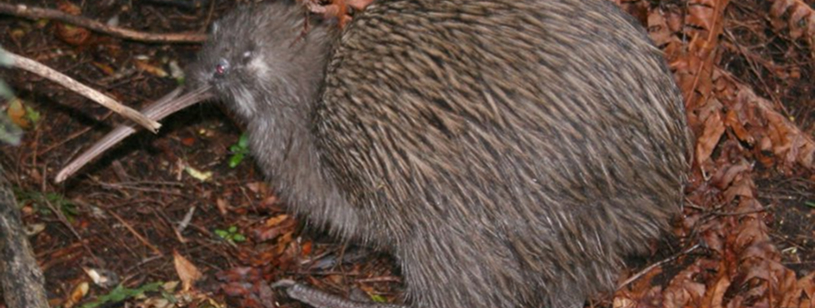
Kiwi (Apteryx) are flightless birds native to New Zealand. They have small wings hidden in their plumage and long bills with nostrils near the tip. They search for food on the ground, often at night.
Kiwi find food mainly by smell and touch, probing the soil with their long bills. Although they are only about the size of a chicken, they lay one of the largest eggs relative to body size of any bird.
Because of predators introduced by people, such as stoats, cats and dogs, kiwi need intensive protection. Conservation programmes have helped some populations grow again.
Quick facts
| Common name | Kiwi |
| Scientific name | Apteryx spp. |
| Typical lifespan | Often 25-50 years; up to about 60 years in captivity |
| Maximum speed | Varies with species or individual, distance and conditions |
| Height | About 25 - 45 cm |
| Weight | About 1 to 3.5 kg (females are larger than males) |
| Diet type | Omnivore (worms, insects, fruit, seeds) |
| Main predators | Introduced stoats, ferrets, cats and dogs; formerly birds of prey |
| Conservation status | Assess separately by species and population; different taxa and regions have different needs |
| Habitat | Forests, scrub, grassland, wetlands and mountains of New Zealand |
- Primary category:Birds
- Explore this animal's categories:
Interesting facts
- Tiny wings - Kiwi have wings only about 3 cm long, hidden under their feathers and far too small for flying.
- Nostrils at the tip of the bill - The kiwi is the only bird with nostrils at the end of its long bill, which helps it smell worms and insects underground.
- A giant egg - A female kiwi lays an egg that can weigh up to about 20% of her body weight, one of the largest eggs relative to body size of any bird.
- Hair-like feathers - Kiwi feathers are loose and shaggy, more like hair than the feathers of most birds.
- No keel - Like other flightless ratites, the kiwi has a flat breastbone without the keel that anchors flight muscles in flying birds.
- A cool body - A kiwi's body temperature is about 38 °C, lower than that of most birds and close to that of many mammals.
- Whiskers - Long, whisker-like feathers around the base of the bill help kiwi feel their way in the dark.
Records and remarkable features
- Kiwi (Apteryx) are flightless birds native to New Zealand. They have small wings hidden in their plumage and long bills with nostrils near the tip. They search for food on the ground, often at night.
- Surprising relatives - DNA studies show that the kiwi's closest relatives were the extinct giant elephant birds of Madagascar, not the moa of New Zealand.
Physical characteristics and adaptations
The kiwi is one of the most unusual birds in the world, with many features that set it apart from other birds.
Distinguishing physical appearance
- Small but sturdy - Kiwi are about 25-45 cm tall and weigh about 1-3.5 kg; females are larger than males.
- Tiny wings - Their wings are only a few centimetres long, hidden under the feathers, each with a small claw at the tip.
- Shaggy feathers - Their soft, hair-like feathers make them look more like small mammals than birds.
- Camouflage colours - Their feathers are brown, grey or speckled, which helps them hide in the undergrowth.
Unique adaptations for survival
- A long bill with nostrils at the tip - The kiwi is the only bird with nostrils at the end of its bill, so it can smell food underground.
- Sensitive bill tip - Sense organs at the tip of the bill may also help detect the vibrations of prey in the soil.
- Heavy, marrow-filled bones - Unlike most birds, which have light, hollow bones for flight, kiwi have heavy bones filled with marrow.
- Strong legs and claws - Kiwi use their powerful legs and sharp claws to dig burrows and to kick when defending themselves.
Developed senses
- An excellent sense of smell - Kiwi rely more on smell than most other birds.
- Poor eyesight - Their eyes are small, and they see poorly, especially in daylight.
- Good hearing - Kiwi have relatively large ear openings and good hearing, which helps them detect prey and danger.
Habits and behaviour
Kiwi are nocturnal, ground-living birds, and in many ways they behave more like small mammals than like other birds.
Solitary life and territory
- Kiwi pairs are territorial and defend their area with calls and, if needed, fights.
- Kiwi territories can span roughly 2–100 hectares, depending on the species and habitat.
- Males and females call loudly at night to mark their territory.
Night-time behaviour
- By day, kiwi rest in burrows, hollow logs or dense vegetation.
- At night, they come out to look for food, probing the ground with their long bills.
Communication and sounds
- Male kiwi make a high, shrill whistle, while females have a lower, harsher call.
- Pairs often call back and forth in duets at night.
- When threatened, kiwi growl, hiss and snap their bills.
Habitat and geographic distribution
Kiwi are found only in New Zealand, where they live in forests, scrub, grassland and mountains.
Geographical distribution
| Region | Species present |
|---|---|
| North Island | Apteryx mantelli (North Island brown kiwi) |
| South Island and Stewart Island | Apteryx australis (tokoeka, or southern brown kiwi) |
| Ōkārito forest, South Island west coast | Apteryx rowi (rowi, or Ōkārito kiwi) |
| Mountains and forests of the north-western South Island | Apteryx haastii (great spotted kiwi, or roroa) |
| Predator-free islands and sanctuaries | Apteryx owenii (little spotted kiwi) |
Habitats
- Native forests - Kiwi prefer damp forests with soft soil and plenty of leaf litter.
- Scrub, grassland and wetlands - Some kiwi live in scrub, tussock grassland and swampy areas.
- Mountains - Great spotted kiwi and some tokoeka live in mountains, even above the tree line.
Habitat threats
- Forest clearance - Large areas of kiwi habitat were cleared for farming in the past.
- Introduced predators - Stoats, ferrets, cats and dogs kill many kiwi; stoats kill most kiwi chicks in unprotected areas.
- Climate change - Changes in rainfall can make it harder for kiwi to find food in dry soil.
Diet and feeding
Kiwi are omnivores that eat mainly invertebrates, as well as fruit and seeds. Unlike most birds, which find food by sight, kiwi rely on smell and touch.
What does the kiwi eat?
| Food type | Examples |
|---|---|
| Worms and insects | Earthworms, beetle larvae, wētā, caterpillars |
| Molluscs | Snails, slugs |
| Other invertebrates | Spiders, centipedes, freshwater crayfish (occasionally) |
| Fruit and seeds | Fallen berries and seeds |
| Plant material | Some leaves and shoots |
Unique feeding methods and adaptations
- Probing - Kiwi push their long bills deep into the soil to find worms and larvae.
- Smelling prey - Nostrils at the tip of the bill let them smell food underground.
- Sensing vibrations - Sense organs at the tip of the bill may help them feel prey moving in the soil.
- Whiskers - Whisker-like feathers help them feel their surroundings in the dark.
Food habits
- Kiwi spend much of the night feeding, moving slowly and probing the ground.
- They eat more fruit when it is available and more worms and insects in damp seasons.
- Kiwi can be heard sniffing loudly as they feed.
Reproduction and life cycle
Kiwi usually form pairs that can stay together for many years. Their eggs are huge, and the incubation period is one of the longest of any bird.
Mating and pair formation
- Kiwi pairs can stay together for many years, sometimes for 20 years or more.
- The breeding season usually lasts from about June to March, and pairs call to each other at night.
Eggs and hatching
| Characteristic | Details |
|---|---|
| Number of eggs | Usually 1-2 per clutch; sometimes two clutches a season |
| Egg size | Huge, up to about 20% of the female's weight |
| Incubation | About 70-90 days |
| Who incubates the egg? | The male in most species; in some species both parents share |
- Kiwi eggs are extremely large compared with the size of the mother, and very rich in yolk.
- In most species, the male incubates the egg for about 2-3 months in a burrow.
- Producing such a large egg takes a lot of food and energy for the female.
Kiwi chicks
- Chicks hatch fully feathered and look like small versions of the adults.
- They are not fed by their parents: they live first on the remains of the yolk and then find food themselves, leaving the burrow after about 5-10 days.
- In unprotected areas, most chicks are killed by introduced predators, especially stoats.
Name and history
Kiwi belong to an ancient group of birds, and they are a national symbol of New Zealand.
Origin of name
- The word "kiwi" comes from the Māori language and probably imitates the male bird's call.
- The scientific name Apteryx means "without wings".
Taxonomic Classification
| Kingdom | Animalia |
|---|---|
| Phylum | Chordata |
| Class | Aves |
| Order | Apterygiformes |
| Family | Apterygidae |
| Genus | Apteryx |
History and discovery
- First scientific description - The kiwi was described by the British naturalist George Shaw in 1813, from a skin brought to Britain.
- Māori culture - Kiwi were highly valued by Māori, and their feathers were woven into special cloaks.
- There are five species of kiwi.
Cultural significance and mythology
The kiwi is deeply rooted in the culture of New Zealand and is a national symbol for both Māori and other New Zealanders.
Kiwi in Māori culture
- A treasured bird - Māori consider the kiwi a taonga (treasure) and see it as a bird under the protection of Tāne, god of the forest.
- Feather cloaks - Cloaks covered in kiwi feathers (kahu kiwi) were highly prized and worn by people of high rank.
- A Māori legend - According to a well-known story, when the forest was in danger, the kiwi agreed to give up its fine feathers and wings and live on the forest floor, and it became the most loved bird.
Kiwi as a national symbol
- New Zealanders are often called "Kiwis", a nickname that became common during the First World War.
- Money - The kiwi appears on the New Zealand one-dollar coin.
- The kiwifruit - The fruit, once called "Chinese gooseberry", was renamed "kiwifruit" by New Zealand exporters in 1959.
Conservation status and threats
Most kiwi species have declined because of introduced predators and habitat loss, but intensive conservation work has helped some populations grow again.
Main threats
- Introduced predators - Stoats, ferrets, cats and dogs kill kiwi; a single dog can kill many adult kiwi.
- Habitat loss - Forest clearance has greatly reduced kiwi habitat.
- Roads - Some kiwi are killed by cars on roads through their habitat.
Kiwi species and their conservation status
| Species | IUCN status | Estimated population |
|---|---|---|
| North Island brown kiwi (Apteryx mantelli) | Vulnerable | About 25,000 |
| Tokoeka (Apteryx australis) | Vulnerable | About 10,000-15,000 |
| Rowi (Apteryx rowi) | Vulnerable | About 600-700 |
| Great spotted kiwi (Apteryx haastii) | Vulnerable | About 15,000 |
| Little spotted kiwi (Apteryx owenii) | Near Threatened | About 2,000 |
Conservation efforts
- Operation Nest Egg - Eggs or chicks are taken from the wild, raised safely and returned to the wild when they are big enough to defend themselves from stoats.
- Predator Free 2050 - A national goal to remove rats, stoats and possums from New Zealand by 2050.
- Sanctuaries - Fenced reserves and predator-free islands give kiwi safe places to live.
- Dog training - Dog owners in kiwi areas are encouraged to train their dogs to avoid kiwi.
In popular culture
Because of its unusual appearance and its role as a national symbol, the kiwi appears in many areas of popular culture.
Kiwi in books and stories
- Children's books - The kiwi is a favourite character in New Zealand children's books.
- Māori legends - The story of how the kiwi lost its wings is often retold for children.
Kiwi in film and animation
- "Kiwi!" (2006) - A short animated film by Dony Permedi about a kiwi that dreams of flying, which became very popular online.
Kiwi in sport and branding
- The New Zealand national rugby league team is nicknamed "the Kiwis".
- Kiwi boot polish - The brand, founded in Australia in 1906, is named after the bird.