Betta fishBetta splendens — habitat, diet and reproduction
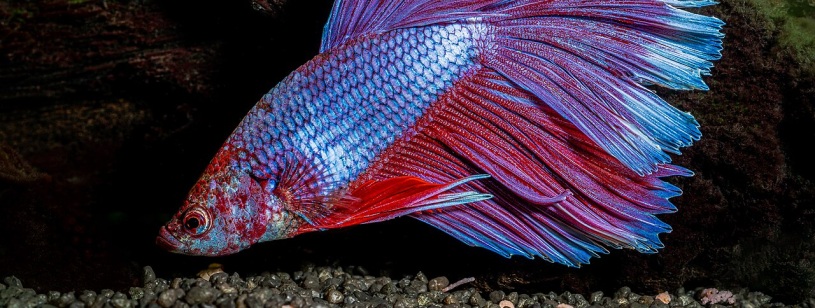
Male Betta splendens, a long-finned ornamental variety. · Henryk Niestrój / CC BY 4.0 (https://creativecommons.org/licenses/by/4.0). Cropped and resized.
The betta, or Siamese fighting fish, is a tropical freshwater fish known for the colours and fins of aquarium varieties. A specialised organ allows it to use air at the surface. Males build bubble nests and care for eggs. Wild populations inhabit quiet, vegetated waters.
Quick facts
| Common name | Betta, Siamese fighting fish |
| Scientific name | Betta splendens |
| Lifespan | Around 2 years in human care, with variation |
| Length | Reported total length up to about 6.5 cm |
| Diet | Carnivore: insect larvae and small aquatic animals |
| Predators | Larger fish and other wetland predators |
| Conservation status | Vulnerable (VU), wild populations |
| Distribution | Southeast Asia; native to Thailand |
| Habitat | Quiet, shallow freshwater with vegetation |
| Family | Osphronemidae |
| Breathing | Gills and an air-breathing labyrinth organ |
| Reproduction | Eggs in a bubble nest guarded by the male |
- Primary category:Fish
- Explore this animal's categories:
Interesting facts
- The labyrinth organ allows oxygen uptake from air above the water.
- Males construct nests from mucus-coated bubbles.
- Ornamental varieties have been selected for different colours and fin shapes.
- A mirror can trigger repeated territorial displays.
Characteristics
The elongated body has an upturned mouth suited to feeding near the surface. Scales and mucus protect the skin. Fins provide movement, balance and social displays.
Wild fish generally have shorter fins and less conspicuous colours than many ornamental forms. Selective breeding has produced broad tails, fringed edges and many colour combinations.
The labyrinth organ lies above the gills. Fish periodically reach the surface for air, including in well-maintained aquariums.
Behaviour
Males defend territories and may attack other males. They spread their fins and display during encounters. Constant exposure to a reflection can prolong these reactions and create stress.
Plants and shelter provide exploration and retreat. Strong currents can hinder long-finned varieties.
Bettas need space, clean water and stable warmth. RSPCA recommends tanks of at least 20 litres ideally, maintained around 24–26°C. Air breathing does not replace these requirements.
Habitat and distribution
The species originates in Southeast Asia and is associated with inland Thai waters. Flooded land, canals and slow waters with dense vegetation provide habitat.
Water levels and plant cover change seasonally. Surface access and shelter are important environmental features. Escaped or released individuals have also been recorded outside the native range; such introductions should be prevented.
Diet and feeding
Natural food consists mainly of small animals, including insect larvae and zooplankton. Fish search among plants and near the surface.
Aquarium diets use good-quality betta food, appropriate supplements and moderate portions. Uneaten food decomposes and harms water quality. Plant leaves provide cover but are not this carnivorous fish’s staple food.
Reproduction and life cycle
The male collects bubbles at the surface, often near vegetation. During spawning he wraps around the female. Fertilised eggs are retrieved and placed in the nest.
He guards the nest and may replace fallen eggs. Hatching occurs after roughly 24–48 hours, depending on temperature. Larvae initially use their internal reserves before beginning to feed.
Adult interactions can be aggressive. Aquarium breeding requires preparation and facilities to separate fish.
Name and history
Regan published the scientific name Betta splendens in 1910. The common name Siamese fighting fish reflects territorial behaviour and the historical connection with Thailand.
Ornamental varieties are now widespread in fishkeeping, illustrating how selective breeding can change appearance.
Conservation and threats
Wild populations are classified as Vulnerable. Habitat degradation and conversion can affect the species despite the abundance of captive ornamental forms.
Protecting wetlands and avoiding releases of ornamental fish are important conservation measures.
Frequently asked questions
Can a betta live on plant roots alone?
It is carnivorous and needs suitable betta food. Roots may provide cover but do not supply a complete diet.
Can two males share a tank?
They can seriously injure each other. Separate housing and arrangements that reduce stress are needed.
Why does it rise to breathe air?
It uses the labyrinth organ for breathing and needs easy access to the surface.
Does a bubble nest mean eggs are present?
Males can build nests before mating. Bubbles alone do not confirm eggs.