IndriInteresting facts and information
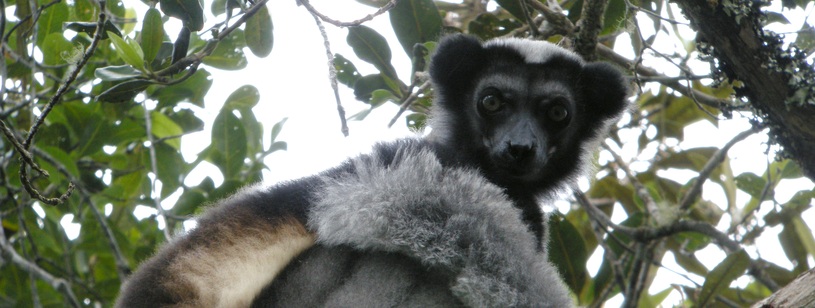
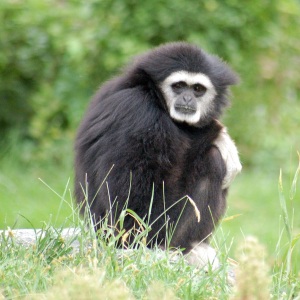
Indri (Indri indri), a lemur endemic to Madagascar. · Cover: Frank Vassen, CC BY 2.0; thumbnail: Christophe Germain, CC BY-SA 4.0. Cropped and resized; full credits below.
The indri (Indri indri) is a large lemur with a very short tail, found only in the forests of eastern Madagascar. It mainly eats leaves and is known for loud songs that group members can produce together.
It is active during the day and spends most of its life in trees. Long, powerful legs help it leap between trunks. Forest loss and hunting threaten this species, which is classified as Critically Endangered.
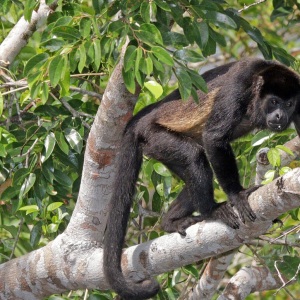
These are real photographs of Indri indri. Photographers, sources and licences are credited at the end of the article.
Quick facts
| Common name | Indri; also called “babakoto” in Madagascar |
| Scientific name | Indri indri |
| Class / order / family | Mammalia / Primates / Indriidae |
| Natural distribution | Eastern Madagascar, Africa |
| Habitat | Tropical rainforest, from lowlands to mountain regions |
| Head-and-body length | Around 60–70 cm; size varies between individuals |
| Tail length | Approximately 5 cm |
| Weight | Approximately 6–9.5 kg |
| Diet | Herbivorous: mainly young leaves, plus flowers, fruit, seeds and bark |
| Activity | Diurnal — active during the day |
| Social life | Small groups, usually 2–6 individuals |
| Gestation | Approximately 4–5 months |
| Young per birth | Usually one infant |
| Interval between births | Generally 2–3 years |
| Reproductive maturity | Around 7–9 years of age |
| Conservation status | Critically Endangered (CR), according to IUCN |
- Primary category:Primates
- Explore this animal's categories:
Interesting facts
- It is a lemur with an unusually short tail. An indri's tail measures only a few centimetres, unlike the long tails of many other lemurs.
- It can sing with its family. Duets or choruses involving several group members can be heard in the forest.
- Its coat pattern varies between individuals. The proportions of black and white differ; animals in the northern part of the range can be much darker.
- Young leaves are its preferred food. It is neither an insect hunter nor a lemur that lives mainly on fruit.
- It reproduces slowly. A female usually gives birth to one infant at intervals of several years.
Records and remarkable abilities
The indri is among the largest lemurs alive today. It is often described as the largest living lemur, but comparisons depend on the individuals measured and the criterion used. Some specialist sources also discuss its size in relation to the diademed sifaka.
An adult weighs approximately 6–9.5 kg. These figures are a guide and do not mean that every animal reaches the upper limit.
People can hear the songs from more than 2 km away in suitable conditions. Terrain, vegetation and weather affect how sound travels; the distance is not the same in every forest.
Characteristics
How can you recognise an indri?
It has large, furry black ears, a dark face and long hindlimbs. Its coat combines black, white and grey areas in proportions that vary from one individual to another.
| Feature | Characteristic |
| Very short tail | Approximately 5 cm long, rather than a long extension of the body. |
| Long hindlimbs | Provide the thrust needed to leap between trees. |
| Grasping fingers and toes | Help it hold onto branches and trunks. |
| Black ears with thick fur | Clearly visible on either side of the head. |
| Variable coat pattern | Northern individuals tend to have less white than southern ones. |
A short tail does not prevent leaping
The indri mainly moves by vertical clinging and leaping. It holds onto a trunk, pushes off with its legs and catches the next support. Its body often remains almost upright, while its arms help control the movement.
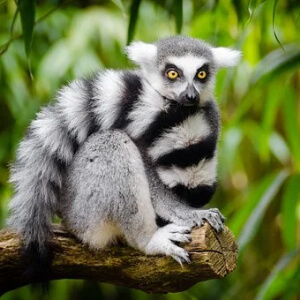
It is a primate in the family Indriidae. The ring-tailed lemur, Lemur catta, belongs to another family and is a different species. Black-and-white colouring alone is not enough for identification.
Habits and behaviour
Family life in the trees
A group usually contains 2–6 animals: an adult pair and their offspring. Females often have priority in interactions over food. Family members groom each other, and the young play.
The indri is diurnal. It alternates between feeding, travelling and resting, and sleeps in trees at night. Its schedule changes with day length and available resources; there is no fixed activity time for every group.
Why do indris sing?
Song is part of the species' communication. It may announce a group's presence and play a part in relationships between neighbours or family members. Not every function of these vocalisations is fully understood.
Both males and females join in. They also make other sounds, including alarm calls. A song should not automatically be interpreted as happiness or as a message with the meaning of human words.
Habitat and geographical distribution
Where does it live?
The indri is endemic to Madagascar, meaning that its entire natural range lies on this island. It occupies eastern forests rather than every region of Madagascar or the forests of mainland Africa.
Its range extends from around Anjanaharibe-Sud in the north to the Anosibe An’ala area in the south. Near Andasibe, the protected forests of Analamazaotra are well known for these lemurs and their songs.
Why does it need forest?
- Lowland tropical rainforests provide trees for travelling, resting and feeding.
- Montane forests are also part of its habitat; the indri is not exclusively a mountain animal.
- Connections between forest patches matter to a tree-dwelling species whose groups may become separated when forests are fragmented.
Cutting down a forest means more than losing a few trees. Sources of leaves, sleeping sites and routes through branches disappear, making travel between the remaining patches harder.
Diet and feeding
What does an indri eat?
The indri is herbivorous and mainly eats young leaves. An animal that feeds mainly on leaves is called a folivore. Its menu changes with the season and available plants.
| Food type | Role in the diet |
| Leaves and leaf stalks | Form the main part of the diet; a leaf stalk is also called a petiole. |
| Flowers, fruit and seeds | Supplement the diet when available. |
| Bark and other plant parts | May be eaten but are not the basis of the diet. |
In a year-long study at Betampona Reserve, leaves and leaf stalks accounted for 82% of feeding records. This percentage describes that study, rather than the weight of food consumed or a fixed rule for every population.
How does it find food, and why does it sometimes eat soil?
The animal travels between feeding trees and uses its mouth to pick the plant parts it eats. Its digestive tract is adapted to a diet rich in plant material.
Indris have also been observed eating soil, a behaviour called geophagy. Proposed explanations involve nutrients, plant compounds and microorganisms. These are research hypotheses, not proof that soil is a “medicine” with a guaranteed effect.
A study published in 2025 found no evidence that the gut bacteria examined were acquired from the soil the animals ate. This finding alone does not explain every reason for geophagy.
Reproduction and life cycle
Infrequent births, usually one infant
Reproduction is seasonal, and gestation lasts approximately 4–5 months. Births are often reported in May and June. A female usually has one infant.
Births are generally 2–3 years apart, and reproductive maturity is reached at around 7–9 years. A population that loses many individuals therefore cannot recover quickly through births alone.
Infant care and development
At first, the infant clings to its mother's underside, against her abdomen. Later, it rides on her back. She nurses it and stays with it as it starts exploring and eating plant food.
Learning to move independently and changing diet happen gradually. Research on the first two years of life examines this transition from dependence on the mother to more independent activities. Maximum lifespan in the wild is not known reliably enough to present as an exact record.
Name and history
Indri, babakoto and the scientific name
Indri indri is the species' scientific name, attributed in zoological classification to Gmelin in 1788. “Babakoto” is one Malagasy name used for this animal.
It belongs to the order Primates and family Indriidae, alongside other lemur groups such as sifakas. Regional colour differences led to proposed subspecies in the past; colour alone does not establish separate species.
Cultural significance and mythology
In some Malagasy communities, indris are protected by fady: traditional taboos and beliefs that may discourage hunting or eating them. These customs vary between places and are not observed by everyone in the same way.
Cultural connections between lemurs and people belong to local traditions. They do not replace biological explanations of primate relationships. Observing taboos can help the species, but does not automatically protect it from deforestation or every form of hunting.
Conservation status and threats
Critically Endangered
IUCN classifies the indri as CR — Critically Endangered. Its population is decreasing, and habitat fragmentation separates groups. This classification indicates an extremely high risk of extinction in the wild.
Main threats and protection measures
- Converting forests to farmland reduces the available habitat.
- Logging and fuelwood collection degrade the remaining forests.
- Hunting affects a species that reproduces slowly.
- Breaking forests into isolated patches limits contact between populations.
Protecting forests, restoring connections between them and working with local communities are important conservation approaches. Organisations in Madagascar carry out monitoring, habitat protection and education.
The island also has other distinctive mammals, including the fossa and aye-aye. Each has different adaptations and needs; protecting forests supports their diversity.
In popular culture
The species' song also features in science communication. In 2021, the Max Planck Institute for Psycholinguistics reported research that identified rhythmic intervals in indri songs comparable to some found in human music.
Researchers analysed songs from 39 animals in 20 groups. They found both equal intervals and ratios of approximately one to two. This rhythmic similarity does not mean that indris compose music in the human sense. It offers clues about how rhythm may evolve in animals.
Frequently asked questions
- What kind of animal is an indri? Indri indri is a lemur species in the family Indriidae. It is a mammal and a primate endemic to Madagascar.
- Where do indris live? Only in eastern Madagascar's forests, including lowland and montane tropical rainforests.
- What do indris eat? Mainly young leaves. They also eat flowers, fruit, seeds, bark and other plant parts.
- Does an indri have a tail? Yes, but it is very short, at approximately 5 cm. It does not have the long tail characteristic of many other lemurs.
- Why do indris sing? Their songs are part of communication and may announce a group's presence. Not all their functions are fully understood.
- Are indris active at night? They are diurnal, meaning active during the day. At night, they rest in trees.
- How many young does an indri have? A female usually has one infant, generally at intervals of 2–3 years.
- Are indris threatened with extinction? Yes. IUCN classifies them as Critically Endangered (CR). Forest loss and hunting are important threats.
Cover photograph: Frank Vassen — Indri indri · CC BY 2.0. Thumbnail: Christophe Germain — Indri indri, Andasibe-Mantadia · CC BY-SA 4.0. Both photographs were cropped and resized. The adapted thumbnail is available under CC BY-SA 4.0.
Did you know?
- The tail of Indri indri is only about 5 cm long.
- Members of a group can sing together.
- It is a day-active, herbivorous lemur endemic to Madagascar.
- A female usually has one infant at intervals of 2–3 years.