European perchPerca fluviatilis — habitat, diet and reproduction
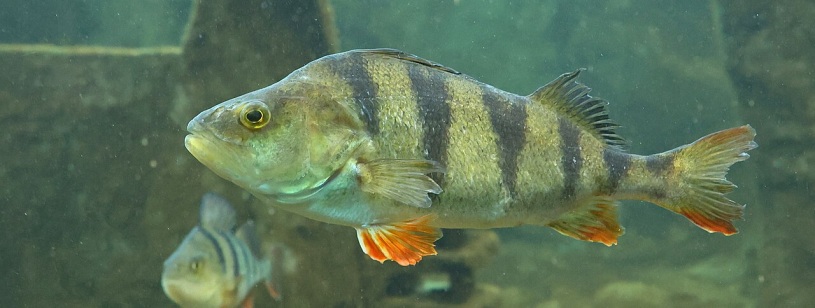
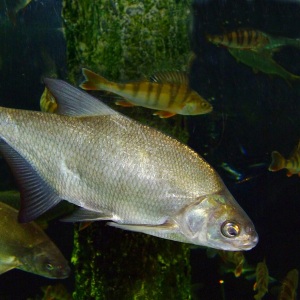
European perch (Perca fluviatilis) viewed from the side underwater. · Clément Bardot / CC BY-SA 4.0 (https://creativecommons.org/licenses/by-sa/4.0). Cropped and resized. Source: https://commons.wikimedia.org/wiki/File:Perche_franche_(Perca_fluviatilis).jpg
European perch (Perca fluviatilis) are predatory fish with dark vertical bars and reddish fins. They inhabit lakes, rivers and some low-salinity coastal waters. Like zander, they belong to the family Percidae. Females lay their eggs in gelatinous ribbons attached to underwater supports.
Quick facts
| Common name | European perch |
| Scientific name | Perca fluviatilis |
| Lifespan | Can exceed 10 years; FishBase reports a maximum of 22 years |
| Length | Often about 15–30 cm; varies greatly among populations |
| Weight | Often 50–350 g in Finnish accounts; large fish can exceed 1 kg |
| Diet | Aquatic invertebrates and fish |
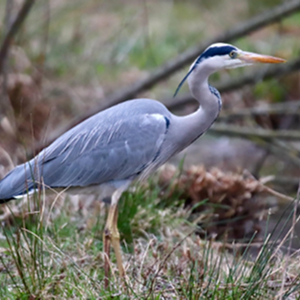
| Predators | Larger predatory fish and fish-eating birds |
| Conservation status | Least Concern (LC), globally |
| Distribution | Europe and northern Asia; introduced elsewhere |
| Habitat | Lakes, ponds, slow rivers and low-salinity coastal waters |
| Family | Percidae |
| Reproduction | Eggs arranged in gelatinous ribbons |
Interesting facts
- Females lay eggs in ribbons attached to submerged objects.
- Fish from brown, humic waters can be darker than those from clear water.
- Slow growth can leave an older perch surprisingly small.
- Larger perch sometimes eat younger members of their own species.
Records and extremes
Perch often measure about 15–30 cm, with substantial variation between waters. Finnish accounts describe fish over 2 kg as rare.
FishBase reports a maximum age of 22 years. This is a longevity record rather than an average lifespan.
Characteristics
The deep, laterally compressed body has dark bars, a greenish back and a pale belly. Lower fins can be orange-red.
Two separate dorsal fins sit along the back. The first is spiny and bears a dark patch near its rear. Scales feel rough, and the gill covers have sharp edges.
Behaviour
Young perch commonly gather in shoals. Feeding groups can drive small fish towards the surface, while larger individuals may become more solitary.
Perch feed by day and can be especially active around dawn and dusk. Shorelines and submerged structures provide feeding opportunities.
Habitat and distribution
The native range covers Europe and northern Asia. Habitats include ponds, lakes and slow rivers, as well as Baltic coastal waters with low salinity.
In Romania, perch occur in the Danube and its delta. Human introductions have also taken the species to Australia and New Zealand.
Diet and feeding
Young fish eat zooplankton, tiny animals suspended in water. Growing perch also take insect larvae and other bottom-dwelling invertebrates.
Fish become important prey for many larger individuals. Local food availability influences this shift, and smaller perch can themselves be eaten.
Reproduction and life cycle
European populations spawn in spring, with regional differences. Females drape egg ribbons over plants, branches and other supports. Fertilisation occurs in the water.
Parents leave the eggs without guarding them. The gelatinous ribbon provides some protection as embryos develop.
A 2025 review gives typical maturity ages of one to two years for males and two to four for females in the native northern range. Growth conditions affect these ages.
Name and history
Linnaeus described Perca fluviatilis in 1758. The related North American yellow perch, Perca flavescens, is a separate species.
Fishing has encouraged introductions into new waters. Ireland’s fisheries authority describes an old introduction, followed by wider redistribution within the country; the original date is uncertain.
Conservation and threats
European perch are globally classified as Least Concern. Local populations depend on suitable habitats and sufficient oxygen, including through winter.
In New Zealand, NIWA identifies introduced perch among fish that have affected native biodiversity. Their predation and competition can change freshwater communities.
Frequently asked questions
Are European and yellow perch the same species?
They are related but distinct species: Perca fluviatilis and Perca flavescens.
Why are some perch dark?
Colour varies with habitat, and fish from brown, humic waters can be darker.
Does a small perch have to be young?
Limited food can slow growth, so small individuals may be relatively old.
What are the pale ribbons on plants in spring?
They may be perch eggs enclosed in a gelatinous ribbon.
Do perch guard their eggs?
They leave the egg ribbons without further parental care.
Can they live in slightly salty water?
Yes. Some populations inhabit low-salinity coastal waters around the Baltic Sea.