Red-eared sliderTrachemys scripta elegans — habitat, diet and reproduction
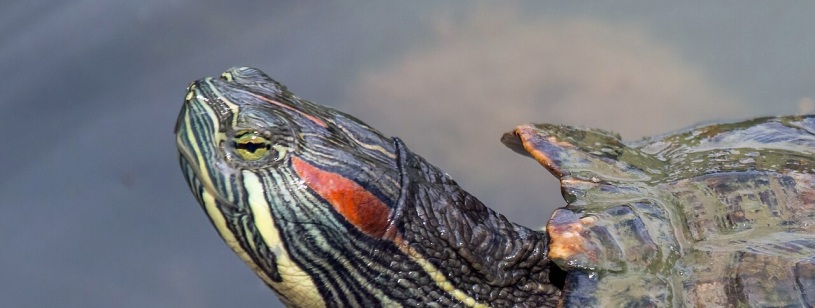
Red-eared slider (Trachemys scripta elegans) basking. · Charles J. Sharp / CC BY-SA 4.0 (https://creativecommons.org/licenses/by-sa/4.0). Cropped and resized.
The red-eared slider is a freshwater turtle native to the southern United States and north-eastern Mexico. It is recognised by the red patch behind each eye. It has been sold in huge numbers as a pet, and released animals have become a problem on many continents, including Europe.
Quick facts
| Common name | Red-eared slider |
| Scientific name | Trachemys scripta elegans |
| Lifespan | About 20–30 years; sometimes over 40 in captivity |
| Length | Shell usually 15–20 cm; some females exceed 30 cm |
| Diet | Omnivore: insects, snails, small fish, water plants |
| Predators | Raccoons, wading birds and large fish take young; adults have few enemies |
| Conservation status | Least Concern (LC); invasive species in the European Union |
| Distribution | Native to the USA and north-eastern Mexico; introduced worldwide |
| Habitat | Lakes, ponds and slow rivers with plants and basking sites |
| Family | Emydidae |
| Reproduction | Lays eggs on land |
- Primary category:Reptiles
- Explore this animal's categories:
Interesting facts
- The red “ears” are patches of coloured skin; the real ears are not visible.
- Since 2016, selling and breeding this subspecies has been banned in the European Union.
- The sex of hatchlings depends on egg incubation temperature.
- Young sliders eat more animal food, adults more plants.
Characteristics
The shell is oval and fairly flat, green in juveniles and darker, sometimes almost black, in adults. The skin has yellow stripes, and two red patches sit behind the eyes.
Females grow larger than males. Males have very long front claws, used to stroke the female’s face during courtship. Hatchlings sold in shops are only 3–4 cm, but adults can reach the size of a dinner plate.
Behaviour
It is a water turtle that often climbs onto logs and banks to bask. When alarmed, it slides straight into the water, hence its English name.
It can stay underwater for long periods. In cold regions it spends winter inactive on pond bottoms. As a pet, it needs a large aquarium with filtered water, a dry basking area and heat and UV lamps.
Habitat and distribution
Its native range is the Mississippi River basin and areas around the Gulf of Mexico. The pet trade introduced it to Europe, Asia, Australia and Africa.
In Romania, released animals live in park lakes and ponds near towns, helped by milder winters.
Diet and feeding
It is omnivorous, eating aquatic insects, snails, worms, tadpoles, small fish and carrion, as well as water plants and algae.
In captivity it gets commercial turtle food plus plants and sometimes insects. Too much meat can deform the shell.
Reproduction and life cycle
The female comes onto land, digs a hole in soft soil and usually lays 2–30 eggs, sometimes several times a year.
Eggs develop in the warm soil for about two to three months. Warmer temperatures produce more females, cooler ones more males. Hatchlings are independent immediately.
Name and history
The scientific name Trachemys scripta elegans roughly means “rough turtle with written markings, elegant”, after the lines on its shell and skin.
In the 1980s and 1990s, millions of hatchlings were exported each year as cheap pets. Many owners did not know how long they live or how big they grow, and released them.
Conservation and threats
The species as a whole is assessed as Least Concern. In Europe, however, this subspecies is on the EU list of invasive species: it competes with native turtles for food and basking sites and can spread disease.
Owners may keep existing animals for life but must not release them. Like other reptiles, it can carry Salmonella, so hands should be washed after every contact.
Frequently asked questions
How long does a red-eared slider live?
Usually 20–30 years, sometimes over 40 with proper care.
How big does it get?
Adults usually have a 15–20 cm shell; some females exceed 30 cm.
Can I release my slider into a lake?
No. It is an invasive species in the EU and release is illegal. Look for a rescue centre that can take it.
What does it eat?
Aquatic turtle food, plants, insects and small fish; young eat more animal food.