Eurasian spoonbillPlatalea leucorodia — habitat, diet and reproduction
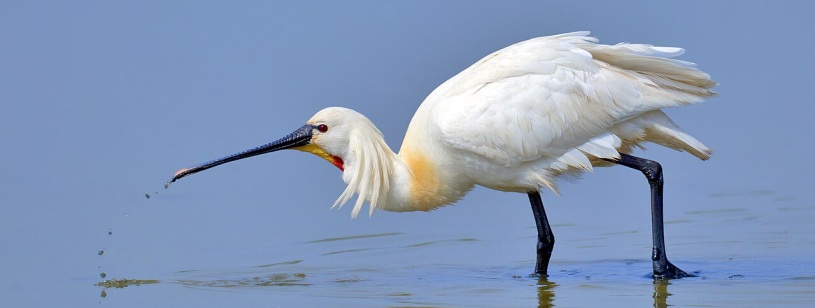
Adult Eurasian spoonbill (Platalea leucorodia) in shallow water. · Andreas Trepte / CC BY-SA 2.5 (https://creativecommons.org/licenses/by-sa/2.5). Cropped and resized.
The Eurasian spoonbill is a large white bird with a long bill that broadens at the tip. It walks through shallow water, sweeping the bill from side to side to find food. In Romania it breeds in wetland colonies, including the Danube Delta. A clear view of the bill distinguishes it from egrets.
Quick facts
| Common name | Eurasian spoonbill |
| Scientific name | Platalea leucorodia |
| Length | 80–93 cm |
| Wingspan | 120–135 cm |
| Weight | 1.13–1.96 kg |
| Diet | Carnivore: aquatic invertebrates and small vertebrates |
| Conservation status | Least Concern (LC), globally |
| Distribution | Europe, Africa and Asia |
| Habitat | Shallow freshwater or brackish wetlands |
| Family | Threskiornithidae |
| Reproduction | Usually 3–4 eggs; colonial nesting |
| Distinctive feature | Flattened bill with a broad spoon-shaped tip |
- Primary category:Birds
- Explore this animal's categories:Animals of AfricaAnimals of AsiaAnimals of EuropeAnimals of RomaniaAnimals of the Danube DeltaAnimals that live in groupsBirdsBirds of RomaniaBirds with unusual beaksCarnivoresEEgg-laying animalsFeathered animalsFish-eating animalsFlying animalsMigratory animalsMigratory birdsSemi-aquatic animalsVertebratesWaterbirdsWetland animalsWild animals
Interesting facts
- The bill is narrow near the base and broad toward its tip.
- Breeding adults may show a crest and yellowish breast band.
- Side-to-side head movements help identify feeding birds.
- Nests can be placed in reeds, bushes or trees.
Characteristics
Plumage is mainly white, while the legs and most of the bill are black. Adult bill tips may be yellowish. Breeding birds develop elongated head plumes and yellowish colour near the base of the neck.
The sexes have similar colours. Juveniles are less ornamented, with bill and plumage details changing as they mature. The spoon-shaped tip is most apparent from the front or at close range; a strict side view can conceal its breadth.
Behaviour
Spoonbills walk through water while sweeping their bills laterally. Several birds may feed together and later rest as a group.
Colonies can occupy dense vegetation and are sensitive to disturbance. Resting adults do not mean there are no nests nearby. During migration the birds need a sequence of feeding and resting sites rather than one protected area alone.
Habitat and distribution
Breeding occurs in scattered areas of Europe, northern Africa and across parts of Asia. Migratory populations move to warmer regions for winter.
In Romania the species is associated with extensive wetlands, especially the Danube Delta and corridor, with other suitable basins also supporting colonies. Arrivals can begin in February or March, and departures continue through autumn. A few individuals remain in winter. Shallow accessible feeding water is essential.
Diet and feeding
Food includes aquatic insects and larvae, worms, molluscs, crustaceans, small fish and tadpoles. Local availability shapes the diet.
The submerged bill sweeps from side to side; captured food is lifted for swallowing. Its shape serves this feeding method rather than nest excavation. Water depth matters because rising levels can cover previously accessible feeding areas.
Reproduction and life cycle
Spoonbills breed in colonies, sometimes with other waterbirds. Nests of sticks and aquatic vegetation are placed in reeds, bushes or trees.
Females usually lay three or four eggs. Incubation takes about 24–25 days, and young become capable of flight at around 45–50 days. Adults provide food. Colonies need supporting vegetation and accessible feeding grounds; cutting shrubs or burning reeds can remove sites used by many pairs.
Name and history
Platalea leucorodia belongs to Threskiornithidae, the family that also includes ibises. Resemblance to egrets reflects white plumage and shallow-water feeding, not membership in the same family.
Leucorodia combines Greek roots for white and heron. Both the Romanian and English common names refer to the broadened bill.
Conservation and threats
The global category is Least Concern. Wetland degradation, colony loss and altered water conditions can still affect local populations.
Conservation must retain nesting and feeding areas together. Muddy margins, fresh or brackish water and refuge vegetation serve different needs. Connected wetlands also provide repeated migration stopovers.
Frequently asked questions
Why is the spoonbill’s bill broad?
It supports finding and catching small animals by sweeping from side to side through shallow water.
Is a spoonbill an egret?
No. It belongs to Threskiornithidae, whereas egrets are herons in Ardeidae.
Where does it breed in Romania?
In wetland colonies, especially in the Danube Delta and along the Danube, with other suitable basins also used.
Does it eat only fish?
No. It also takes crustaceans, insects, worms, molluscs and other small aquatic animals.