Red pandaInteresting facts and information
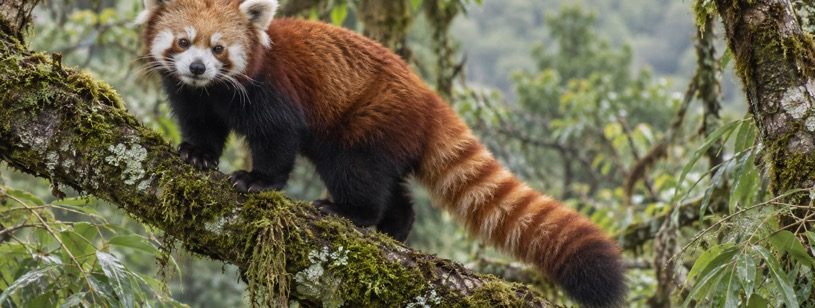
Red pandas are tree-dwelling mammals of Asian forests, recognised by their reddish coats, pale faces and long, bushy, ringed tails. Despite the shared name, they are not bears. They belong to their own family, Ailuridae; references differ on whether to recognise one red panda species or two.
These elusive animals live mainly in cool, moist mountain forests, where bamboo provides much of their food. Their appearance may suggest a fox, cat or small bear, but their classification and adaptations reflect their own evolutionary history.
Quick facts
| Common name | Red panda |
| Scientific names | Ailurus fulgens; Ailurus styani in the two-species classification |
| Family | Ailuridae |
| Class | Mammalia (mammals) |
| Diet | Mainly bamboo; also fruit, acorns and occasional animal food |
| Habitat | Forests, especially cool mountain forests with bamboo and dense tree cover |
| Distribution | Himalayan region and south-western China; ranges differ between taxonomic forms |
| Body length | Approximately 51–64 cm, excluding the tail |
| Tail length | Approximately 28–49 cm |
| Weight | Generally about 3–6 kg |
| Activity | Often at night and around dawn and dusk |
| Conservation status | Endangered (EN) in the broad Ailurus fulgens assessment; taxonomic splits require care |
Curiosities and fascinating facts
- A red panda is not a bear. Red pandas belong to Ailuridae, while the giant panda belongs to the bear family, Ursidae.
- The tail has important jobs: it helps with balance on branches and can keep the animal warm when wrapped around its resting body.
- An accomplished climber: sharp claws and flexible joints allow it to move through trees and climb down headfirst.
- Bamboo dominates the menu. Red pandas belong to the order Carnivora, but eat mainly bamboo, which supplies relatively little usable energy.
- They are active when people find them harder to see: dawn, dusk and night are important activity periods.
- They leave scent messages. Scent marks and secretions help individuals communicate without meeting face to face.
Records and remarkable features
- The only living members of their family: red pandas are the surviving representatives of Ailuridae. References differ on whether to recognise one species or two.
- A life among branches: trees provide places to rest, travel, find refuge and sometimes feed. This is an adaptation, rather than a measured ranking of climbing mammals.
- A tail nearly as long as the body: in some individuals its length approaches that of the main part of the body.
- A conservation ambassador: red pandas feature in education about protecting mountain forests and bamboo habitat.
Physical characteristics
Red pandas have small bodies, dense coats, dark legs and pale faces with distinctive white markings. Their reddish fur blends with the mosses, lichens and branches of their forest surroundings.
The long, bushy tail has rings that vary in prominence. It provides balance and insulation, while sharp claws grip bark and branches.
| Feature | Role |
|---|---|
| Bushy tail | Balance in trees and additional warmth during rest |
| Sharp claws | Climbing and gripping branches |
| Dense fur | Insulation in cool, damp mountain forests |
| Pale facial markings | A distinctive part of the animal's appearance; not evidence by itself of a particular communication function |
Habits and behaviour
Red pandas are generally solitary. Adults come together mainly during the breeding season and otherwise use their own home ranges. Trees provide important escape routes and resting places.
During the day they often rest on branches, in tree hollows or in sheltered spots. When active, they search for food, travel through vegetation and leave scent marks. Their frequent evening and night activity places them among nocturnal animals, although dawn and dusk are also important.
Habitat and geographical distribution
Red pandas live mainly in cool, moist mountain forests with bamboo and dense tree cover. Taken together, their range includes parts of Nepal, Bhutan, north-eastern India, northern Myanmar and south-western China.
They need vegetation that provides food and shelter. Roads, forest clearance and expanding settlements can divide suitable habitat into isolated patches, making it harder for animals to move between populations.
Diet and feeding
Bamboo leaves and tender shoots form the main food. Red pandas are not strict herbivores: they can also eat fruit, acorns and occasional animal food, such as insects or eggs.
Bamboo is difficult for them to digest efficiently and supplies limited usable energy. Frequent feeding and long resting periods help them meet their energy needs.
- Bamboo leaves and young shoots;
- Fruit and acorns;
- Insects and larvae;
- Occasional eggs or other small animal food.
Reproduction and life cycle
Breeding usually takes place early in the year. After pregnancy, a female normally gives birth to one to four cubs in a sheltered place, such as a hollow tree or a well-hidden den.
The cubs are born with their eyes closed and depend on their mother. She feeds and protects them, and may carry them to another den. They gradually become able to explore, but their survival continues to depend on food, shelter and suitable forest habitat.
Name and history
The name “panda” was used for the red panda before the giant panda was described by Western zoologists. Ailurus fulgens combines words referring to a cat and a shining or fiery appearance. The exact origin of the common name “panda” remains uncertain.
For many years researchers debated the animal's relationship to raccoons, bears and mustelids. It is now placed in its own family, Ailuridae.
There is a further classification question within red pandas. Some references use one species, Ailurus fulgens, with different forms or subspecies. The Mammal Diversity Database recognises two species, Ailurus fulgens and Ailurus styani, while noting continuing debate. This page uses “red panda” for the group; its general range and habits should not be read as a precise description of only one taxonomic form.
Cultural significance and mythology
Red pandas have become modern symbols of Himalayan forest conservation. Their distinctive appearance can draw attention to habitats that are less familiar than open grasslands or tropical rainforests.
They should not be assigned one supposed legend shared by every community across their range. Here, their cultural significance refers to their role in education and conservation, without inventing a common mythology.
Conservation status and threats
The IUCN assessment of the red panda under the broad name Ailurus fulgens classifies it as Endangered (EN). That assessment and the newer two-species classification do not have identical boundaries: a newly separated taxon should not automatically be assigned a separate assessment that has not been made.
Important threats include loss and fragmentation of forest, poaching, accidental capture in snares and other human pressures. Protecting mountain forests and connections between habitat patches is central to conservation.
Red Panda Network works with local communities and forest guardians to monitor and protect habitat. This is why red pandas belong in the broader category of threatened animals.
In popular culture
Red pandas appear in wildlife programmes, educational material, illustrations, games and children's media. Their pale faces, reddish coats and ringed tails make them recognisable.
Public interest can support conservation when it leads to better understanding and protection. An appealing appearance does not make a red panda a suitable pet: it remains a wild animal adapted to forest life.
Frequently asked questions
- Is a red panda a bear? No. Red pandas belong to Ailuridae, rather than the bear family, Ursidae.
- Is it a close relative of the giant panda? No. They belong to different families. Both use bamboo extensively, but that does not make them close relatives.
- Where do red pandas live? In Asian forests, including parts of the Himalaya and south-western China. The exact range depends on the taxonomic form.
- What do red pandas eat? Mainly bamboo, with fruit, acorns and occasional animal food such as insects or eggs.
- Are red pandas nocturnal? They are often active at night and around dawn and dusk.
- Why are red pandas threatened? Forest loss, habitat fragmentation, poaching and accidental capture are important pressures.
- Can a red panda be a pet? It is a wild animal with specialised needs and should not be treated as a household pet.
Did you know? About red panda
- Red pandas are not bears, despite the shared common name.
- Red pandas are the only living representatives of Ailuridae; some references recognise two species.
- The tail can be wrapped around the body for warmth during rest.
- An enlarged wrist bone acts as a false thumb to help grasp bamboo.
- They are often active at night and around dawn and dusk.
- Young cubs depend on their mother during their early months.
- The reddish coat blends with mosses and lichens in forest habitat.
- An appealing appearance does not make a red panda a suitable household pet.