Cicada orniCicada orni — habitat, diet and reproduction
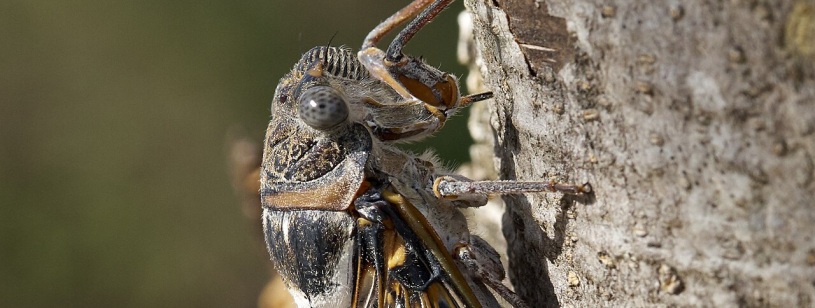
Cicada on tree bark, showing its eye and transparent wings. · Sputniktilt / CC BY-SA 4.0 (https://creativecommons.org/licenses/by-sa/4.0). Cropped and resized. Source: https://commons.wikimedia.org/wiki/File:Cicadidae_2017_Koroni_08.jpg
Cicada orni is a cicada whose males produce loud calls in warm weather. Adults rest on trunks and branches, while nymphs develop underground. Both stages feed on plant sap. This account focuses on the European species, a member of Cicadidae.
Quick facts
| Common name | Cicada orni; common Mediterranean cicada |
| Scientific name | Cicada orni |
| Lifespan | Estimated cycle around three years; adults live weeks |
| Length | Body approximately 2.3–2.8 cm, excluding wings |
| Appearance | Grey-brown body and transparent wings with dark spots |
| Diet | Plant sap; nymphs feed from roots |
| Predators | Birds and other insect eaters; wasps and spiders also capture cicadas |
| Conservation status | Not Evaluated in the Évora Biodiversity Museum species account |
| Distribution | Mainly southern Europe towards the Black Sea and western Asia |
| Habitat | Open woodland, plantations, parks and wooded gardens |
| Family | Cicadidae |
| Reproduction | Eggs in plant tissue; nymphs develop underground |
- Primary category:Insects
- Explore this animal's categories:
Interesting facts
- Males call using specialised abdominal membranes.
- Empty shells on trunks are the old skin of nymphs, called exuviae.
- Piercing mouthparts extract plant sap.
- Song patterns help distinguish similar-looking species.
Records and extremes
Cicadas have distinctive species-specific calls. Cicada orni produces repetitive phrases separated by pauses, usually while stationary.
Most of its estimated three-year cycle is spent underground. Adult life lasts only weeks.
The 13- and 17-year cycles belong to North American periodical Magicicada. Cicadas heard every summer may instead come from overlapping generations.
Characteristics
Grey-brown colouring blends with bark. Transparent wings carry visible veins and dark marks on some of them, folding along the body at rest.
The head has large compound eyes, three simple eyes and short antennae. Slender mouthparts fold beneath the body when unused.
Nymphs have digging forelegs. Newly emerged adults have soft wings and body coverings that gradually expand and harden.
Behaviour
Males often call from warm, exposed positions on trees. Calls attract females and help recognition between potential mates. Their interrupted rhythm differs from Cicada barbara’s continuous song.
Tymbals are membranes that buckle and spring back under muscular action. Repetition and body resonance produce the call.
Adults may fly when disturbed. Camouflage can make a loudly calling insect surprisingly difficult to locate.
Habitat and distribution
The range stretches through the Mediterranean region towards the Black Sea and western Asia. Many tree species provide habitat in open woodland and plantations.
Parks and tree-lined avenues are also occupied. Trees provide food, calling positions and egg-laying sites, while surrounding soil shelters nymphs.
Both above-ground vegetation and underground roots matter throughout development.
Diet and feeding
Nymphs draw sap from roots, while adults feed from trees and shrubs. Fine mouthparts penetrate tissues that transport liquid.
This herbivorous liquid diet differs from leaf-chewing beetles. Plants supply water and nutrients through the different life stages.
Reproduction and life cycle
Females insert eggs into plant tissues using an ovipositor. Newly hatched nymphs reach the ground and burrow into soil.
Repeated moults accompany underground growth. Mature nymphs emerge and climb a trunk or other support for the final moult.
The empty exuvia remains attached to bark. Winged adults begin the reproductive stage; there is no pupa.
Name and history
Linnaeus described Cicada orni in 1758. It belongs to Hemiptera, an order characterised by piercing-sucking mouthparts, and the family Cicadidae.
Cicada is also a common name for other family members. Reliable identification may require wing markings and song, because appearances can be very similar.
Conservation and threats
The Évora Biodiversity Museum account gives Not Evaluated status. The species is common in many Mediterranean areas, with local occurrence depending on habitat.
Vegetation loss, repeated soil disturbance and intensive agriculture can disrupt development. Trees and roots must remain available over several years.
Green spaces with relatively undisturbed soil can support the complete life cycle, including hidden nymphs.
Frequently asked questions
Is it a cricket?
It belongs to Hemiptera. Crickets are in a different order and use a different sound mechanism.
Do all cicadas live 17 years?
No. The 13- and 17-year cycles characterise certain American Magicicada species.
What is the empty insect shell on a tree?
It is an exuvia, the old nymphal covering left after adult emergence.
Which sex sings?
Males produce calls with vibrating membranes called tymbals.
What do they eat?
Plant sap, with nymphs feeding from roots.
Why can I hear it but not see it?
Bark-like colouring provides camouflage, while calls carry some distance.