Edible dormouseGlis glis — habitat, diet and reproduction
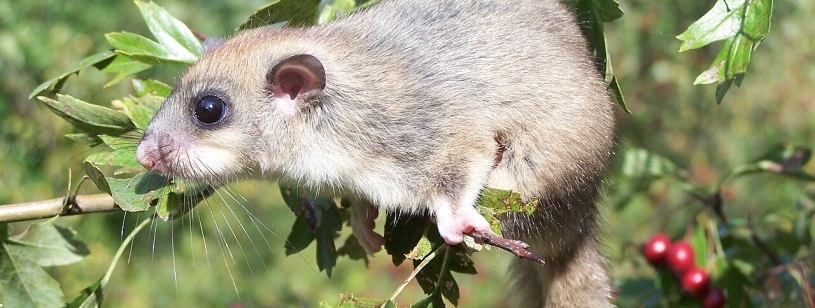
Edible dormouse (Glis glis) on a branch with berries. · Azay / CC BY-SA 3.0 (http://creativecommons.org/licenses/by-sa/3.0/). Cropped and resized.
The edible dormouse is a forest rodent that looks like a small grey squirrel with large black eyes. It is active at night in tree canopies and hibernates for seven months or more. The Romans fattened it in special jars and served it as a delicacy.
Quick facts
| Common name | Edible dormouse, fat dormouse |
| Scientific name | Glis glis |
| Lifespan | About 5–9 years in the wild, long for a small rodent |
| Length | Body about 13–20 cm, tail about 11–15 cm |
| Weight | About 70–200 g; heavier before hibernation |
| Diet | Omnivore: beechnuts, hazelnuts, acorns, fruit, buds, insects |
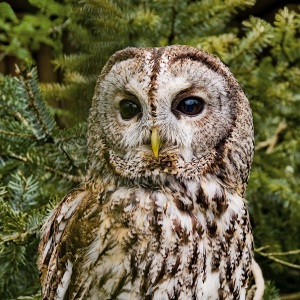
| Predators | Owls, tawny owls, martens, wild cats |
| Conservation status | Least Concern (LC) |
| Distribution | Continental Europe and western Asia |
| Habitat | Broadleaf and mixed forests, orchards, sometimes buildings |
| Family | Gliridae |
| Activity | Nocturnal; hibernates |
Interesting facts
- The edible dormouse can hibernate for seven months or more, often buried in the ground.
- If grabbed by the tail, the tail skin can slip off, letting the animal escape.
- In years without beechnuts and seeds, many dormice do not breed at all.
- The Romans kept them in clay jars called “gliraria” and fattened them on nuts.
Characteristics
The edible dormouse has soft grey fur, a white belly and a long, bushy tail. Its eyes are large and black, ringed with dark fur, and its ears are small and round.
Padded toes help it climb and leap between branches. Before hibernation its weight can almost double.
Behaviour
It is nocturnal and spends much time in tree canopies. By day it sleeps in tree holes, leaf nests or bird boxes.
Sometimes it moves into lofts of houses and cabins, making noise at night. In autumn it retreats to burrows or crevices and hibernates until late spring.
Habitat and distribution
The species lives across continental Europe, from France and northern Spain to Russia, the Caucasus and northern Iran. It was introduced to England in 1902.
In Romania it is widespread in hill and mountain beech and oak forests, especially where old hollow trees remain.
Diet and feeding
It mostly eats plant food: beechnuts, hazelnuts, acorns, chestnuts, seeds, fruit, buds and flowers. It also catches insects and may eat bird eggs or chicks.
In autumn it feeds heavily to build fat for winter. It can gnaw bark of young trees and eat orchard fruit.
Reproduction and life cycle
Dormice breed in summer, only in years when the forest promises plenty of seeds. The female usually has 4–6 blind, hairless young in a tree-hole nest.
Young stay with their mother for about a month and a half and must build enough fat by autumn to survive their first winter.
Name and history
The scientific name Glis glis comes from the Latin “glis”, the Roman name for this animal.
In Slovenia, dormouse trapping is an old tradition, and caps made from their fur were part of folk costume. The edible dormouse is related to the smaller hazel dormouse.
Conservation and threats
The species is assessed as Least Concern. It is protected in some European countries and hunted in others.
Main threats include felling of old forests and loss of hollow trees. Nest boxes and retaining old trees help.
Frequently asked questions
How long does the edible dormouse sleep in winter?
Usually about seven months, sometimes more, from autumn to late spring.
Is the edible dormouse a squirrel?
It belongs to a different rodent family, the dormice. It looks like a small squirrel but is active at night.
What should I do if a dormouse is in my loft?
Seal the entrances after it leaves, in autumn or spring, without harming it.
What does it eat?
Beechnuts, hazelnuts, acorns, fruit, buds and sometimes insects.