Blotched snakeElaphe sauromates — habitat, diet and reproduction
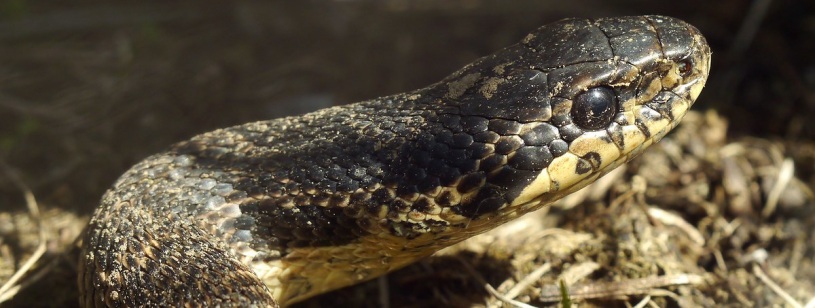
Blotched snake (Elaphe sauromates), head and front of the body. · Roman / CC BY 4.0 (https://creativecommons.org/licenses/by/4.0). Cropped and resized.
The blotched snake is Romania’s largest snake: adults often reach 1.5 metres and can exceed 2 metres. Despite its fearsome Romanian name, “Dobrujan dragon”, it has no venom and does not attack people. It lives in the steppes and stony hills of Dobruja and southern Romania, hunting rodents and birds.
Quick facts
| Common name | Blotched snake |
| Scientific name | Elaphe sauromates |
| Lifespan | Probably over 15 years; wild data are limited |
| Length | Usually 1.2–1.8 m; can exceed 2 m |
| Diet | Carnivore: rodents, birds and eggs, lizards |
| Predators | Large birds of prey; young taken by small mammals |
| Conservation status | Strictly protected in Romania and the EU |
| Distribution | South-eastern Europe, from the Balkans to the Caucasus and Asia Minor |
| Habitat | Steppe, stony hills, scrub and woodland edges |
| Family | Colubridae |
| Reproduction | Lays eggs |
- Primary category:Reptiles
- Explore this animal's categories:
Interesting facts
- It is the longest snake in Romania’s fauna.
- It has no venom and kills prey by constriction.
- Young have a very different pattern, with large dark blotches on a pale background.
- It can climb shrubs and trees to reach bird nests.
Characteristics
The blotched snake has a long, powerful body and a head slightly distinct from the neck. Adults are yellowish or brown with dark blotches and stripes, clearest towards the front of the body. The belly is yellowish.
Pupils are round, as in all non-venomous Romanian snakes. Juveniles have large dark blotches on a grey-yellow ground that fade with age.
Behaviour
It is active by day, especially in the morning and late afternoon. It shelters in rodent burrows, rock crevices and under stones.
It is a calm snake that prefers to flee. If grabbed, it may hiss and bite, but the bite is not venomous. In winter it hibernates in deep burrows safe from frost.
Habitat and distribution
The species lives in south-eastern Europe: the north-eastern Balkans, southern Ukraine and Russia, the Caucasus and Asia Minor.
In Romania it lives mainly in Dobruja, especially around Măcin, Babadag and the hills near the Black Sea, plus a few sites in the south. It prefers shrubby steppe and sunny stony slopes.
Diet and feeding
Its main prey is rodents: ground squirrels, hamsters, mice and rats. It also eats ground- and shrub-nesting birds, eggs and sometimes lizards.
It seizes prey with its mouth, then coils around it until it cannot breathe, and swallows it whole, head first. By eating rodents, it plays a useful role in steppe ecosystems.
Reproduction and life cycle
Mating takes place in spring after hibernation. Males may wrestle by coiling around each other without biting.
In summer, the female usually lays 6–16 eggs in soft soil, under stones or in burrows. Young hatch in late summer or autumn and are independent immediately.
Name and history
The scientific name Elaphe sauromates refers to the Sarmatians, an ancient people of the steppes north of the Black Sea. The species was long considered a subspecies of the four-lined snake (Elaphe quatuorlineata).
The Romanian name “balaur” comes from folklore, where it was a dragon-like monster, although this snake is harmless to people.
Conservation and threats
In Romania the blotched snake is rare and strictly protected. Under the EU Habitats Directive, its group is a species of community interest for which protected areas are designated.
Main threats include conversion of steppe to cropland, fires, road traffic and killing by people who mistake it for a venomous snake. Măcin Mountains National Park holds one of the important populations.
Frequently asked questions
Is the blotched snake venomous?
No. It has no venom and kills prey by constriction. It may bite if grabbed, but the bite is not dangerous.
What is the largest snake in Romania?
The blotched snake, usually 1.2–1.8 m long and sometimes over 2 m.
Where does it live?
Mainly in Dobruja, on stony hills and shrubby steppe, including the Măcin Mountains.
What should I do if I see one?
Keep your distance and let it go. It is a rare, strictly protected species.