EmuInteresting facts and information
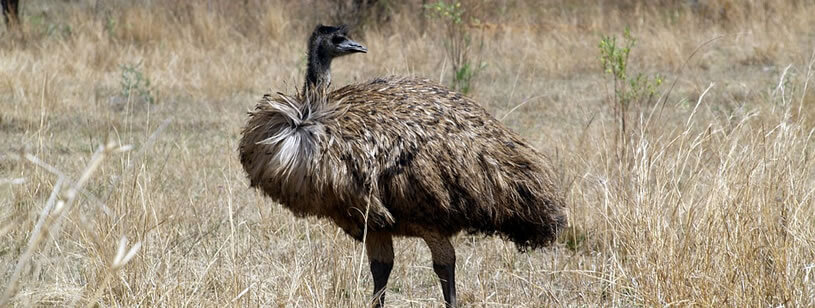
The emu (Dromaius novaehollandiae) is a large flightless bird found only in mainland Australia. It is the second-tallest bird in the world, after the ostrich, and can run at about 50 km/h on its long, strong legs.
Emus eat seeds, fruit, flowers and insects, and travel long distances to follow food and water. The male incubates the big dark green eggs and raises the striped chicks on his own. The emu appears on the Australian Coat of Arms, alongside a kangaroo.
Quick facts
| Common name | Emu |
| Scientific name | Dromaius novaehollandiae |
| Typical lifespan | 10-20 years in the wild, up to about 30 years or more in captivity |
| Maximum speed | About 50 km/h |
| Height | 1.5 - 1.9 m |
| Weight | 30 - 55 kg |
| Diet type | Omnivore (seeds, fruit, flowers, insects) |
| Main predators | Dingoes and wedge-tailed eagles; foxes and feral pigs take eggs and chicks |
| Conservation status | Least Concern (IUCN) |
| Distribution | Mainland Australia |
| Habitat | Grasslands, savannas, open woodland and semi-arid land |
- Primary category:Birds
- Explore this animal's categories:
Interesting facts
- Australia's largest bird - The emu is the second-tallest bird in the world, after the ostrich, and can stand up to about 1.9 metres tall.
- A fast runner - Emus can run at about 50 km/h on their long, powerful legs and take strides of up to about 2.7 metres.
- Wings, but no flight - Emus have tiny wings, only about 20 cm long, which cannot lift them; they flap them when running, perhaps to help balance.
- Huge green eggs - Emu eggs have a dark green shell, are about 13 cm long and weigh about 500-650 g.
- Devoted fathers - The male emu incubates the eggs for about 8 weeks, barely eating or drinking, and then looks after the chicks for many months.
- Built for dry country - Emus can go for some time without drinking, getting moisture from plants, but they drink regularly when water is available.
- Booming calls - Female emus make deep drumming or booming sounds using an inflatable sac in their neck, while males grunt.
- Good swimmers - Although they live mostly in dry areas, emus can swim well and cross rivers.
- Protected eyes - A see-through third eyelid protects their eyes from dust and wind.
- The "Emu War" - In 1932, in Western Australia, soldiers with machine guns were sent to stop huge numbers of emus damaging wheat crops; the emus proved so hard to shoot that the operation failed.
Records and remarkable features
- Emus are flightless birds, but they still have small wings.
- The emu is the tallest bird in Australia and the second-tallest in the world.
- Emus have a special double feather: two shafts grow from the same base.
Characteristics
The emu is a large bird with a sturdy body, strong legs and shaggy feathers. It is well adapted to life in harsh environments and has features that help it survive heat, drought and long journeys.
Main physical characteristics
- Great height - Emus can be up to about 1.9 metres tall, making them the tallest birds in Australia.
- Weight - Usually about 30-55 kg; females are often slightly larger than males.
- Very strong legs - Emus have long, muscular legs with three toes, each with a sharp claw.
- Shaggy feathers - Their loose, hair-like feathers have two shafts from one base and help protect them from heat and cold.
- Tiny wings - About 20 cm long and far too small for flying.
- Bare skin on the neck - Their head and neck have only thin feathers, with bluish skin showing through.
Special adaptations for survival
- Long-distance running - Emus can sprint fast and also keep up a steady pace over long distances.
- A third eyelid - Protects the eyes from dust and wind.
- Coping with drought - Emus get water from plants and can go some time without drinking, but they drink regularly when water is available.
- Staying cool - Their feathers keep the sun off their skin, and they pant to lose heat.
Habits and behaviour
Emus are active, curious birds that are well adapted to dry environments. They are nomadic and move around to follow food and water.
Social behaviour
- Small groups - Emus often live alone or in small groups, but may gather in large flocks when moving to new feeding areas.
- Long journeys - They can travel hundreds of kilometres in search of food and water, following the rains.
- Curiosity - Emus are known for investigating new objects and even approaching people.
- Calls - Females make deep booming sounds, and males make low grunts.
Breeding season
- Pairs form in summer, and eggs are laid in the cooler months, mainly from about April to June.
- Active females - Females court males and may mate with more than one male in a season.
- Fathers raise the young - After laying her eggs, the female usually leaves, and the male incubates them and raises the chicks.
Defence and survival methods
- Running - Their first defence is to run away fast, often zigzagging.
- Kicking - Emus can kick hard with their clawed feet, causing serious injuries.
- Camouflage - Their brown feathers help them blend into the landscape.
Habitat and geographic distribution
The emu lives only in mainland Australia, where it is found in almost every habitat, from forests to dry plains, although it avoids dense rainforest and the driest deserts.
Habitat types
- Grasslands and savannas - Their most common habitat, with plenty of food.
- Open woodland and eucalyptus forests - They shelter among trees, where there is shade and varied food.
- Farmland - Emus are often seen near crops, where they eat grain and insects.
- Dry inland areas - They live in semi-desert regions, moving long distances to find food and water.
Geographic distribution
| Region | Situation |
|---|---|
| Mainland Australia | Widespread; roughly 600,000-700,000 birds |
| Tasmania, Kangaroo Island and King Island | Their island emus died out in the 19th century after European settlement |
| Farmland in southern and western Australia | Common; emus benefit from farm water supplies but can damage crops |
Impact of climate change and human activities
- Habitat loss - Clearing land for farms and towns reduces emu habitat in some areas.
- Conflict with farmers - Emus eat crops and damage fences, which can lead to conflict.
- Changing rainfall - Droughts and changing rainfall affect where emus can find food and water.
The emu remains one of the most adaptable birds in the world.
Diet and feeding
The emu is an omnivore that eats many kinds of food, depending on the season. Its diet includes seeds, fruit, flowers, shoots and insects.
Main food
- Plants and seeds - Most of their diet: seeds, grasses, leaves and shoots.
- Fruit and flowers - They eat the fruits and flowers of many native Australian plants.
- Insects and small animals - Grasshoppers, beetles, caterpillars and other insects, and sometimes small lizards.
- Stones - Emus swallow pebbles, which help grind food in their gizzard.
Diet by habitat
| Habitat | Type of food |
|---|---|
| Grasslands | Seeds, grasses, insects |
| Woodland | Fruit, flowers, leaves |
| Farmland | Grain, crops, insects |
| Dry regions | Drought-resistant plants, insects |
Feeding methods
- Swallowing stones - Like many birds, emus have no teeth and swallow small stones to help grind their food.
- Seasonal changes - They eat more insects when they are plentiful and more seeds and fruit at other times.
- Travelling for food - Emus walk long distances to find enough to eat, and they help spread the seeds of many plants in their droppings.
Reproduction and life cycle
The emu has an unusual breeding system: the male incubates the eggs and raises the chicks, while the female may leave and mate with other males.
Mating
- Courtship - Females approach males and make booming calls, and pairs stay together for several months.
- Active females - Females often compete for males, and some mate with several males in a season.
- Nesting - The nest is a simple platform of grass, leaves and sticks on the ground.
Eggs and incubation
- Incubation - Lasts about 8 weeks, during which the male hardly eats or drinks, living on his fat reserves.
- Eggs - A clutch usually has about 5-15 large, dark green eggs.
- Hatching - The chicks hatch after about 8 weeks, covered with striped down that camouflages them.
Development of the chicks
- Living with dad - The male protects the chicks and leads them to food, often for about 6 months or more.
- Fast growth - Chicks grow quickly and reach adult size within about a year.
- Independence - Young emus may stay with their father for up to a year or more before leaving.
Longevity
- In the wild - Usually about 10-20 years.
- In captivity - Up to about 30 years or more.
Name and history
The emu is a symbol of Australia, with a long history in Aboriginal culture and in the records of European explorers.
Origin of the name
- The word "emu" probably comes from the Portuguese ema, a name once used for large flightless birds such as cassowaries.
- The scientific name Dromaius novaehollandiae means "racer of New Holland", an old European name for Australia.
Taxonomic classification
| Taxonomic category | Name |
|---|---|
| Kingdom | Animalia |
| Phylum | Chordata |
| Class | Aves |
| Order | Casuariiformes |
| Family | Casuariidae (sometimes placed in its own family, Dromaiidae) |
| Genus | Dromaius |
| Species | Dromaius novaehollandiae |
Discovery and documentation
- First European sightings - Dutch explorers led by Willem de Vlamingh saw emus in Western Australia in 1696.
- Aboriginal knowledge - Aboriginal Australians have hunted emus and told stories about them for tens of thousands of years.
- Scientific description - The emu was scientifically described in 1790, soon after British settlement.
The role of the emu in Australia's history
- The emu appears on the Australian Coat of Arms, alongside a kangaroo.
- A source of food - Aboriginal people have used emus for meat, fat, feathers and bones for thousands of years.
- "The Emu War" (1932) - The Australian army's attempt to cull emus with machine guns in Western Australia failed, because the birds were fast and scattered quickly.
The emu remains one of Australia's most iconic animals, a symbol of strength, adaptability and survival.
Cultural significance and mythology
The emu is an important symbol in Australian culture and in Aboriginal traditions, where it appears in many stories, ceremonies and works of art.
The emu in Aboriginal traditions
- Dreaming stories - The emu is an important ancestral being in the Dreaming stories of many Aboriginal peoples.
- The Emu in the Sky - Many Aboriginal peoples see an emu formed by the dark dust clouds of the Milky Way; its position in the night sky tells them when emus are laying eggs.
- The sun from an egg - In one traditional story, an emu's egg was thrown into the sky and burst into flame, becoming the sun.
Emu symbolism
- Endurance and survival - Because emus can live in harsh conditions and travel long distances.
- Moving forward - A popular belief says that emus and kangaroos cannot walk backwards, which is often given as the reason they were chosen for the coat of arms, although emus can in fact step backwards.
- Good fathers - Because males care for the eggs and chicks, emus are symbols of devoted fatherhood.
The emu in modern Australian culture
- The emu appears on the Australian Coat of Arms, alongside a kangaroo.
- Emu oil - Oil from emu fat has long been used by Aboriginal people to soothe aches and skin problems.
- Symbols - Emus appear on stamps, logos and brands across Australia.
Conservation status and threats
The emu is not threatened and is listed as Least Concern by the IUCN, but some local populations have declined because of habitat loss, and island emus became extinct in the past.
Conservation status
- Least Concern (IUCN) - The mainland population is large and widespread.
- Lost island emus - The emus of Tasmania, Kangaroo Island and King Island died out in the 19th century, mainly because of hunting and habitat change.
Main threats
- Habitat loss - Clearing land reduces the areas where emus can feed.
- Conflict with farmers - Emus eat crops and damage fences, which leads to conflict with farmers.
- Road accidents - Emus often cross roads and are hit by vehicles.
- Predators - Dingoes and wedge-tailed eagles hunt emus, and introduced foxes and feral pigs take eggs and chicks.
Conservation efforts
- Protected areas - Emus are protected in national parks and reserves.
- Living with farmers - Farmers are encouraged to use fences and other non-lethal methods to keep emus away from crops.
- Monitoring - Researchers follow emu numbers to detect local declines.
In popular culture
The emu is a symbol of Australia and appears in books, television, art and stories.
The emu in literature
- Edward the Emu (Sheena Knowles, 1988) - A much-loved Australian picture book about an emu who tries being other animals before deciding it is best to be an emu.
- Aboriginal stories - Traditional stories explain, for example, why the emu cannot fly.
The emu on television
- Rod Hull and Emu - For many years, the British entertainer Rod Hull performed with Emu, a mischievous puppet famous for attacking guests on TV shows.
- Nature documentaries - Emus often appear in films about Australian wildlife.
The emu as a symbol
- The coat of arms - The emu and the kangaroo hold up the shield of the Australian Coat of Arms.
- Art - Emus are common subjects in Aboriginal paintings, carvings and decorated emu eggs.