Polar bearInteresting facts and information
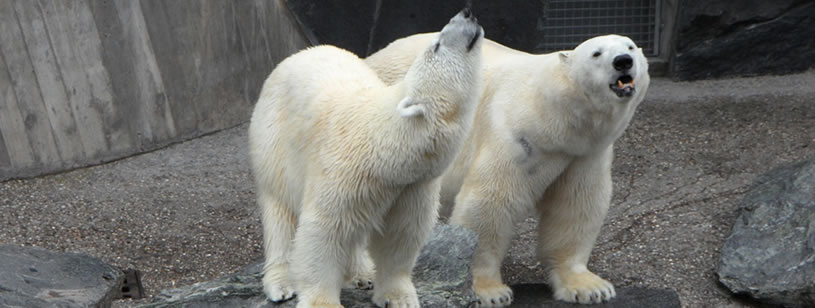
The polar bear (Ursus maritimus) is a large Arctic mammal that depends heavily on sea ice for hunting seals. Its dense fur, body fat and broad paws help it live in the cold and move between ice and water.
Seals provide the energy-rich food that polar bears need. Loss of sea ice can cut them off from their hunting grounds.
The loss of sea ice is the main threat to polar bears. Population estimates are made for separate subpopulations and should always be read with the date of the survey in mind.
Quick facts
| Common name | Polar bear |
| Scientific name | Ursus maritimus |
| Typical lifespan | 20-30 years in the wild, up to about 40 years in captivity |
| Maximum speed | About 40 km/h over short distances on land; about 10 km/h swimming |
| Height | 1.3-1.6 m at the shoulder; up to about 3 m standing on its hind legs |
| Weight | Typically about 150–250 kg for adult females and 300–635 kg for adult males; condition and pregnancy affect weight |
| Diet | Carnivore (mainly seals) |
| Main predators | Humans (hunting, climate change); other polar bears (for cubs) |
| Conservation status | Vulnerable (IUCN) |
| Geographic distribution | Arctic: Canada, Greenland, Norway, Russia, USA (Alaska) |
| Habitat | Sea ice, Arctic coasts and islands |
| Social behaviour | Usually solitary, with overlapping home ranges; several bears may gather where food is plentiful |
| Special adaptations | Translucent fur, black skin, thick layer of fat, ability to swim long distances |
- Primary category:Mammals
- Explore this animal's categories:
Interesting facts
- The polar bear is classed as a marine mammal - Because it spends most of its life on sea ice and in the water, it is treated as a marine mammal, like whales and seals.
- It has black skin and colourless fur - The fur looks white because it reflects light, while the black skin helps absorb the sun's heat.
- It is an exceptional swimmer - Polar bears can swim for days and cover more than 100 km without a break, helped by their large paws and a thick layer of fat.
- It has a superb sense of smell - A polar bear can smell a seal from more than a kilometre away, even under the snow.
- It can go for months without food - When there is no sea ice to hunt from, polar bears can live for months on their fat reserves; pregnant females in dens may fast for up to about 8 months.
- It hardly ever drinks - Fresh water is scarce in its frozen habitat, so the polar bear gets most of the water it needs from its food, especially from breaking down seal fat.
Records and remarkable features
- The polar bear is the largest living land carnivore; big males can weigh more than 600 kg.
- It is the only bear species classed as a marine mammal.
- The oldest polar bear on record, a female called Debby, lived to about 41 years in a zoo in Canada.
Characteristics
The polar bear (Ursus maritimus) has a series of unique adaptations that help it survive the extreme Arctic climate. From its water-repellent fur and black skin to its ability to hunt in icy water, this predator is superbly adapted to life on the ice.
Appearance
- Translucent, dense fur - The guard hairs are hollow, which helps insulate the body; they scatter light, so the bear looks white.
- Black skin - Helps absorb heat from sunlight, which is important in the cold.
- Thick body fat - A layer of fat up to about 10 cm thick protects against the cold and stores energy for times without food.
- Large, strong paws - Up to about 30 cm across, they are good paddles for swimming and spread the bear's weight on thin ice.
- Sharp, strong claws - Used to grab prey, grip the ice and dig dens.
- Teeth for a meat diet - Long canine teeth tear flesh, and sharp cheek teeth cut through meat and fat.
Special adaptations
- Holding its breath - A polar bear can stay underwater for up to about 2 minutes while hunting.
- Good grip on ice - Small bumps and fur on the soles of the paws help stop it slipping.
- Good vision in poor light - Helps it hunt in the long Arctic night and spot movement when visibility is low.
- High tolerance of extreme cold - It copes with temperatures below -40°C.
Habits and behaviour
The polar bear is a solitary hunter that spends most of its time on the sea ice looking for prey. It is an intelligent animal that adapts its hunting strategy to the conditions around it.
Social behaviour
- Polar bears are usually solitary, apart from mothers with cubs. They use overlapping home ranges rather than defending fixed territories.
- Tolerance of other bears - Although they live alone, polar bears sometimes share a large carcass, such as a dead whale, with other bears.
- Cubs stay with their mother for 2-3 years - Mothers are very protective and teach their cubs to hunt and survive.
Survival techniques
- Ambush hunting - The bear waits beside a seal's breathing hole and attacks when the seal comes up for air.
- Camouflage - Its pale fur blends in with the snow and ice, which helps it approach prey.
- Strong swimming - It can cross long stretches of open water between areas of sea ice in search of food.
- Energy storage - In hard times, it lives on its fat reserves for months.
- Following the ice - Polar bears move with the seasonal changes in sea ice to stay close to seals.
Habitat and geographic distribution
The polar bear lives only in the Arctic and depends on sea ice for hunting.
| Region | Population estimate | Preferred habitat |
|---|---|---|
| Canada (Nunavut, Manitoba, Ontario, Quebec, Newfoundland and Labrador) | About 60% of all polar bears | Sea ice, tundra |
| Greenland | 3,000 - 4,000 bears | Sea ice and coasts |
| Norway (Svalbard) | 2,500 - 3,000 bears in the Barents Sea region | Arctic islands, sea ice |
| Russia (Franz Josef Land, northern Siberia) | 3,000 - 5,000 bears | Tundra, pack ice |
| Alaska (USA) | 4,000 - 6,000 bears | Arctic coasts, sea ice |
Types of habitat
- Sea ice - The ideal hunting ground, where seals are plentiful.
- Arctic islands and frozen coasts - Used for shelter and for maternity dens.
- Arctic tundra - In summer, when the ice retreats, some bears stay on land and live off their fat, with the occasional meal of carcasses, eggs or plants.
Human impact and threats
- Climate change - Melting sea ice reduces the area where bears can hunt and forces them to swim longer distances.
- Pollution - Oil and chemical pollution in the Arctic affects polar bear health.
- Illegal hunting - In some regions, polar bears are still killed illegally for their fur and meat.
- Conflict with people - As sea ice shrinks, hungry polar bears come closer to towns and villages.
Diet and feeding
The polar bear is a carnivore, and seals are its main food. To survive the extreme Arctic conditions, it needs large amounts of energy-rich fat.
What does the polar bear eat?
| Type of food | Share of the diet (approximate) |
|---|---|
| Ringed seals and bearded seals | About 90% |
| Walruses, belugas and narwhals (occasionally) | About 5% |
| Whale carcasses (washed ashore or left by hunters) | About 2% |
| Fish and crustaceans | About 1% |
| Grass, seaweed, berries (only when other food is scarce) | < 1% |
Feeding techniques
- Still hunting - The polar bear waits motionless beside a breathing hole in the ice and attacks the seal when it surfaces.
- Stalking - It sometimes creeps up on seals resting on the ice, swimming or crawling close before it charges.
- Breaking into dens - It uses its strong front legs to smash through snow and reach seal pups hidden in their lairs.
- Occasional cannibalism - In times of extreme hunger, adult males may kill and eat cubs or weaker bears.
- Other foods - In summer, when the ice melts, some polar bears eat bird eggs, berries or even rubbish.
Reproduction and life cycle
Polar bears breed slowly: females usually give birth only every 2-3 years, so populations recover slowly.
| Feature | Details |
|---|---|
| Age at maturity | 4-6 years |
| Mating season | April-June |
| Type of reproduction | Live birth (mammal) |
| Cubs per litter | 1-3 (usually 2) |
| Pregnancy | 195-265 days (including delayed implantation) |
| Weight at birth | 600-700 g |
| Age at independence | 2-3 years |
| Lifespan | 20-30 years in the wild, up to about 40 years in captivity |
Mating
- Males fight for females - During the mating season, males may fight fiercely, and the winner gets the chance to mate.
- Delayed implantation - Mating takes place in spring, but the embryo only starts developing in autumn, so that cubs are born in the middle of winter.
- No lasting pairs - After mating, males go back to their solitary lives, and the female raises the cubs alone.
Birth and raising cubs
- Pregnant females dig maternity dens and give birth while sheltering through winter. Their metabolism changes during this period.
- Cubs are blind and helpless at birth - They weigh less than 1 kg, which is very small compared with the size of their mother.
- Very rich milk - Polar bear milk contains about 30-35% fat, so the cubs grow quickly.
- Learning to hunt - Cubs start learning to hunt in their first year, but stay with their mother for 2-3 years to learn how to survive.
Name and history
Origin of the name
- The scientific name Ursus maritimus means "sea bear", reflecting its close link with the ocean.
- The word "polar" comes from Latin and refers to the area around the North Pole, where the bear lives.
- In Inuktitut, the polar bear is called nanuq (often written "Nanook" in English).
The polar bear in human history
- Early contact - Inuit and other Arctic peoples have hunted polar bears for thousands of years, using them for food, clothing and tools.
- European explorers - The polar bear was formally described by scientists in 1774, during the age of Arctic exploration.
- A respected animal - Many Arctic peoples treated the polar bear with great respect, and hunting it was surrounded by special customs.
The polar bear in folklore and superstition
Cultural significance and mythology
- Inuit traditions - The polar bear, nanuq, is a powerful and respected animal in Inuit stories, often seen as wise and almost human.
- Rituals of respect - In many Arctic communities, a successful bear hunt was followed by customs meant to honour the animal's spirit.
- A symbol of the Arctic - Today the polar bear is widely seen as a symbol of the Arctic and of the effects of climate change.
Conservation status and threats
The polar bear is listed as Vulnerable and is one of the bear species most directly affected by climate change and habitat loss.
| IUCN status | Population estimate | Countries |
|---|---|---|
| Vulnerable (VU) | About 22,000 - 31,000 bears | Canada, Greenland, Russia, USA (Alaska), Norway |
Main threats
- Climate change - Rising temperatures melt the sea ice, reducing hunting grounds and forcing bears to swim longer distances for food.
- Harder hunting - As the sea ice shrinks, seals become harder to catch, which affects the bear's main food supply.
- Conflict with people - Hungry polar bears more often enter human settlements, where they can be dangerous.
- Pollution - Oil and toxic chemicals build up in the Arctic food chain and affect the bears' health.
- Illegal hunting - Although polar bears are protected, some are still killed illegally for their fur and meat.
Conservation efforts
- Protected areas - National parks and reserves in Canada, Greenland, Norway (Svalbard) and Russia protect important polar bear habitat.
- Cutting greenhouse gas emissions - Global action on climate change is the most important long-term measure for saving sea ice.
- Monitoring - Researchers use satellite collars and surveys to follow polar bear movements, numbers and health.
- International cooperation - The five polar bear countries signed an agreement on polar bear conservation in 1973, and groups such as WWF work to protect the Arctic.
In popular culture
- The Golden Compass (2007) - Iorek Byrnison, an armoured talking polar bear from Philip Pullman's novel Northern Lights, is one of the main characters.
- Polar Bear (Disneynature, 2022) - A documentary about a polar bear mother and her life in a changing Arctic.
- Christmas advertising - Animated polar bears have appeared in Coca-Cola's winter adverts since 1993.
- Knut - A polar bear cub born at Berlin Zoo in 2006 became world-famous and attracted huge crowds.
Frequently asked questions
- Where does the polar bear live? Polar bears live in the frozen northern areas of the Arctic Ocean and its coasts, in Canada, Alaska, Greenland, Russia and Norway (the Svalbard archipelago).
- What does the polar bear eat? Polar bears feed mainly on seals, especially ringed and bearded seals, but they occasionally eat fish, birds, eggs or whale carcasses.
- How long does a polar bear live? In the wild, a polar bear can live to about 30, but this is rare; most adults die before 25. In captivity, they can live to around 40.
- Do polar bears hibernate? Polar bears are generally active through the winter. Pregnant females use maternity dens and undergo metabolic changes while giving birth and nursing cubs.
- Do polar bears live at the North Pole or the South Pole? Polar bears live in the Arctic, the region around the North Pole. In Antarctica, around the South Pole, there are penguins, seals, whales and many seabirds, but no polar bears. Related profile: Animals of Antarctica.