MongooseInteresting facts and information
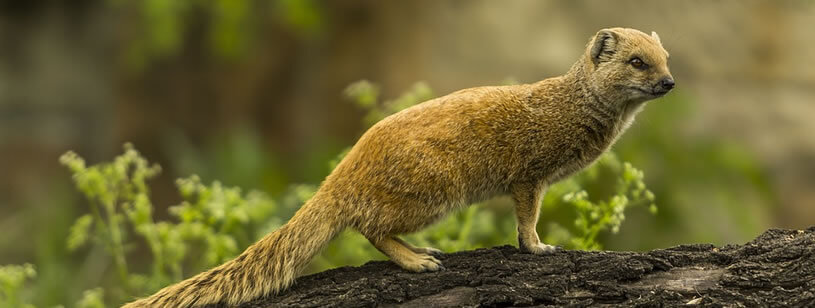
The mongoose is a small, agile and clever mammal, famous for its ability to fight venomous snakes, including cobras. Mongooses make up the family Herpestidae, with about 34 species, including the meerkat, which live in Africa, Asia and southern Europe.
With a slim, flexible body, sharp claws and quick reflexes, the mongoose is an efficient predator. Besides snakes and other reptiles, mongooses eat insects, birds, eggs, small mammals and sometimes fruit.
Social behaviour varies between mongoose species. Dwarf mongooses, banded mongooses and meerkats live in groups, while many other mongooses spend much of their time alone.
Quick facts
| Common name | Mongoose |
| Scientific name | Herpestidae (family with about 34 species) |
| Typical lifespan | About 6 - 10 years in the wild, up to about 20 years in captivity |
| Maximum speed | Fast in short bursts; often quoted as about 30 km/h |
| Dimensions | About 18 - 60 cm long without the tail, depending on the species |
| Weight | About 0.2 - 5 kg |
| Diet type | Mainly carnivore (insects, reptiles, small mammals, birds, eggs, some fruit) |
| Main predators | Birds of prey, jackals, big cats and large snakes |
| Conservation status | Varies by species; most are Least Concern, a few are threatened |
| Distribution | Africa, Asia, southern Europe; introduced to many islands |
| Habitat | Savannas, forests, scrubland, arid and semi-arid areas |
- Primary category:Mammals
- Explore this animal's categories:
Interesting facts
- Resistance is not immunity – Some mongooses have changes in their nerve receptors that reduce the effect of certain snake venoms. Snakebites can still injure or kill them.
- Snake fighters – Not all mongooses hunt snakes, but those that do rely on speed, quick dodges and thick fur to avoid being bitten.
- Some species are very social – Banded mongooses live in groups of about 10-40 animals, and dwarf mongooses in family groups led by a breeding pair.
- Lots of sounds – Social mongooses use many different calls, including chirps, twitters and growls, to keep in touch and warn of danger.
- Meerkats are mongooses – The famous meerkat belongs to the mongoose family.
- Births on the same night – In banded mongoose groups, several females often give birth on the same night and raise their pups together.
Records and remarkable features
- Largest mongooses – The white-tailed mongoose (Ichneumia albicauda) and the Egyptian mongoose (Herpestes ichneumon) can be over 1 m long including the tail and weigh up to about 4-5 kg.
- The smallest mongoose – The common dwarf mongoose (Helogale parvula) is about 18-28 cm long without its tail and weighs only about 200-350 g.
- Fast – Mongooses can run quickly in short bursts, which helps them catch prey and escape predators.
- Most widely introduced – The small Indian mongoose (Urva auropunctata) has been introduced to many islands, including Hawaii, Fiji, Mauritius and the Caribbean, where it is an invasive species.
- Very social – The banded mongoose (Mungos mungo) lives in groups of up to about 40 animals, sometimes more, cooperating to defend themselves and raise their young.
Characteristics
Mongooses are small carnivorous mammals with long, flexible bodies, short legs, pointed faces and strong claws for digging and catching prey. There are about 34 species, including the meerkat.
Main physical characteristics:
| Characteristic | Details |
|---|---|
| Size | About 18-60 cm long without the tail, depending on the species |
| Weight | About 0.2-5 kg |
| Colour | Grey, brown or reddish, sometimes banded or speckled |
| Tail | Long and often bushy |
| Teeth | Sharp teeth for catching and eating meat and insects |
| Eyesight | Good; quick to spot movement |
| Hearing and smell | Very good; used to find prey hidden in soil and leaves |
| Movement | Fast and agile, with excellent reflexes |
| Claws | Long and non-retractable, used for digging |
Special adaptations:
- Resistance to some toxins – Changes in certain nerve receptors reduce the action of some snake venoms, but the protection is not complete.
- A flexible body – Their long body and bendy spine let them twist and dodge very quickly.
- Camouflage – Their grey or brown fur helps them blend into the landscape and hide from predators.
- Digging claws – Used to dig burrows and to dig out insects and other prey.
Habits and behaviour
Mongooses are active and clever mammals. Most species are solitary, but a few live in close-knit groups.
Social behavior:
- Solitary species – The Egyptian mongoose and the small Indian mongoose usually hunt alone.
- Social species – Dwarf mongooses, banded mongooses and meerkats live in groups and cooperate to find food, watch for danger and raise young.
- Communication – Social mongooses keep in contact with soft calls while foraging and give alarm calls that warn of predators.
Feeding and survival methods:
- Varied diet – They eat insects, other invertebrates, reptiles, birds, eggs and small mammals, and some also eat fruit.
- Hunting techniques – They use quick pounces and fast reflexes to catch prey.
- Opening eggs – Banded mongooses break eggs and hard-shelled prey by throwing them backwards between their legs against a rock.
Defense and Survival Strategies:
- Avoiding bites – Quick movement helps some mongooses hunt snakes, but venomous snakes remain dangerous.
- Mobbing – Social mongooses can bunch together and attack a predator, often driving it away.
- Lookouts – In social species such as dwarf mongooses, individuals may act as sentinels and give alarm calls.
Habitat and geographic distribution
Mongooses are very adaptable and live in many habitats, from forests and savannas to dry scrub and even deserts.
Habitat types:
| Habitat | Predominant regions |
|---|---|
| Savanna | Sub-Saharan Africa, India |
| Rainforests | Central and West Africa, South and Southeast Asia; Malagasy mongoose-like carnivores belong to a different family |
| Scrubland | Southern Spain and Portugal, Middle East |
| Deserts and semi-deserts | Kalahari, dry areas of India and the Middle East |
| Farmland and towns | Hawaii, Caribbean, other islands (introduced species) |
Geographic distribution:
- Africa – The greatest number of species, including the banded mongoose, the dwarf mongoose and the meerkat.
- Asia – Several species live from the Middle East through India and Sri Lanka to Southeast Asia.
- Europe – The Egyptian mongoose (Herpestes ichneumon) lives in Spain and Portugal.
- Islands – The small Indian mongoose was introduced by people to many islands, including the Caribbean, Hawaii, Fiji and Mauritius, to control rats and snakes.
The impact of human activities on mongoose populations:
- Invasive species – Mongooses introduced to control rats and snakes have instead killed many native birds, reptiles and other animals.
- Hunting and trade – In some places, mongooses are hunted for meat or traditional medicine, and in India they have been illegally killed for their hair, used in paintbrushes.
- Habitat destruction – Deforestation and farming reduce the areas where some species can live.
Mongooses are very versatile and can survive in a wide range of environments.
Diet and feeding
Mongooses are mostly carnivores with a very varied diet. Some are famous for hunting venomous snakes, but most eat mainly insects and other small animals, and some also eat fruit.
Types of food consumed:
| Food group | Examples of species that consume it |
|---|---|
| Insects | Dwarf mongoose, banded mongoose, meerkat |
| Snakes and other reptiles | Indian grey mongoose, Egyptian mongoose |
| Small rodents | Most species |
| Bird eggs | Banded mongoose, small Indian mongoose |
| Fruit | Banded mongoose and several other species |
Feeding methods:
- Fast and accurate hunting – Mongooses use nimble leaps and precise bites to kill prey.
- Fighting snakes – They use their quick reflexes to dodge strikes and then bite the snake's head or neck.
- Egg cracking – Mongooses throw eggs against rocks or hard surfaces to break them open.
Thanks to their varied diet, mongooses help control rodents and insects in their native ecosystems.
Reproduction and life cycle
Mongoose breeding varies a lot between species, from solitary mothers to groups that raise their young together.
Life cycle stages:
| Stage | Approximate duration | Characteristics |
|---|---|---|
| Mating | Seasonal or year-round | Depends on the species and region |
| Gestation | About 42 - 80 days | Females give birth in burrows, termite mounds or rock crevices |
| Birth | Usually 2 - 6 pups per litter | The pups are born blind and helpless |
| Care of the young | 1 - 3 months | The mother, or in social species the whole group, feeds and protects the young |
| Sexual maturity | About 9 months - 2 years | Depends on the species; in social species, many adults do not breed |
| Lifespan | About 6 - 10 years in the wild, up to about 20 years in captivity | Varies by species |
Reproductive behavior:
- Solitary mongooses – The female raises her young alone.
- Social mongooses – In dwarf mongooses, usually only the dominant pair breeds; in banded mongooses, several females give birth at the same time and the group raises the pups together.
- Babysitters and escorts – In banded mongooses, adults guard the pups at the den and later each pup has an adult "escort" that feeds and protects it.
Their breeding rate helps mongooses recover from losses to predators or harsh years, and helps introduced mongooses spread quickly.
Name and history
Mongooses have been known since ancient times and appear in myths, art and stories, especially in India and Egypt.
Origin and etymology of the name:
- "Mongoose" – Comes from Marathi mangūs, a word related to names for the animal in other Indian languages such as Telugu and Kannada.
- Scientific name "Herpestidae" – From the Greek herpestes, meaning "creeper".
- Other names – In French mangouste, in Hindi nevla.
Taxonomic classification:
| Taxonomic category | Name |
|---|---|
| Kingdom | Animalia |
| Phylum | Chordata |
| Class | Mammalia |
| Order | Carnivora |
| Family | Herpestidae |
| Main genera | Herpestes, Urva, Mungos, Helogale, Suricata |
| Known species | About 34 species |
Mongooses in history and culture:
- Ancient Egypt – The Egyptian mongoose, or ichneumon, was a sacred animal; it appears in Egyptian art and was sometimes mummified.
- Rudyard Kipling – “Rikki-Tikki-Tavi” (1894) – The story of a brave mongoose who protects a family from two cobras is one of the most famous mongoose stories.
Mongooses have long been admired for their hunting skills and seen as symbols of protection and courage.
Cultural significance and mythology
Because they can fight venomous snakes, including cobras, mongooses have long been admired. They appear in legends, religious art and stories, and are linked with protection, courage and good luck.
Mongoose Symbolism:
- Courage and protection – Their ability to fight cobras made them symbols of bravery.
- Wealth – In Hindu and Buddhist art, Kubera, the god of wealth, is often shown holding a mongoose that spits out jewels.
- Cleverness – Mongooses are seen as quick, clever animals; in the Indian Panchatantra, a loyal mongoose saves a baby from a snake.
Conservation status and threats
Most mongoose species are widespread and not threatened, but a few rare forest species are at risk. In many places where they were introduced, mongooses are themselves a threat to native wildlife.
Conservation status
| Species | Status (IUCN) |
|---|---|
| Common dwarf mongoose | Least Concern |
| Banded mongoose | Least Concern |
| Malagasy mongoose-like carnivores | Different family (Eupleridae); status depends on the particular species |
| Liberian mongoose | Vulnerable |
| Small Indian mongoose | Least Concern; invasive on many islands where it was introduced |
Main threats:
- Habitat loss – Deforestation and farming reduce the areas where forest species can live and hunt.
- Hunting and trade – In some regions, mongooses are killed for meat, traditional medicine or their hair.
- Introduced mongooses – In places such as Hawaii, Fiji, Okinawa and the Caribbean, mongooses introduced to control rats and snakes have harmed native birds, reptiles and mammals.
- Disease – Mongooses can carry rabies, for example in Puerto Rico and southern Africa, which sometimes leads to control measures.
Conservation efforts:
- Habitat protection – Protecting forests helps rare species such as the Liberian mongoose; Madagascar’s mongoose-like species are classified in the family Eupleridae.
- Controlling invasive mongooses – On some islands, introduced mongooses are trapped to protect native wildlife; on Amami Ōshima in Japan, they were completely removed after a long programme.
- Ending the hair trade – In India, mongooses are protected by law, and authorities seize illegal paintbrushes made from mongoose hair.
Most mongooses are not endangered, but introducing them to new places can turn them into a serious threat to local wildlife.
In popular culture
Mongooses appear in literature, film, television and folklore, usually as brave, fast and clever animals.
Mongooses in literature:
- "Rikki-Tikki-Tavi" (Rudyard Kipling, 1894) – Published in The Jungle Book, it tells of a young mongoose in India who defends a family from two cobras.
- The Panchatantra – This ancient Indian collection of fables includes the story of a faithful mongoose wrongly blamed after saving a child from a snake.
- Encyclopedias and nature guides – Mongooses are often featured as efficient, adaptable predators.
Mongooses in film and television:
- "The Lion King" (1994, 2019) – The character Timon is a meerkat, a member of the mongoose family.
- "Rikki-Tikki-Tavi" (1975) – An animated TV film by Chuck Jones, based on Kipling's story.
- Nature documentaries – Mongooses often appear in documentaries about African and Asian wildlife.
Meerkats on screen:
- "Meerkat Manor" (2005-2008) – A popular TV series that followed a family of wild meerkats in the Kalahari.
- "Compare the Meerkat" – Since 2009, a series of British TV adverts has featured Aleksandr Orlov, a talking meerkat.
Mongoose as a cultural symbol:
- Good luck – In parts of India, seeing a mongoose is traditionally thought to bring good luck.