Tawny owlStrix aluco — habitat, diet and reproduction
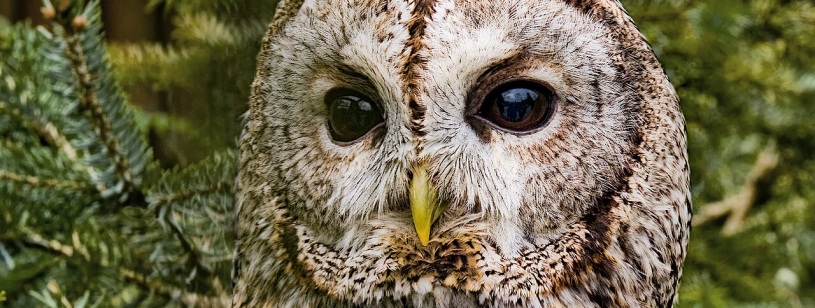
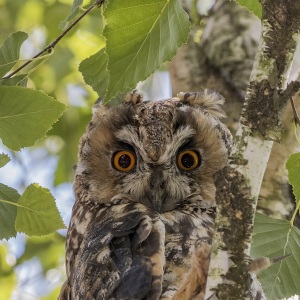
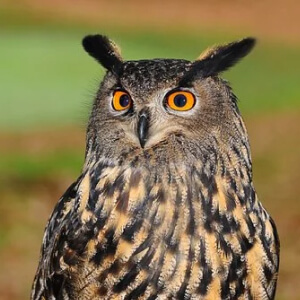
Tawny owl (Strix aluco) among conifer branches. · Michael Gäbler / CC BY 3.0 (https://creativecommons.org/licenses/by/3.0). Cropped and resized.
The tawny owl is a round-headed woodland owl with dark eyes and no ear tufts. Its wavering “hoo-hoooo” is the sound many people link with night-time. It lives in woods, large parks and gardens with old trees.
Quick facts
| Common name | Tawny owl |
| Scientific name | Strix aluco |
| Lifespan | About 5 years in the wild; some exceed 20 years |
| Length | About 37–46 cm |
| Weight | About 385–800 g; females are heavier |
| Diet | Carnivore: rodents, small birds, frogs, earthworms |
| Predators | Eagle owls and goshawks; martens may take chicks |
| Conservation status | Least Concern (LC), globally |
| Distribution | Europe, western Asia and north-west Africa |
| Habitat | Broadleaf and mixed woodland, parks, large gardens |
| Family | Strigidae |
| Activity | Nocturnal |
- Primary category:Birds
- Explore this animal's categories:
Interesting facts
- The famous “hoo-hoo” is usually the male’s call; the female answers with a sharp “ke-wick”.
- There are grey and rufous tawny owls; colour does not depend on sex.
- Soft-edged feathers make its flight almost silent.
- Photographer Eric Hosking lost an eye when a tawny owl defended its nest.
Characteristics
The tawny owl is a medium-sized, sturdy owl with a large round head. The facial disc is well defined, and the eyes are very dark. Mottled, streaked plumage hides it against tree bark.
The female is larger and heavier than the male. Broad, rounded wings suit flight between branches.
Behaviour
It is strictly nocturnal. By day it sits still against a trunk or in dense cover. If discovered, small birds gather and scold it to drive it away.
Pairs are faithful and stay in the same territory for years. In autumn, young owls must find a free territory, and many do not survive their first year. Hearing is extremely sharp: it can locate a mouse by rustling, even in near-total darkness.
Habitat and distribution
The species lives across almost all of Europe, in western Asia and in north-west Africa. It is absent from Ireland and the far north.
In Romania it is the most widespread woodland owl, from lowlands to mountains, in oak, beech and mixed forest, and in large city parks.
Diet and feeding
The main prey is small rodents such as wood mice and voles. It also takes small birds, frogs, earthworms and large beetles.
It watches from a branch, then drops and seizes prey with its talons. Small prey is swallowed whole, and bones and fur are coughed up as pellets. In towns, tawny owls often hunt sparrows and other roosting birds.
Reproduction and life cycle
The nest is usually in a large tree hole. Old crow nests, cavities in buildings and nest boxes are also used.
The female usually lays 2–5 white eggs in late winter or early spring and incubates them for about a month while the male brings food. Chicks leave the nest before they can fly well and perch nearby. At this stage, parents attack any intruder, including people.
Name and history
The scientific name Strix aluco combines the Greek word for owl, “strix”, with an old Italian name for the bird.
In Romanian it is called “huhurez mic”, the small huhurez, to separate it from the larger Ural owl (Strix uralensis) of mountain forests. The owl hoot used in cartoons and films is almost always this species.
Conservation and threats
The species has a large, stable population and is assessed globally as Least Concern. It adapts well to parks and suburbs with old trees.
Main threats are the felling of hollow trees, collisions with vehicles and poisoning by rodent-control chemicals. Like all birds of prey, it is protected in Romania.
Frequently asked questions
Which owl goes “twit-twoo”?
The tawny owl. The “twoo” hoot is usually the male, and the “ke-wick” is often the female; the two are rarely a single call.
Is the tawny owl dangerous?
Not if left alone. Near the nest, while chicks are young, it may attack people who come too close.
Where does a tawny owl sleep by day?
It sits still against a tree trunk, in dense foliage or in a hollow.
How does it differ from the Ural owl?
The Ural owl is larger, paler and lives mainly in mountain forests.